

Jurisprudential Trends, Case Law Patterns, and Interpretative Evolution
Examining how judicial reasoning, evolving social norms, and recurring interpretative patterns shape the practical legality of naturist environments across jurisdictions.
The legal stability of naturist environments depends on their ability to align with recurring judicial reasoning patterns, ensuring that conduct, context, and observable impact remain consistently interpretable within evolving jurisprudential standards.
3.1 The Role of Jurisprudence in Defining Practical Legality
While statutes establish formal boundaries, jurisprudence determines how those boundaries are applied in practice.
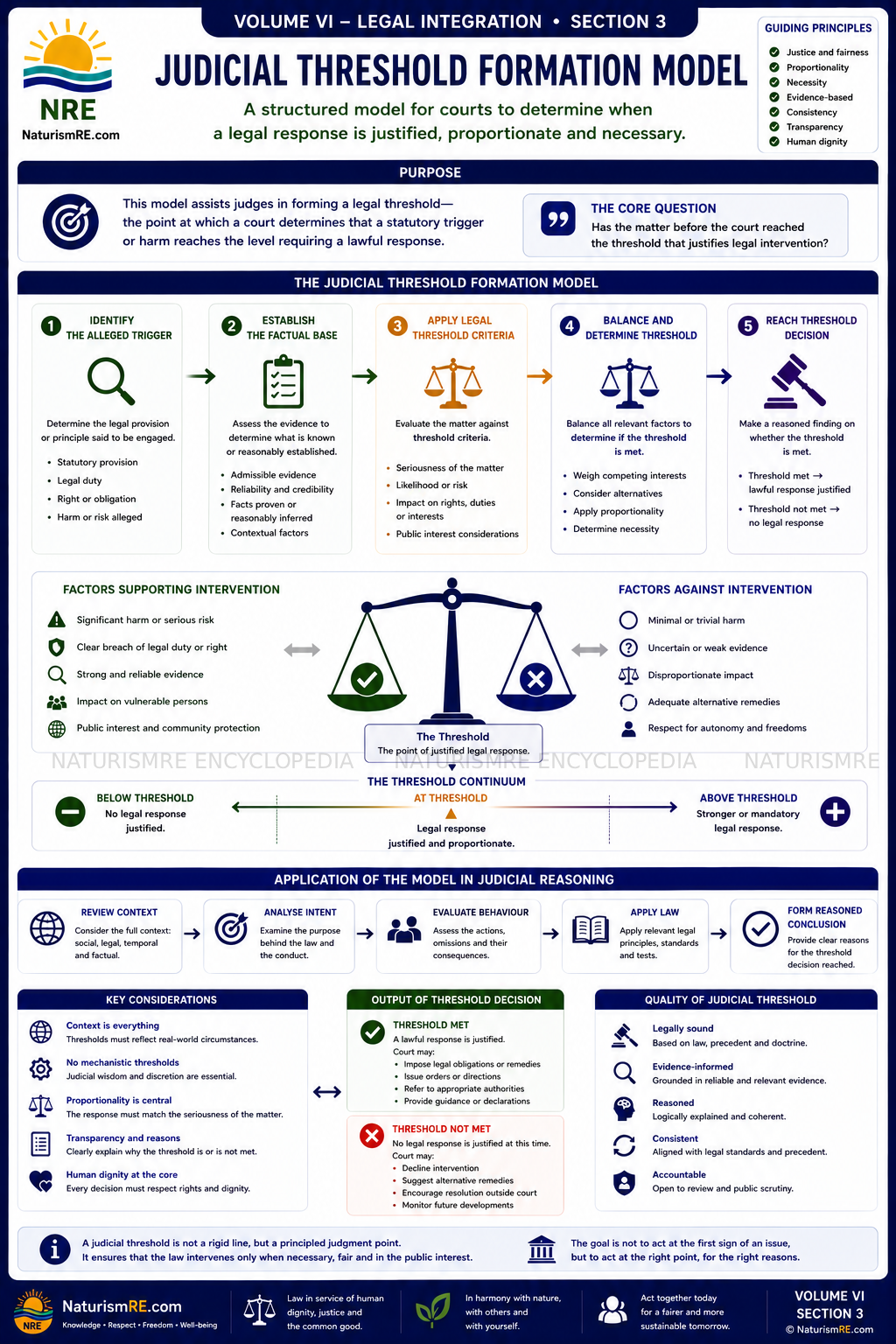
Courts interpret statutory language, legislative intent, and the contextual circumstances surrounding conduct. In matters involving nudity, judicial decisions clarify thresholds for indecency or offensiveness, assess the relevance of intent and behaviour, and determine the weight assigned to environmental context.
Jurisprudence therefore operates as a dynamic interpretative layer that shapes real-world legality beyond written law.
3.2 Recurring Judicial Considerations
Across jurisdictions, case law reveals recurring factors in judicial reasoning.
Contextual Environment
Courts assess whether the environment is associated with similar conduct and whether boundaries or designation are present.
Behavioural Conduct
Judicial reasoning evaluates whether actions remain passive or introduce provocative or disruptive elements.
Intent and Purpose
Courts examine whether behaviour aligns with non-sexual or neutral activity and whether conduct supports the stated intent.
Impact and Reasonableness
Decisions consider observable impact on others and whether behaviour aligns with reasonable expectations in context.
These factors are applied in combination rather than in isolation, forming the basis of judicial determination.
3.3 Passive Nudity Versus Conduct-Based Offence
A consistent jurisprudential distinction exists between passive nudity and conduct-based offence.
In some cases, courts have recognised that nudity alone may not meet the threshold for legal offence and have emphasised the role of behaviour in determining illegality.
However, this distinction is not applied uniformly. Outcomes may vary depending on jurisdictional standards, factual circumstances, and prevailing social expectations.
This reinforces the importance of maintaining behavioural clarity. Legal defensibility is strengthened when conduct remains clearly non-ambiguous rather than relying solely on the absence of intent.
3.4 The Influence of Social Norms on Judicial Interpretation
Judicial reasoning is influenced by prevailing societal norms, which evolve over time.
Cultural attitudes toward the body, historical acceptance of naturist practices, and exposure to designated environments all contribute to shaping interpretative thresholds.
As social norms shift, definitions of what constitutes offensive or acceptable conduct may change. This introduces a temporal dimension in which identical conduct may be interpreted differently across periods.
Jurisprudence evolves alongside societal perception, requiring ongoing alignment with changing interpretative standards.
3.5 Variability and Inconsistency in Case Outcomes
A defining characteristic of jurisprudence in this domain is variability.
Similar factual scenarios may produce different outcomes due to differences in judicial interpretation, local context, evidentiary factors, and application of reasonableness standards.
This variability limits predictability and reduces the reliability of isolated decisions as guides for future conduct.
Naturist systems must therefore align with broader patterns of judicial reasoning rather than rely on individual favourable outcomes.
3.6 Precedent Limitations and Transferability Constraints
While precedent plays a role in legal systems, its applicability is constrained.
Precedents are limited by jurisdictional boundaries, differences in statutory language, and variation in factual circumstances. Decisions in one jurisdiction may have persuasive value elsewhere but are not binding.
Courts may distinguish new cases based on contextual differences, and evolving social norms may reduce the relevance of earlier decisions.
This limits the effectiveness of precedent as a primary mechanism for achieving legal certainty.
3.7 Judicial Emphasis on Contextual Clarity
A consistent trend across jurisdictions is the judicial emphasis on clarity of context.
Environments that demonstrate a defined purpose, consistent behavioural patterns, and alignment with non-disruptive use are more likely to be interpreted favourably.
Conversely, environments characterised by ambiguity, inconsistency, or lack of identifiable structure are more likely to attract adverse interpretation.
This reinforces the importance of clearly defined environments, observable behavioural integrity, and alignment between stated purpose and actual practice.
Legal defensibility is strengthened through reduction of interpretative uncertainty.
3.8 Analytical Conclusion
Jurisprudence relating to naturist practice reflects a context-driven, evolving, and non-uniform interpretative landscape.
Courts consistently prioritise context, behaviour, intent, and impact in legal assessment. Passive nudity may be distinguished from conduct that introduces ambiguity or disruption. Judicial reasoning is influenced by social norms and evolves over time. Case outcomes exhibit variability, limiting predictability. Precedents provide guidance but have limited transferability. Clarity of environmental context significantly influences interpretation.
Naturist systems must therefore operate within a framework that aligns with established patterns of judicial reasoning, minimises ambiguity, and avoids reliance on isolated legal interpretations.
This establishes a defining principle for Volume VI:
The legal stability of naturist environments depends on their ability to align with recurring judicial reasoning patterns, ensuring that conduct, context, and observable impact remain consistently interpretable within evolving jurisprudential standards.
Primary Supporting Articles
Judicial Threshold Formation, How Courts Define Offensiveness and Acceptability in Naturist Contexts
Why Legal Clarity Without Operational Context Fails in Practice
Why Intent Cannot Protect Behaviour Without Defined Context
Why Enforcement Is Driven by Perception Rather Than Legal Principle
Secondary Supporting Articles
Contextual Legality and Interpretive Enforcement, The United Kingdom Model of Naturist Regulation
Fragmented Regulation and Jurisdictional Divergence, The United States Model of Naturist Law
Legal Pluralism and Conditional Tolerance, The European Model of Naturist Regulation