

Development of Modern Naturism: System Formation and Institutional Differentiation
Examining the structural transformation through which nudity evolved from dispersed participation into a governed, repeatable, and institutionally differentiated social system.
Why Structure Converts Participation Into Systems
Nudity becomes viable not through acceptance alone, but through structure, regulation, and controlled interpretation.
3.1 Purpose
This section examines the structural transition through which nudism and naturism evolved from dispersed practices, philosophical interpretations, and health-oriented experimentation into a structured, identifiable, and regulated social system.
Its objective is to define the mechanisms that enable system formation, to explain how naturism became organised and codified, and to establish how it differentiated itself from other forms of bodily exposure.
This section does not provide a chronological history. It defines the structural transformation from behaviour to system.
3.2 Transition from Dispersed Practice to Structured Activity
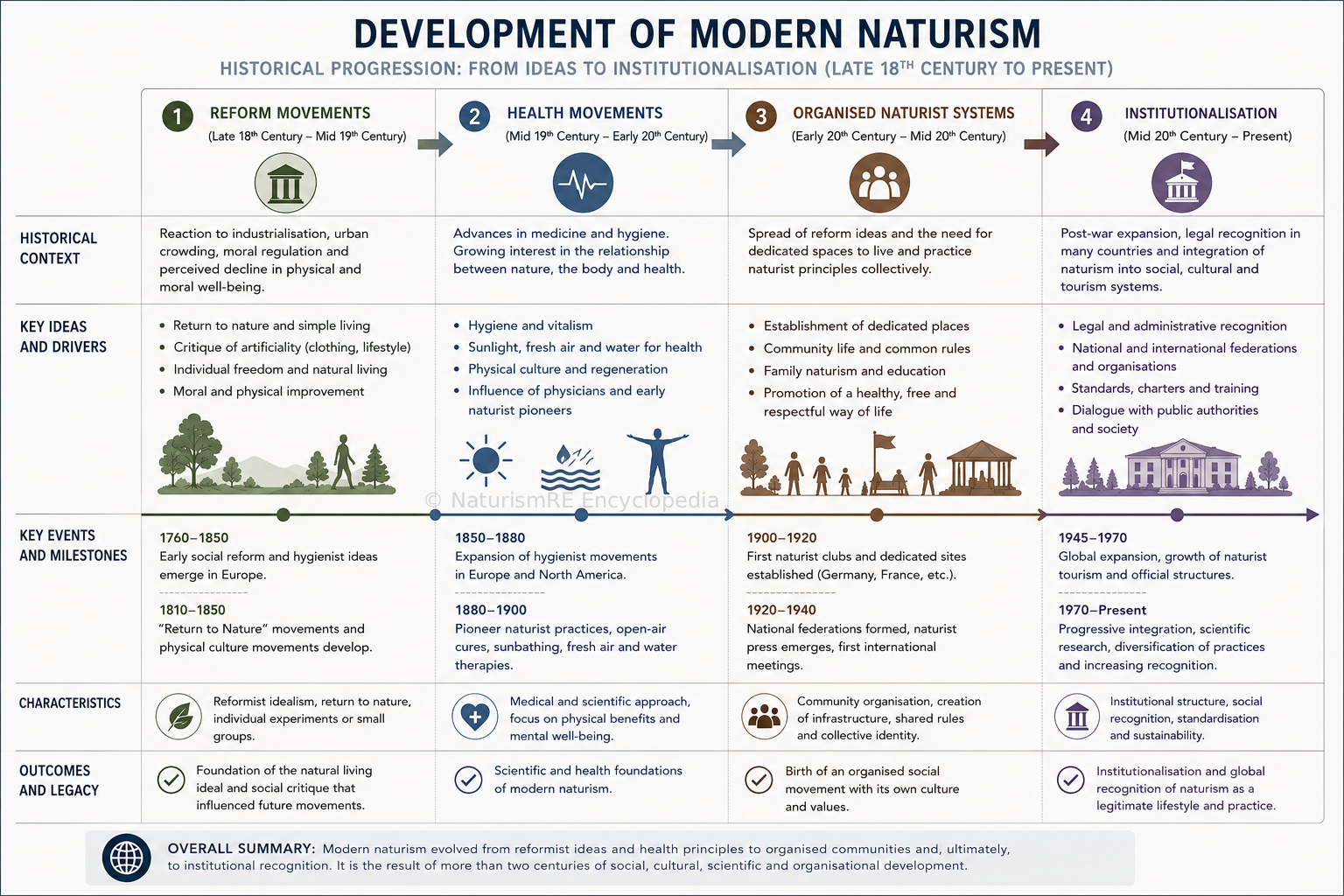
By the late nineteenth and early twentieth centuries, nudity within Western societies underwent a measurable transformation. It shifted from isolated, context-specific practices toward intentional and organised forms of participation.
This transition was not singular in origin. It emerged through the interaction of health reform movements, philosophical reinterpretation of the body, environmental and lifestyle responses to industrialisation, and forms of social experimentation that sought alternatives to prevailing conditions.
At this stage, nudity ceased to be incidental. It became a deliberately structured activity occurring within defined environments, where conditions of interpretation could be stabilised.
3.3 System Formation Requirements
The transition from practice to system required the introduction of conditions that allowed behaviour to be repeated, interpreted consistently, and sustained over time.
This included the development of shared behavioural rules, clearly defined participation conditions, controlled environments, and identifiable communities. These elements were not supplementary. They were necessary to reduce ambiguity, stabilise interpretation, and enable continuity.
From this, a core principle emerges:
Nudity becomes socially viable only when structured.
3.4 Institutional Formation as a Stabilisation Mechanism
The early twentieth century marked the emergence of formal institutional structures, including clubs, associations, and designated environments.
These institutions did not arise arbitrarily. They developed as responses to legal restrictions, social stigma, the need for controlled participation, and the requirement to demonstrate non-sexual intent in defensible ways.
To achieve this, they implemented membership systems, codified behavioural standards, established spatial boundaries, and introduced governance mechanisms capable of maintaining consistency over time.
This transformed nudity from an individual condition into a collectively regulated system.
3.5 Differentiation from Sexual and Deviant Frameworks
A defining characteristic of modern naturism is its explicit and deliberate separation from sexual and illicit contexts. This distinction was not assumed. It was constructed as a structural necessity.
Early organisations recognised that long-term viability depended on legal defensibility, social legitimacy, and the ability to differentiate clearly from sexual behaviour. As a result, strict norms were established governing non-sexual conduct, consent, interaction boundaries, and behavioural neutrality.
This produced a defining structural condition:
Naturism is not defined by nudity alone, but by the controlled interpretation of nudity.
This distinction remains central across legal frameworks, social perception systems, and institutional governance.
3.6 Emergence of a Managed Social System
As institutional structures developed, naturism evolved into a managed social system characterised by defined behavioural expectations, structured participation, internal governance, and regulated environments.
Participation patterns expanded to include intergenerational engagement, demographic variation influenced by broader social conditions, and the coexistence of formal and informal participation.
This demonstrates that naturism operates simultaneously as a structured system and as a distributed behavioural phenomenon.
3.7 Cultural Positioning and Narrative Control
Naturism did not evolve solely through structural mechanisms. It also required the construction and maintenance of a distinct cultural identity.
This identity was established through differentiation from artistic nudity, separation from media-driven sexualisation, and alignment with body-neutral or body-normalisation frameworks. These positions were actively maintained to preserve interpretative clarity.
Externally, naturism was frequently subject to misrepresentation and sexualisation bias within media systems. Internally, communities reinforced non-sexual framing through behavioural norms and consistent governance.
This establishes a critical condition:
Cultural identity within naturism is maintained through structured control.
3.8 Legal Adaptation and Boundary Formation
Naturism developed within legal systems that did not initially provide explicit accommodation for its existence. As a result, it required continuous adaptation.
This included negotiation within legal frameworks, the establishment of designated spaces, reliance on forms of implicit tolerance, and alignment with evolving regulatory conditions.
Over time, certain jurisdictions introduced mechanisms that recognised designated environments, adopted intent-based interpretation models, and differentiated nudity from indecency within legal analysis.
These developments reinforce a consistent conclusion:
Structure, governance, and context are prerequisites for legal viability.
3.9 Transition to a Recognisable System
By the mid-twentieth century, naturism had acquired the characteristics of a fully formed system. It was defined by identifiable communities, shared behavioural norms, institutional governance, structured environments, and partial legal accommodation.
This represents a structural transition from behaviour to movement, and from movement to system.
Naturism became repeatable, recognisable, and conditionally scalable within broader constraints.
3.10 Analytical Implications
This transformation establishes a set of principles that define the operational architecture of modern naturism.
Naturism develops through structured organisation rather than spontaneous adoption. Governance and behavioural control are necessary for stability. Legal and social legitimacy depend on clear differentiation from sexual frameworks. Controlled environments are required for consistent interpretation. Informal and structured participation coexist and interact within the same system.
3.11 Conclusion
The development of modern naturism represents the transformation of nudity into a structured, governed, and context-dependent system.
This transformation was driven by the need for legitimacy, the constraints imposed by legal systems, the influence of social perception, and the requirement for behavioural control within defined environments.
Naturism is not a spontaneous or unregulated practice. It is a constructed system of meaning, behaviour, and organisation designed to stabilise interpretation.
This leads to a defining principle:
Nudity becomes viable not through acceptance alone, but through structure, regulation, and controlled interpretation.
The emergence of modern naturism is therefore not an expansion of nudity, but the creation of a system capable of sustaining it.
Primary Supporting Articles
From Reform to System, The Emergence of Modern Naturism as an Organised Framework
Institutionalisation of Naturism, From Structured Practice to Organised Systems
Why Structure Converts Participation Into Systems
From Convergence to Organisation, The Formalisation of Naturist Systems (1900-1939)