

19th Century Reform Movements: Conceptual Reconfiguration and Pre-System Formation
Examining the nineteenth century as the transitional phase in which nudity evolved from moral classification toward structured reinterpretation within emerging health, environmental, and reform systems.
Nudity becomes viable only when embedded within structured frameworks that define purpose, behaviour, and boundaries.
3.1 Purpose
This section examines the nineteenth century as the phase in which nudity transitioned from a condition primarily regulated through moral and religious frameworks to a subject of systematic reinterpretation within emerging health, philosophical, and social models.
Its purpose is to identify the structural drivers that enabled this reconfiguration, to analyse how nudity became a variable within broader reform systems, and to define the conditions that allowed the transition toward organised naturist systems.
This section establishes the pre-system phase in which the conceptual foundations of modern naturism are formed.
3.2 Industrialisation and Systemic Reassessment of the Body
The nineteenth century introduced large-scale structural changes through industrialisation, urbanisation, and the reorganisation of labour and living conditions.
These developments resulted in dense population centres, reduced interaction with natural environments, increasingly sedentary work patterns, and greater reliance on artificial systems.
In response, reform movements began to reassess physical health, environmental conditions, and social organisation. The human body became a focal point of analysis, no longer treated primarily as a moral object, but as a system influenced by environmental and structural conditions.
3.3 Emergence of Natural Living Frameworks
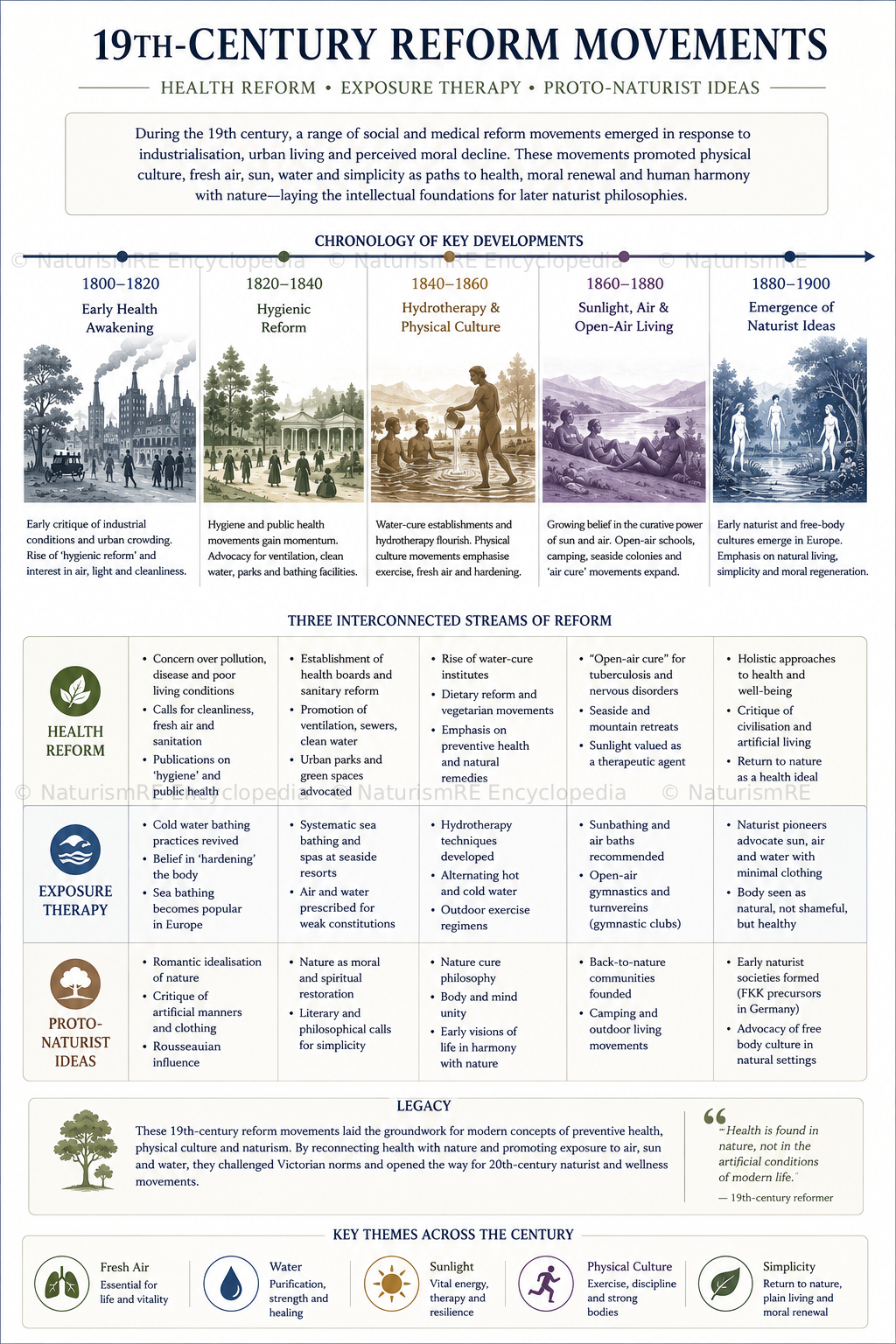
Reform movements across Europe and North America promoted a return to environmental exposure, physical activity, and simplified living conditions.
Environmental Exposure
Fresh air, sunlight exposure, and interaction with natural environments became associated with improved physical conditions.
Physical Culture
Exercise systems, movement practices, and bodily conditioning gained importance within health-oriented reform models.
Hydrotherapy and Environmental Therapies
Water exposure, environmental therapies, and natural treatment approaches emerged as alternatives to industrial-era conditions.
Lifestyle Reform
Simplified living conditions, dietary reform, and reduced dependence on industrial systems became integrated within broader reform movements.
Within these frameworks, the body was increasingly understood as dependent on environmental interaction, responsive to external conditions, and affected by artificial constraints.
This introduced a critical shift in interpretation. The body was no longer defined solely through moral frameworks, but as a functional system interacting with its environment.
3.4 Introduction of Bodily Exposure as a System Variable
Within these reform systems, reduced or absent clothing began to be explored as a factor influencing the body’s interaction with the environment.
Practices such as controlled air exposure, structured sunlight exposure, and outdoor activity with minimal clothing represented a structural transition. Nudity moved from a prohibited condition to a controlled experimental variable within health-oriented systems.
These applications remained limited in scale and were constrained by prevailing social norms. They were carefully framed to avoid moral conflict and to maintain legitimacy within broader societal expectations.
3.5 Philosophical Reframing of the Body and Environment
Parallel to medical developments, philosophical movements contributed to the reconfiguration of bodily norms.
Influences including natural law theory, Romantic critiques of industrialisation, and early ecological and holistic perspectives emphasised alignment with natural conditions, reduction of artificial constraints, and the value of simplicity and authenticity.
Within this framework, the body was increasingly interpreted as inherently natural, not intrinsically requiring concealment, and as part of a broader environmental system.
This did not establish naturism as a system. It provided the intellectual basis for reinterpreting bodily exposure.
3.6 Lebensreform and Integrated Reform Systems
In German-speaking regions, the Lebensreform movement represented a critical stage of system integration.
This movement combined health reform, environmental awareness, and social critique. It promoted outdoor living, physical culture, and reduced dependence on industrial systems.
Within this framework, nudity began to be incorporated as a logical extension of natural living principles and as a method of reducing artificial constraints.
This marks a key structural shift. Nudity became integrated within a broader system rather than treated as an isolated practice.
3.7 Emergence of Structured Experimental Environments
By the late nineteenth century, reform practices began to adopt controlled environments with defined participation conditions and behavioural expectations.
These environments limited exposure to external interpretation, established non-sexual intent, and introduced early forms of governance.
This represents the emergence of proto-system structures, in which nudity is managed within defined parameters rather than left to uncontrolled interpretation.
3.8 Early Organised Experiments and System Testing
Initial attempts to organise social nudity remained small in scale, operated within restricted environments, and encountered varying levels of social resistance.
However, these experiments demonstrated key system properties. They showed the feasibility of structured participation, the necessity of behavioural regulation, and the importance of clearly defined boundaries.
They confirmed a structural reality. Unstructured exposure remains unstable, while structured environments enable stability.
3.9 Transition Toward System Formation
By the end of the nineteenth century, several essential components had been established. These included health-based justification for bodily exposure, philosophical frameworks supporting natural conditions, experimental validation of structured environments, and the emergence of behavioural norms.
Together, these elements created the conditions for formal organisation, scalable participation, and the development of governance systems.
This marks the transition from conceptual reform to pre-system architecture.
3.10 Analytical Implications
The nineteenth century establishes several system-defining transformations.
Intentional Variable
Nudity shifts from incidental condition toward intentional environmental and behavioural experimentation.
Health and Environmental Reframing
Health-oriented and environmental frameworks begin replacing purely moral interpretation systems.
Structured Environments
Controlled conditions emerge as necessary mechanisms for interpretative stability and legitimacy.
Behavioural Regulation
Behavioural expectations and defined participation boundaries become prerequisites for acceptability.
These developments define the conceptual architecture required for institutionalisation.
3.11 Conclusion
The nineteenth century represents the decisive reconfiguration of nudity within Western systems.
It marks the transition from moral prohibition to structured interpretative and experimental frameworks. This transformation did not normalise nudity. It redefined the conditions under which nudity could be analysed, tested, and eventually organised.
Nudity moved from a prohibited state to a controlled variable within emerging systems of health, environment, and social organisation.
This establishes a defining principle:
Nudity becomes viable only when embedded within structured frameworks that define purpose, behaviour, and boundaries.
Modern naturism does not emerge as a continuation of earlier practices. It emerges from this systemic reconfiguration, in which intellectual justification, environmental interaction, and behavioural regulation combine to create the conditions for organised, governable, and scalable systems of non-sexual social nudity.
This forms the foundation for the institutional developments of the early twentieth century, where these concepts are transformed into fully operational systems.
Primary Supporting Articles
Industrialisation, Urbanisation, and the Biological Mismatch That Preceded Naturism
From Therapy to Social Practice, How Medicine Indirectly Enabled Naturism
The Structural Transition from Reform Movements to Proto-Naturist Systems
From Reform to System, The Emergence of Modern Naturism as an Organised Framework