Technological Integration, Digital Infrastructure, and Hybrid System Models
Examining how naturist systems evolve through integration of digital infrastructure, distributed coordination networks, and hybrid operational models.
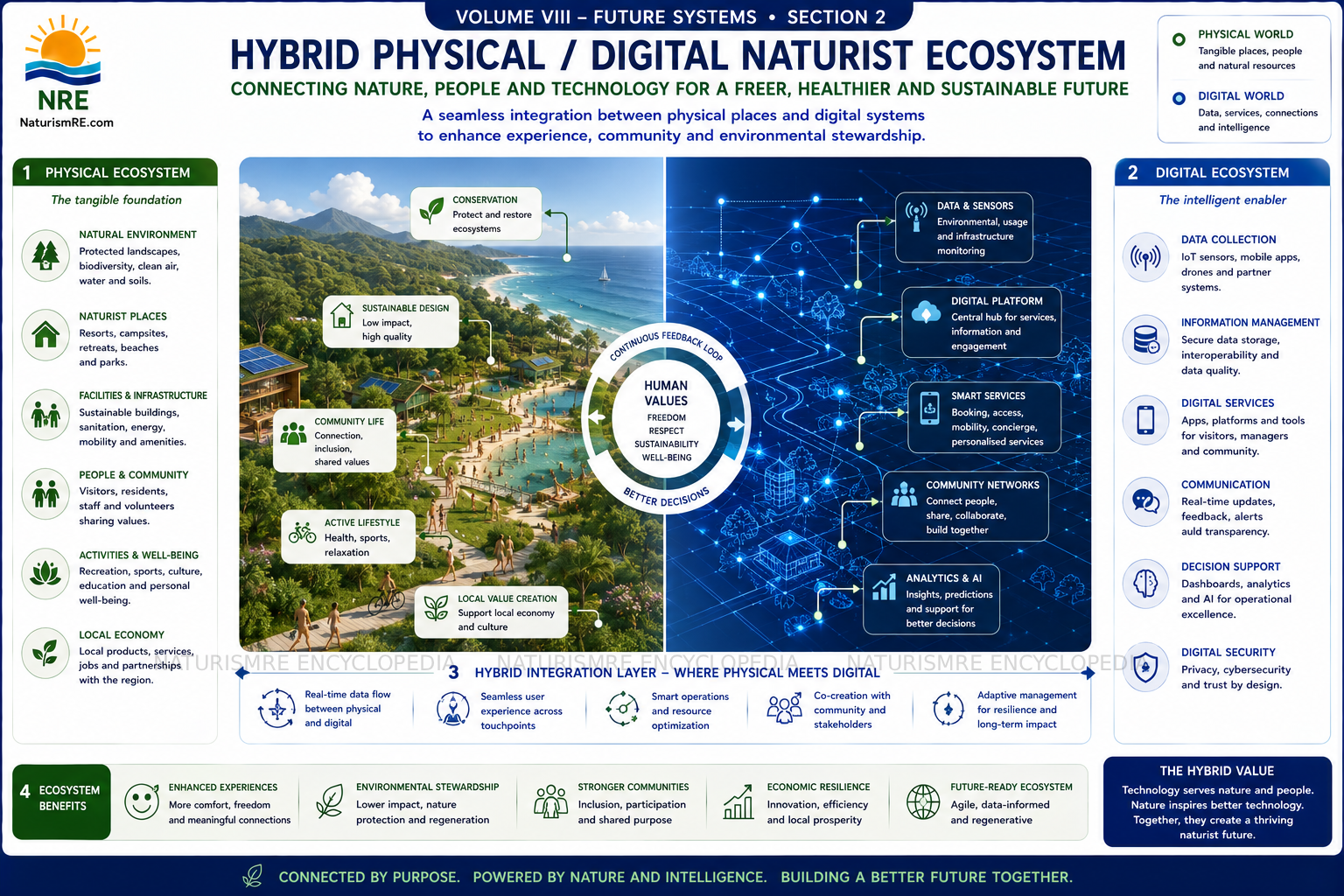
The evolution of naturist systems depends on their ability to develop hybrid models that integrate digital infrastructure as a supporting mechanism, enabling coordination and adaptation while preserving the autonomy, stability, and interpretability of physical environments.
2.1 The Emergence of Hybrid Naturist Systems
Future naturist systems are increasingly characterised by hybridisation, combining physical, context-defined environments with digital infrastructure layers.
This shift is driven by the ubiquity of digital communication, the need to coordinate across distributed environments, and the growing role of data in monitoring and adaptation.
Naturist systems are therefore transitioning from purely physical environments to integrated physical–digital systems in which each layer influences the other.
2.2 Functions of Digital Infrastructure
Digital infrastructure extends the operational capacity of naturist systems across several domains.
Information Distribution
Supports communication of environmental conditions, behavioural standards, and contextual clarity.
Coordination and Access
Enables scheduling, participation management, and operational alignment across distributed sites.
Monitoring and Feedback
Facilitates collection of participant input, aggregation of indicators, and identification of operational trends.
System Integration
Links multiple environments into cohesive operational networks across jurisdictions and contexts.
These functions enhance operational capability beyond what is achievable through physical environments alone.
2.3 Constraints Imposed by Digital Platforms
Despite its advantages, digital infrastructure introduces structural constraints.
These include platform moderation policies, restrictions on representation of nudity, algorithmic filtering of content, and the risk of decontextualisation.
Such constraints limit the ability to visually represent environments, increase reliance on indirect or descriptive communication, and may create misalignment between digital representation and physical reality.
Naturist systems must therefore design communication strategies that operate within platform rules, avoid dependence on unrestricted digital visibility, and ensure that operational clarity is not contingent on digital interpretation.
2.4 Data-Driven Adaptation and System Feedback
Digital systems enable data-informed adaptation, allowing naturist environments to analyse participation patterns, identify behavioural trends, and assess environmental performance.
These capabilities support refinement of operational parameters, early detection of instability, and improved alignment with stakeholder expectations.
However, limitations arise from variability in data quality, privacy constraints, and potential bias in self-reported information.
Data must therefore be interpreted cautiously, contextualised within environmental conditions, and integrated with observational insights.
2.5 Privacy, Surveillance, and Participation Conditions
Technological integration introduces challenges related to privacy, surveillance, and control over digital representation.
Participants may experience increased exposure beyond intended contexts, uncertainty regarding data usage, and reduced perception of privacy.
Structured systems must address these concerns through transparent communication, minimisation of unnecessary data collection, and alignment with applicable privacy standards.
Failure to manage these factors may reduce participation, increase perceived risk, and affect system stability.
2.6 Distributed Networks and Decentralised Coordination
Digital infrastructure enables the development of distributed naturist networks composed of multiple independent but aligned environments.
These networks support scalability across regions, flexibility in local adaptation, and resilience to disruption at individual sites.
At the same time, they introduce challenges in maintaining consistency, ensuring alignment with core principles, and managing variability across implementations.
Effective networks rely on common operational frameworks, consistent communication systems, and coordinated adaptation processes.
2.7 Limits of Technological Dependence
While technology enhances system capability, excessive dependence introduces risk.
These include vulnerability to platform restrictions, loss of control over communication channels, and exposure to shifts in digital policy environments.
Naturist systems must therefore maintain operational independence from digital platforms, ensure that physical environments remain functional without digital support, and treat digital infrastructure as a supporting layer rather than a primary foundation.
This balance preserves long-term resilience.
2.8 Analytical Conclusion
Technological integration transforms naturist systems into hybrid physical–digital environments, expanding capability while introducing new constraints.
Digital infrastructure supports coordination, communication, and data-driven adaptation. Platform constraints limit representation and influence visibility. Data systems enhance feedback but require cautious interpretation. Privacy and surveillance affect participation conditions. Distributed networks enable scalable implementation, while excessive reliance on technology introduces systemic vulnerability.
Naturist systems that succeed will be those that integrate digital tools without compromising physical system integrity, adapt to technological constraints, and maintain operational independence while leveraging digital advantages.
This establishes a defining principle for Volume VIII:
The evolution of naturist systems depends on their ability to develop hybrid models that integrate digital infrastructure as a supporting mechanism, enabling coordination and adaptation while preserving the autonomy, stability, and interpretability of physical environments.