

Statutory Frameworks, Offence Typologies, and Enforcement Triggers
Examining how statutory law, offence categories, interpretative standards, and enforcement mechanisms regulate naturist environments through layered legal systems.
The legal exposure of naturist environments is determined not by a single statutory provision, but by the interaction of offence typologies, interpretative standards, and enforcement triggers. Structured systems must therefore minimise ambiguity and align with the thresholds that activate legal response mechanisms.
2.1 Mapping Statutory Architecture Across Jurisdictions
Legal control of nudity is typically embedded within broader statutory architectures rather than within dedicated naturism legislation.
Common legislative domains include public order and safety statutes, indecency and obscenity provisions, offensive conduct or behaviour laws, and local government bylaws and park regulations.
These statutes are designed to regulate disturbance, harm or perceived harm, and disruption to public order rather than the physical state of nudity itself.
As a result, naturist activity is indirectly regulated through behaviour-based legal constructs rather than explicitly addressed in law.
2.2 Typologies of Relevant Offences
Across jurisdictions, several offence typologies are commonly applied in cases involving nudity.
Offensive or Indecent Conduct
Typically assessed through behaviour, context, and perception of offensiveness to a reasonable observer.
Public Exposure Offences
May involve bodily exposure in public settings, often linked to intent or perceived impact.
Disorderly or Disruptive Behaviour
Applied where conduct is interpreted as interfering with public order or creating disturbance.
Localised Regulatory Breaches
Includes violation of bylaws, park regulations, signage conditions, or designated usage restrictions.
These offence categories demonstrate that legal exposure is multi-layered, with different provisions potentially applying simultaneously.
2.3 The “Reasonable Person” Standard
A central mechanism in legal interpretation is the “reasonable person” standard.
This standard evaluates whether conduct would be considered offensive or inappropriate by an ordinary member of the public and whether it deviates from accepted norms within a given context.
Its application is inherently subjective, influenced by prevailing social norms and varying across cultural and geographic contexts.
For naturist systems, this introduces uncertainty in legal outcomes, increases dependence on contextual clarity, and reinforces the importance of aligning environments with identifiable and socially interpretable purposes.
The “reasonable person” standard does not provide certainty. It establishes a threshold of interpretation that must be managed through system design.
2.4 Enforcement Triggers and Escalation Pathways
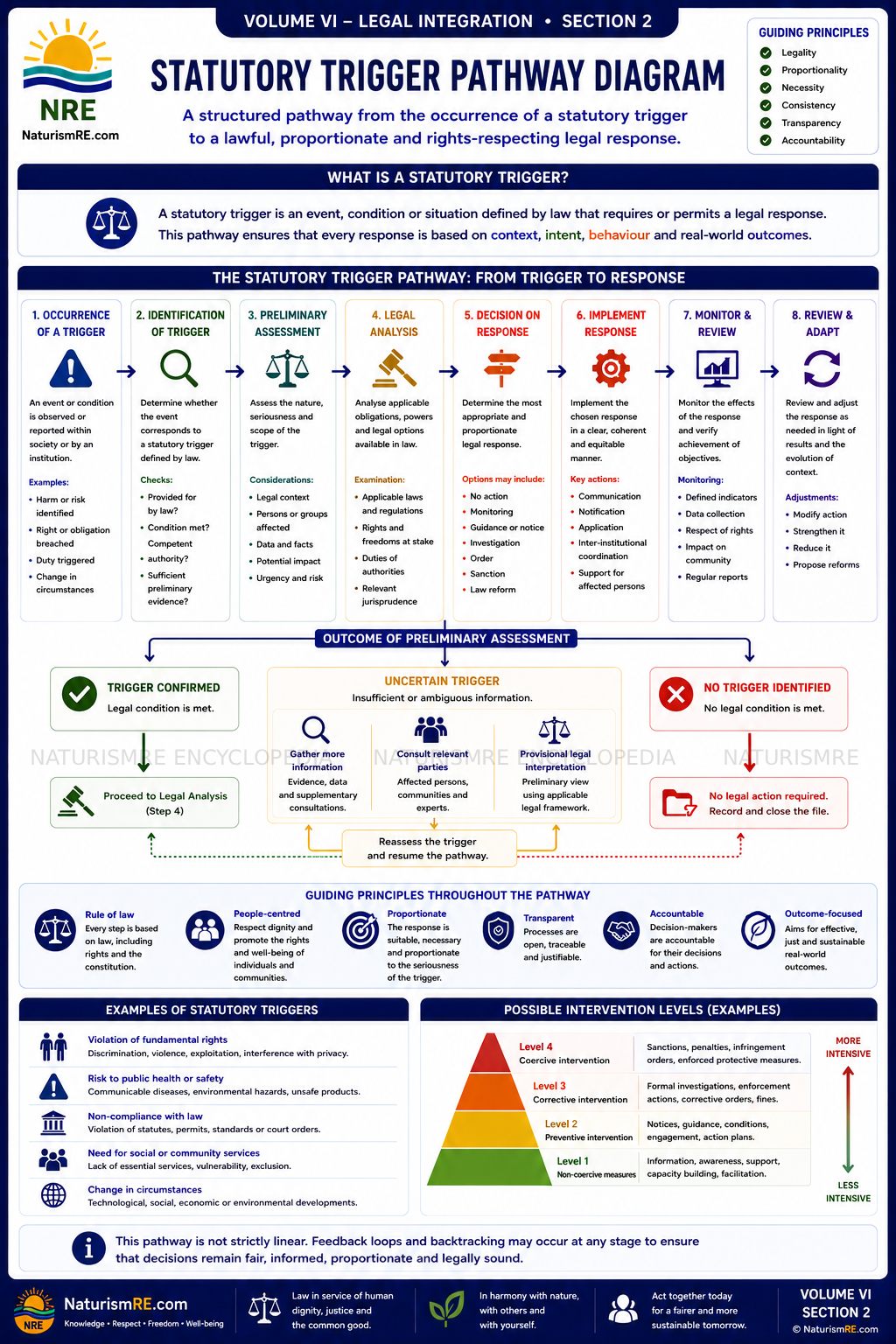
Legal enforcement is typically not continuous. It is activated through identifiable triggers.
These may include complaints from members of the public, perceived disruption or disturbance, direct observation by enforcement authorities, or reporting through media or third parties.
Once activated, enforcement may follow a progression from initial assessment of context, behaviour, and impact, to warning or direction, to formal enforcement action such as fines or charges, and, where applicable, to judicial consideration.
Understanding these triggers is critical. The absence of complaints may result in practical tolerance, while the presence of complaints significantly increases the likelihood of enforcement.
This reinforces the importance of minimising conditions that generate perceived disturbance or concern.
2.5 The Role of Signage, Designation, and Notice
Legal interpretation is influenced by the presence of environmental indicators such as signage, publicly communicated participation conditions, and formal or informal recognition of specific zones.
These elements inform participants of expectations, signal intent to observers, and reduce ambiguity in interpretation.
While not determinative in all cases, such indicators may support arguments of contextual appropriateness, reduce the likelihood of complaint, and demonstrate reasonable operational measures.
However, in the absence of formal legal designation, signage alone does not guarantee legal protection. Its effectiveness remains dependent on jurisdictional context.
2.6 Discretionary Enforcement and Selective Application
Even within defined statutory frameworks, enforcement frequently involves discretionary judgment.
Authorities may consider the seriousness of conduct, the presence of aggravating factors, resource allocation priorities, and prevailing community standards.
This results in selective enforcement across similar situations, variability between jurisdictions and enforcement bodies, and inconsistency over time.
Discretion introduces flexibility but also unpredictability.
Reliance on discretion alone is insufficient for system stability. Structured environments seek to reduce the need for discretionary intervention by aligning with clearly interpretable conditions.
2.7 Interaction Between Statutory Law and Case Law
Legal interpretation is shaped not only by statutes but also by judicial decisions that establish precedents.
Case law may clarify the application of statutory provisions, define thresholds for offence, and interpret concepts such as indecency or offensiveness.
However, precedents are jurisdiction-specific, limited to comparable factual circumstances, and subject to evolution over time.
For naturist systems, this requires consideration of both written law and interpretative history, while avoiding reliance on isolated precedents.
Consistent alignment with broader legal principles remains necessary.
2.8 Analytical Conclusion
Statutory frameworks governing nudity operate through indirect, behaviour-based regulation rather than explicit naturist legislation.
Multiple offence typologies may apply simultaneously. The “reasonable person” standard introduces subjectivity and variability. Enforcement is typically triggered by complaints or perceived disturbance. Signage and environmental definition may influence interpretation but do not ensure protection. Discretionary enforcement contributes to inconsistency. Case law shapes interpretation but remains limited in scope.
Naturist systems therefore operate within a legal environment characterised by layered statutory provisions, interpretative flexibility, and enforcement variability.
This establishes a defining principle for Volume VI:
The legal exposure of naturist environments is determined not by a single statutory provision, but by the interaction of offence typologies, interpretative standards, and enforcement triggers. Structured systems must therefore minimise ambiguity and align with the thresholds that activate legal response mechanisms.
Primary Supporting Articles
Behavioural Thresholds and Legal Trigger Points in Structured Naturist Environments
Judicial Threshold Formation, How Courts Define Offensiveness and Acceptability in Naturist Contexts
Why Enforcement Is Driven by Perception Rather Than Legal Principle
Why Risk Becomes Perception When Context Is Unclear
From Legal Principle to Operational Reality, Why Law Requires Structured Environments to Function
Secondary Supporting Articles
Why Legal Clarity Without Operational Context Fails in Practice
Visibility Management and Its Role in Perception Stability
Why Boundary Definition Determines Whether Systems Stabilise or Collapse
Contextual Legality and Interpretive Enforcement, The United Kingdom Model of Naturist Regulation