

Physiological Pathways and Environmental Exposure Mechanisms
Examining how naturist environments alter physiological interaction through direct exposure to environmental variables and adaptive biological response systems.
The physiological implications of naturist practice are not determined by the absence of clothing alone, but by the interaction between environmental conditions, exposure parameters, and the body’s adaptive systems within controlled and context-defined environments.
2.1 Defining Physiological Interaction in Naturist Contexts
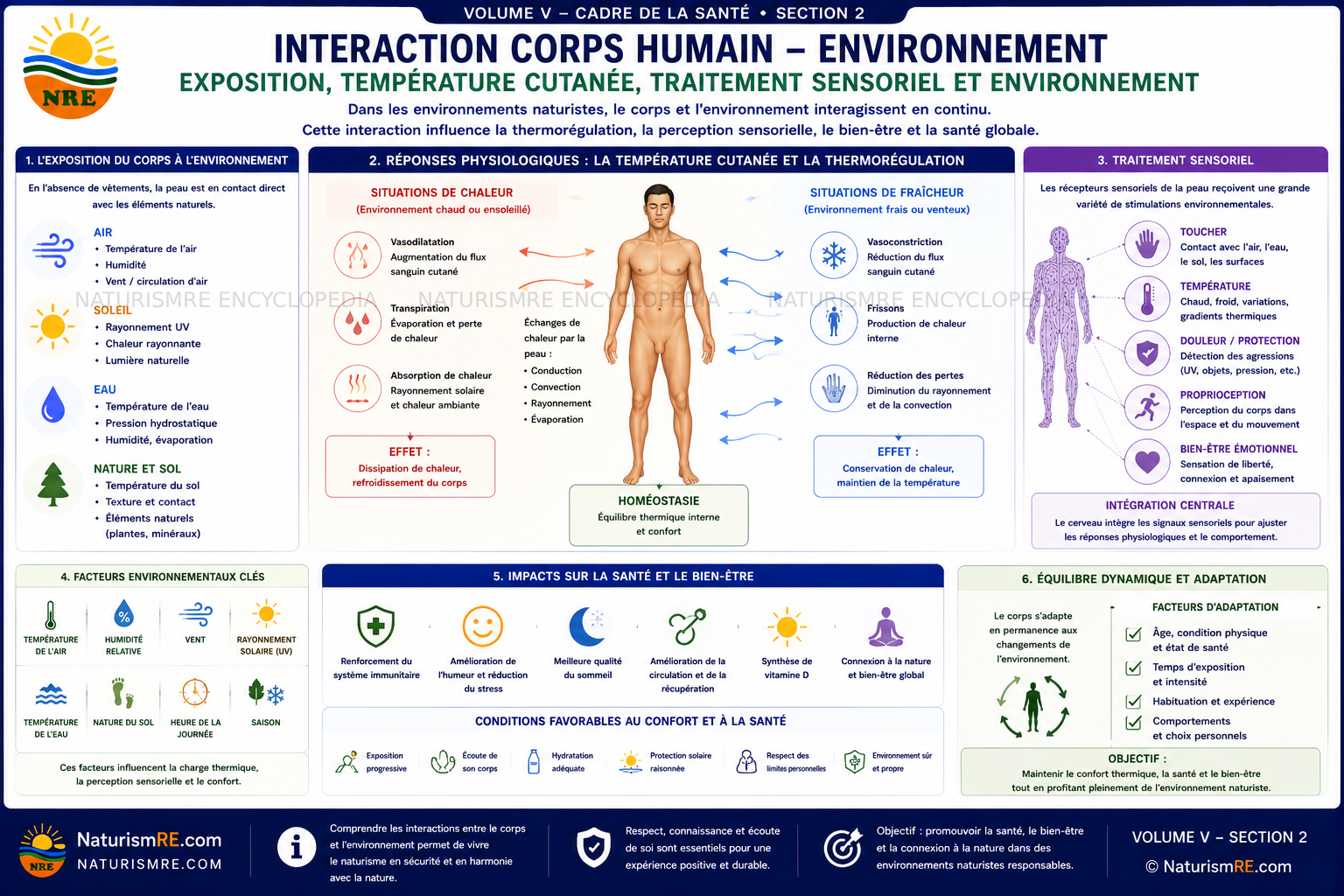
Physiological responses associated with naturist environments arise from direct, unmediated interaction between the human body and external conditions.
Unlike clothed environments, where multiple layers regulate exposure, naturist contexts alter thermal exchange, skin exposure to air and sunlight, tactile interaction with surfaces, and evaporative processes.
These changes activate primary physiological systems, including thermoregulation, cardiovascular response, integumentary function, and sensory and neural pathways.
These responses are not inherently beneficial or harmful. They are adaptive processes contingent upon environmental parameters and individual conditions.
2.2 Thermoregulation and Heat Exchange Dynamics
Thermoregulation is one of the most immediate physiological systems affected by reduced clothing.
Vasodilation and Vasoconstriction
The body regulates internal temperature through vascular adjustment in response to environmental conditions.
Sweating and Evaporation
Increased skin exposure enhances evaporative cooling efficiency in warm environments.
Thermal Perception
Reduced clothing increases direct sensory awareness of temperature variation and airflow.
Adaptive Capacity
Physiological outcomes depend on exposure duration, environmental intensity, and individual tolerance.
Potential outcomes include improved heat dissipation in warm conditions and increased cooling in colder or wind-exposed environments.
Risks may arise when exposure exceeds adaptive capacity, when environmental conditions are extreme, or when protective measures are absent.
Thermoregulatory response must therefore be understood as environmentally dependent, requiring alignment between exposure conditions and duration.
2.3 Skin Function and Environmental Interaction
The skin serves as a multifunctional organ responsible for protection, temperature regulation, sensory perception, and interaction with external elements.
Naturist environments increase the extent of skin-environment interaction through exposure to air and sunlight, contact with natural surfaces, and variation in humidity and temperature.
These conditions may influence sweat gland activity, stimulate cutaneous receptors, and alter the skin’s immediate microenvironment.
At the same time, increased exposure may introduce risks such as ultraviolet radiation, mechanical irritation, and contact with environmental contaminants.
Outcomes depend on the duration and intensity of exposure, environmental conditions, and individual skin characteristics.
Skin interaction in naturist contexts is therefore variable and condition-sensitive.
2.4 Sunlight Exposure and Photobiological Considerations
Sunlight represents a significant environmental variable affecting physiological response.
Key interactions include ultraviolet radiation exposure, visible light affecting circadian signalling, and thermal effects.
Physiological processes influenced by sunlight exposure may include vitamin D synthesis through ultraviolet interaction, modulation of circadian rhythms, and neuroendocrine responses.
However, sunlight exposure also introduces well-documented risks, particularly when exposure is prolonged or uncontrolled. These include skin damage, accelerated ageing, and increased risk of dermatological conditions.
Structured naturist environments must therefore emphasise controlled exposure, awareness of environmental intensity, and appropriate protective strategies.
Sunlight interaction is a dose-dependent variable rather than an inherently beneficial or harmful factor.
2.5 Sensory Activation and Neural Response
Reduced clothing increases sensory input from the environment, affecting tactile perception, temperature sensing, and proprioceptive feedback.
This increased sensory engagement may result in heightened environmental awareness, altered perception of physical space, and changes in movement and posture.
The nervous system integrates these inputs, contributing to adaptive behavioural responses and modulation of stress or relaxation states.
However, sensory response varies significantly between individuals. Some may experience increased comfort and awareness, while others may experience heightened sensitivity or discomfort.
Sensory activation functions as a modulatory factor influencing subjective experience rather than producing uniform physiological outcomes.
2.6 Circulatory and Cardiovascular Responses
Environmental exposure influences circulatory dynamics primarily through temperature-related mechanisms.
Responses may include vasodilation in warm conditions, vasoconstriction in cooler environments, and redistribution of blood flow to support thermoregulation.
These processes contribute to the maintenance of core body temperature and adaptation to environmental variation.
Under moderate and controlled conditions, these responses are part of normal physiological regulation. Under extreme conditions or prolonged exposure, risks may include thermal stress, circulatory strain, and fatigue.
Structured environments reduce these risks by aligning exposure conditions with adaptive capacity and allowing behavioural adjustments.
2.7 Interaction with Environmental Surfaces and Microenvironments
Direct contact with environmental surfaces introduces additional physiological considerations, including tactile stimulation, mechanical pressure, friction, and exposure to surface temperature variation.
These interactions may influence posture, movement, sensory perception, and localised skin response.
Environmental surfaces vary in cleanliness, texture, and thermal properties. Structured environments manage these variables through site selection, maintenance practices, and participant awareness.
This reduces the likelihood of adverse interaction while maintaining controlled exposure conditions.
2.8 Analytical Conclusion
Physiological responses in naturist environments arise from direct interaction between the body and environmental variables.
Naturist contexts modify thermoregulation, sensory input, and skin interaction, but do not introduce new biological processes. Responses are adaptive and condition-dependent, with outcomes varying according to environmental intensity, duration, and individual factors.
Both potential benefits and risks exist within the same exposure mechanisms.
Structured environments provide the conditions necessary to manage variability and reduce risk by aligning exposure with adaptive capacity.
This establishes a defining principle for Volume V:
The physiological implications of naturist practice are not determined by the absence of clothing alone, but by the interaction between environmental conditions, exposure parameters, and the body’s adaptive systems within controlled and context-defined environments.
Primary Supporting Articles
Dermal Interface and Sensory Processing in Direct Exposure Environments
Environmental Design as a Behavioural Regulation Tool
Risk Exposure as a System Variable, From Environmental Interaction to Managed Conditions
Protective Mechanisms and Adaptive Safeguards in Structured Naturist Environments