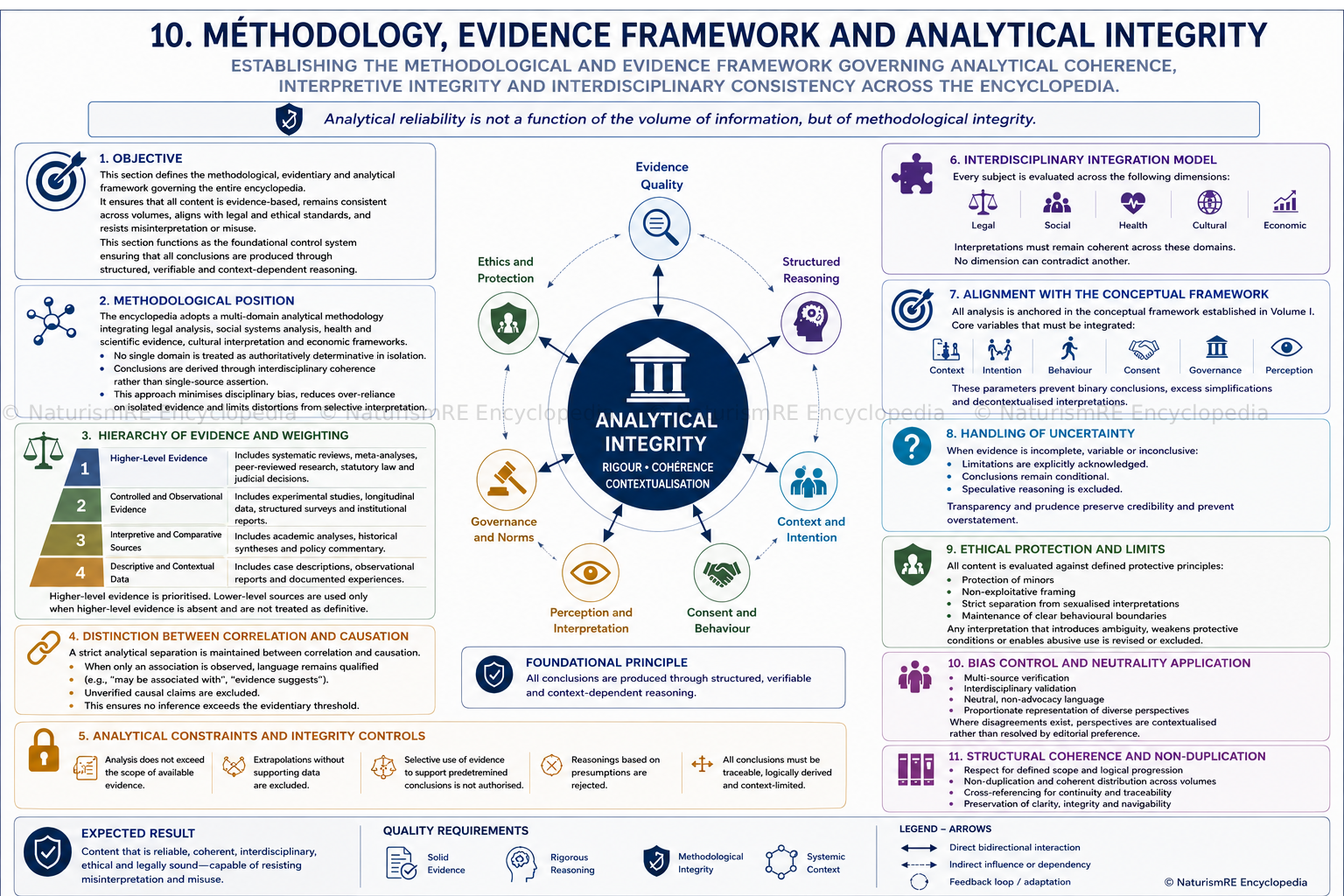
Methodology, Evidence Framework, and Analytical Integrity
Establishing the methodological and evidentiary control framework governing analytical consistency, interpretative integrity, and cross-domain coherence throughout the encyclopedia.
Analytical reliability is not a function of volume, but of methodological integrity.
10.1 Purpose
This section defines the methodological, evidentiary, and analytical framework governing the entire encyclopedia.
Its purpose is to ensure that all content is evidence-informed, remains internally coherent across volumes, aligns with legal and ethical standards, and is resistant to misinterpretation or misuse.
This section functions as the foundational control system, ensuring that all conclusions are derived through structured, verifiable, and context-bound reasoning.
10.2 Methodological Position
The encyclopedia adopts a multi-domain analytical methodology integrating legal analysis, social systems analysis, health and scientific evidence, cultural interpretation, and economic frameworks.
No single domain is treated as authoritative in isolation. Conclusions are derived through cross-domain consistency rather than single-source assertion.
This approach prevents disciplinary bias, reduces over-reliance on isolated evidence, and limits distortion through selective interpretation.
10.3 Evidence Hierarchy and Weighting
All claims are evaluated according to a structured evidence hierarchy that ensures proportional weighting.
Higher-Level Evidence
Includes systematic reviews, meta-analyses, peer-reviewed research, statutory law, and judicial rulings.
Controlled and Observational Evidence
Includes experimental studies, longitudinal data, structured surveys, and institutional reports.
Interpretative and Comparative Sources
Includes academic analysis, historical synthesis, and policy commentary.
Descriptive and Contextual Data
Includes case descriptions, observational reports, and documented experiences.
Higher-tier evidence is prioritised. Lower-tier sources are used only where higher-tier evidence is unavailable and are not treated as definitive.
10.4 Distinction Between Correlation and Causation
A strict analytical separation is maintained between correlation and causation.
Where only association is observed, language remains qualified. Claims are expressed in terms such as “may be associated with” or “evidence suggests.” Unverified causal claims are excluded.
This ensures that no inference exceeds the evidentiary threshold.
10.5 Analytical Constraints and Integrity Controls
To maintain methodological integrity, strict constraints are applied.
Analysis does not extend beyond the scope of available evidence. Extrapolation without supporting data is excluded. Selective use of evidence to support predetermined conclusions is not permitted. Assumption-based reasoning is rejected.
All conclusions must be traceable, logically derived, and contextually bounded.
10.6 Domain Integration Model
All analysis operates through a domain integration model in which each subject is evaluated across legal, social, health, cultural, and economic dimensions.
Interpretations must remain consistent across these domains. A health-related observation cannot contradict legal realities, and legal interpretation must align with behavioural and contextual evidence.
This ensures systemic coherence across all volumes.
10.7 Conceptual Framework Alignment
All analysis is anchored in the conceptual framework established earlier in Volume I.
Every conclusion must incorporate context, intent, behaviour, consent, governance, and perception as core analytical variables. These are treated as mandatory inputs, preventing binary conclusions, oversimplification, and decontextualised interpretation.
10.8 Treatment of Uncertainty
Where evidence is incomplete, variable, or inconclusive, limitations are explicitly acknowledged.
Conclusions remain conditional, and speculative reasoning is excluded. This ensures transparency, preserves credibility, and prevents overstatement.
10.9 Safeguarding and Ethical Boundaries
All content is evaluated against defined safeguarding principles.
These include the protection of minors, non-exploitative framing, strict separation from sexualised interpretation, and the maintenance of clear behavioural boundaries.
Any interpretation that introduces ambiguity, weakens safeguarding conditions, or enables misuse is revised or excluded.
10.10 Bias Control and Neutrality Enforcement
Bias is controlled through multi-source verification, cross-domain validation, neutral and non-advocacy language, and proportional representation of differing perspectives.
Where disagreement exists, perspectives are contextualised rather than resolved through editorial preference.
10.11 Structural Consistency and Non-Duplication
Each section adheres to defined scope, progressive structure, and non-duplication principles.
Content is distributed across volumes to maintain clarity, avoid redundancy, and preserve analytical precision.
10.12 Legal and Reputational Safeguards
All content is constructed to align with general legal principles, avoid prescriptive or advisory language, and prevent misinterpretation as instruction.
This protects institutional credibility, public trust, and reduces exposure to legal risk.
10.13 Interpretation Boundaries
This encyclopedia does not promote naturism as a required or superior practice. It does not provide legal or medical advice and does not prescribe behavioural or policy actions.
It provides structured analysis, evidence-informed interpretation, and context-dependent conclusions.
10.14 System Governance Function
This section governs all volumes and functions as a validation framework, a consistency control mechanism, and an interpretative boundary system.
It ensures that definitions remain consistent, historical analysis remains contextual, and legal, social, and health frameworks remain aligned.
10.15 Conclusion
The validity of this encyclopedia is determined not only by the information it contains, but by the method through which that information is produced and interpreted.
Through structured evidence hierarchy, cross-domain validation, conceptual integration, analytical constraints, and safeguarding and neutrality controls, this framework ensures that conclusions are internally consistent, externally defensible, and resistant to misinterpretation.
This establishes a defining principle:
Analytical reliability is not a function of volume, but of methodological integrity.
The framework defined in this section transforms the encyclopedia from a collection of information into a coherent system of structured analysis capable of supporting policy-level discussion, withstanding critical scrutiny, and maintaining long-term credibility across domains.