

Transition from Conceptual Frameworks to Operational Deployment
Examining how naturist systems transition from theoretical models into deployable, scalable, and operationally stable environments through structured implementation pathways.
The success of naturist systems depends on their ability to move from conceptual validation to controlled deployment through structured, modular, and adaptive implementation strategies aligned with real-world legal, social, and operational conditions.
1.1 The Implementation Gap
Previous volumes have established conceptual foundations, governance structures, risk and liability frameworks, health and human factors, and legal and regulatory alignment.
Despite this, a persistent constraint remains: the implementation gap.
This gap represents the distance between theoretical viability and real-world operational deployment.
It arises from the absence of actionable models, uncertainty regarding initial deployment steps, perceived legal and reputational risk, and the lack of scalable implementation templates.
As a result, many frameworks remain analytically robust but operationally inactive.
Bridging this gap requires a transition from conceptual analysis to structured implementation pathways.
1.2 Characteristics of Deployable Naturist Systems
For a naturist system to transition from concept to deployment, it must exhibit specific operational characteristics.
Operational Clarity
Requires defined environments, identifiable boundaries, and explicit purpose aligned with operational objectives.
Behavioural Consistency
Requires clearly communicated expectations and observable alignment among participants.
Legal Interpretability
Requires alignment with statutory frameworks and minimisation of contextual ambiguity.
Scalable Structure
Requires adaptability across different participation levels and jurisdictional conditions.
Risk Containment
Requires identification and management of foreseeable operational and environmental risks.
Systems lacking these characteristics may remain theoretical, encounter resistance, or fail under real-world conditions.
1.3 Entry-Level Deployment Models
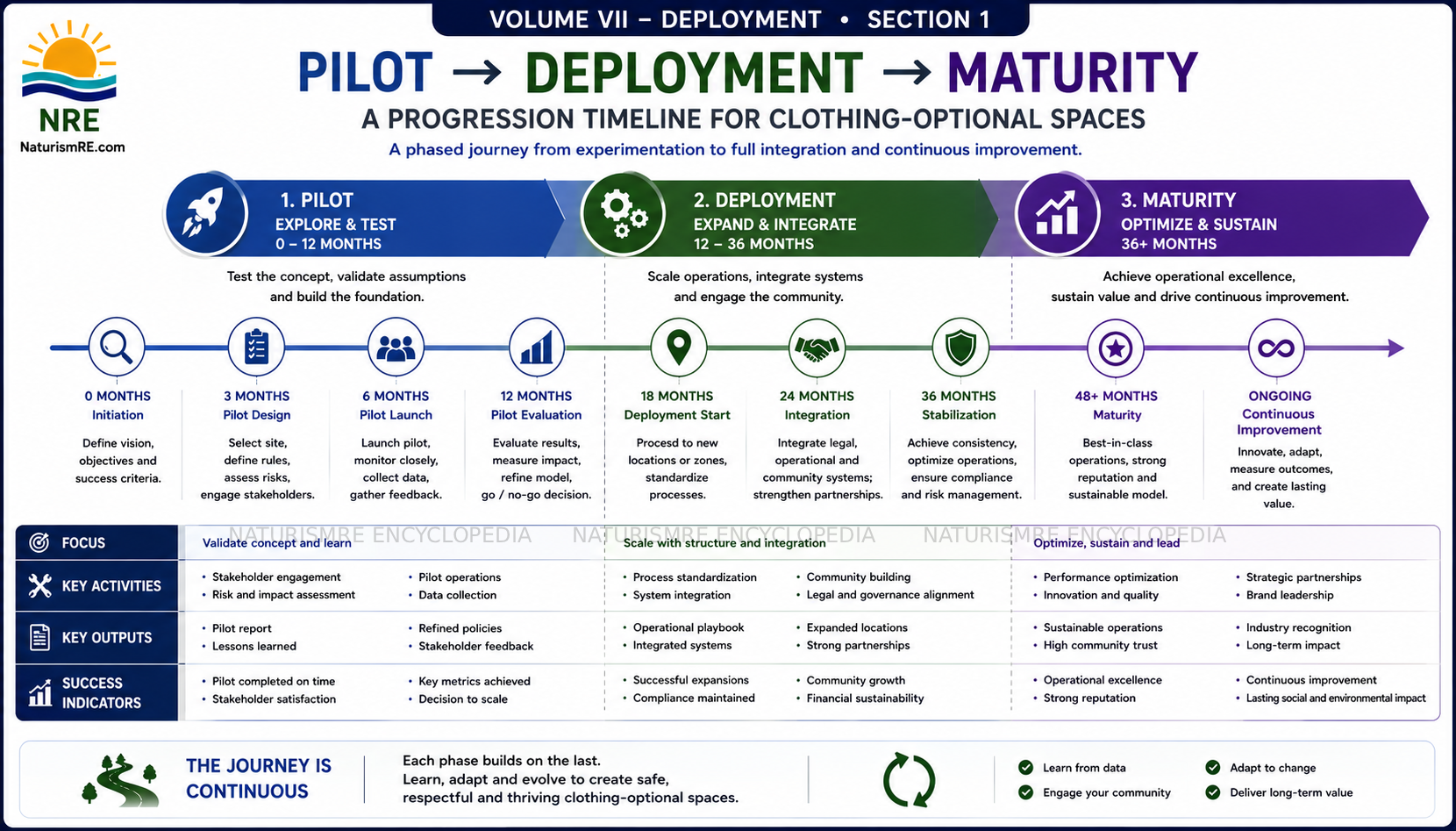
Implementation typically begins with controlled, low-complexity models that enable testing and adaptation.
Micro-environment deployment involves small, clearly defined spaces with limited participant numbers and minimal infrastructure. This reduces risk exposure and allows close monitoring and adjustment.
Time-bound activation involves environments that operate during specific periods or under defined temporal conditions. This allows controlled exposure and facilitates regulatory acceptance.
Event-based implementation involves structured, short-term activities with defined participation conditions. These provide high levels of control and clearly bounded operational parameters.
These models function as testing mechanisms that enable transition from conceptual design to operational reality.
1.4 Scaling Pathways and Expansion Logic
Scaling requires progressive and conditional expansion rather than immediate large-scale deployment.
Initial stages involve controlled pilot environments with high levels of oversight. Stabilised operation follows, characterised by consistent behavioural patterns and predictable outcomes.
Incremental expansion involves gradual increases in participation or frequency, accompanied by adaptation of governance mechanisms.
Replication occurs when the model is applied to new locations with adjustment to local conditions.
Scaling must be contingent on system stability, absence of significant incidents, and alignment with legal and social thresholds.
Uncontrolled expansion increases risk exposure, reduces behavioural consistency, and may trigger regulatory response.
1.5 Implementation Barriers and Failure Points
Deployment commonly encounters identifiable failure points.
Over-expansion may exceed governance capacity and reduce behavioural control.
Context misalignment may occur when environments do not align with local norms or legal frameworks, increasing the likelihood of complaint or enforcement.
Ambiguity in design may result from unclear boundaries or inconsistent participant expectations.
Insufficient risk preparation may leave systems vulnerable to environmental or behavioural disruption.
Dependence on individual actors may reduce resilience and continuity.
These factors highlight the necessity of structured and repeatable implementation models.
1.6 Modular Deployment Frameworks
To address variability and enable scalability, implementation benefits from modular frameworks.
In this approach, core principles remain constant while operational elements are adapted to local conditions.
Modules may include environmental definition templates, behavioural standards, risk assessment structures, and communication protocols.
This allows consistency across deployments while preserving flexibility in application and reducing complexity during scaling.
1.7 Transition from Individual Action to System-Level Adoption
Naturist deployment often begins with individual or small-group initiatives, but long-term viability requires transition to system-level adoption.
This transition involves moving from informal activity to structured environments, introducing governance and compliance mechanisms, and aligning with regulatory frameworks.
System-level adoption enables increased stability, broader recognition, and integration with institutional systems.
This transition must be gradual to avoid resistance, increased legal exposure, and disruption of established participation patterns.
1.8 Analytical Conclusion
The transition from conceptual frameworks to operational deployment represents a critical phase in the evolution of naturist systems.
Implementation gaps arise from the absence of structured pathways. Deployable systems require clarity, consistency, and legal alignment. Entry-level models provide controlled starting points. Scaling must be progressive and conditional. Failure points are primarily associated with over-expansion and ambiguity. Modular frameworks enable adaptability while maintaining coherence. Long-term viability depends on transition to system-level adoption.
Naturist systems are not constrained by theoretical limitations, but by the capacity to translate frameworks into structured, repeatable, and scalable operational models.
This establishes the foundational principle for Volume VII:
The success of naturist systems depends on their ability to move from conceptual validation to controlled deployment through structured, modular, and adaptive implementation strategies aligned with real-world legal, social, and operational conditions.
Primary Supporting Articles
Transition from Pilot Program to Permanent System
Transition Timelines, Realistic vs Theoretical Deployment Horizons
Early-Stage Failure Modes in Naturist System Deployment
From Fragmented Systems to Operational Coherence, Defining Maturity in Naturist System Deployment
From Informal Practice to Institutional Systems, How Naturism Scales