

Pre-Modern and Indigenous Contexts: Contextual Integration and Non-Standardised Body Systems
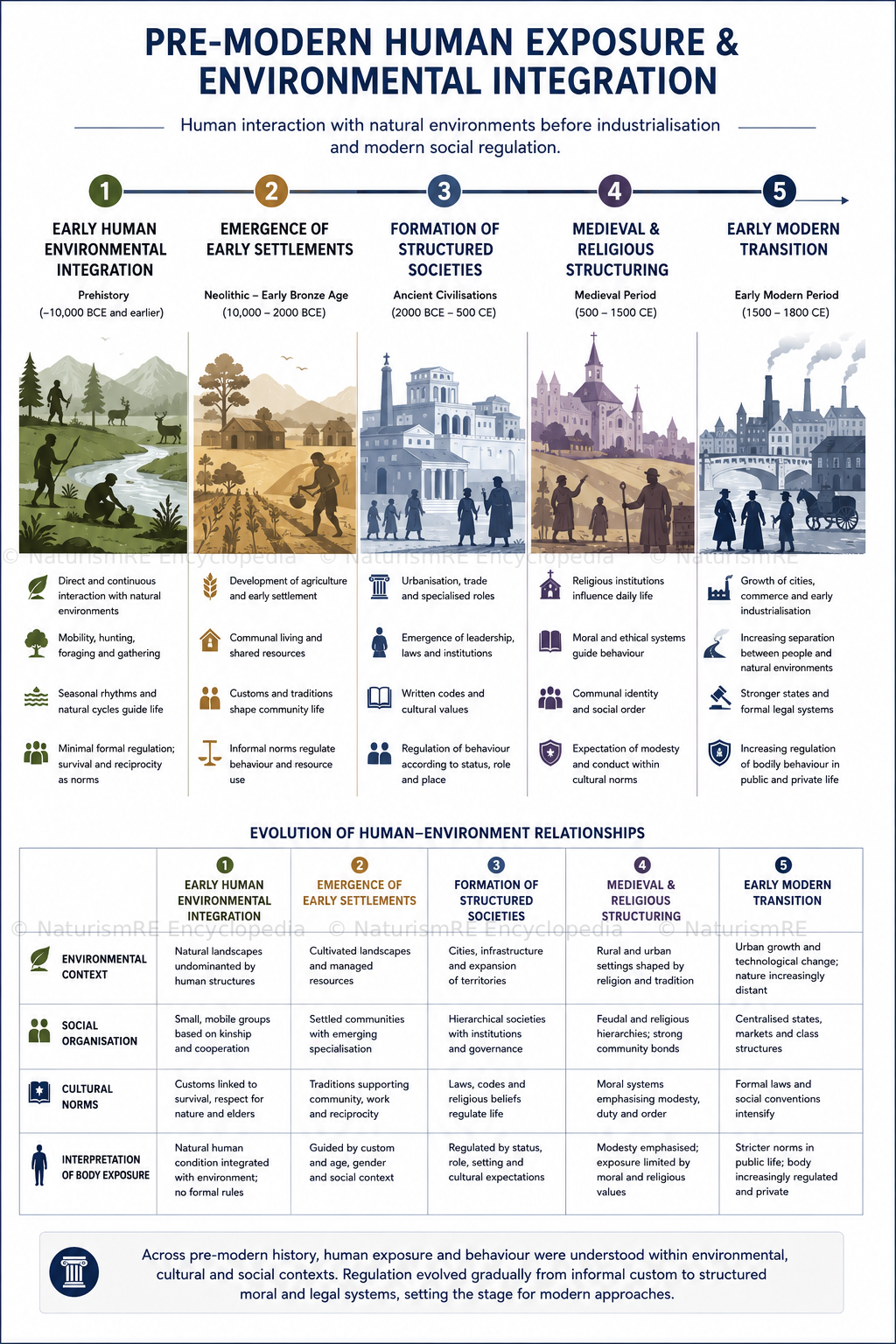
Examining nudity within pre-modern and indigenous societies prior to the emergence of modern legal, institutional, and regulatory systems.
Nudity has no intrinsic legal, moral, or social meaning. Meaning emerges only within the systems that interpret it.
1.1 Purpose
This section establishes the historical baseline required to understand nudity prior to the emergence of modern legal, social, and institutional frameworks.
Its purpose is to analyse the role and function of nudity in pre-modern and indigenous societies, to identify the structural principles governing its interpretation, and to demonstrate that nudity historically operated as a context-dependent condition rather than as a universally regulated category.
It provides the foundational premise that nudity cannot be understood independently of the systems that interpret it.
1.2 Absence of Universal Normative Standards
Archaeological, anthropological, and ethnographic evidence demonstrates that no universal standard governing nudity existed across early human societies.
Material evidence from regions including Neolithic Anatolia, Jōmon-period Japan, the Indus Valley, and prehistoric Saharan cultures indicates frequent representation of the unclothed body without consistent evidence of stigma, prohibition, or uniform moral classification.
Depictions in figurative artefacts, ritual objects, and rock art suggest that bodily exposure was culturally integrated, contextually interpreted, and not inherently exceptional.
This establishes a critical analytical principle:
Nudity has no fixed meaning outside the system in which it is interpreted.
1.3 Functional Integration and Environmental Adaptation
In many pre-modern societies, nudity or minimal clothing functioned primarily as an adaptive response to environmental conditions.
Climate, patterns of physical labour, interaction with terrain, and the availability of textile production determined the necessity and form of clothing. In such contexts, clothing was often partial, situational, or unnecessary, and bodily exposure remained functionally neutral.
Where clothing existed, it frequently served protective, symbolic, or identity-related roles rather than universal bodily coverage.
This establishes a foundational condition:
Nudity in these systems was environmentally adaptive rather than socially deviant.
1.4 Nudity as a Structured Symbolic Medium
Beyond functional use, nudity frequently appeared within structured symbolic systems.
It was present in ritual practices, spiritual ceremonies, rites of passage, and communal performances. Within these contexts, the unclothed body functioned as a symbolic medium, a communicative device, and a transitional state.
It could represent origin and creation, transformation or transition, vulnerability or purification, and connection to natural or metaphysical systems.
Importantly, this use was controlled, context-specific, and governed by cultural rules.
This establishes a critical condition:
Nudity was not unregulated. It was structured within symbolic systems.
1.5 Cultural Variability and Interpretative Systems
Different societies assigned distinct meanings to nudity based on internal interpretative frameworks.
Neutrality in Daily Life
Bodily exposure functioned as an ordinary condition integrated within environmental and social routines.
Ritual Significance
Nudity operated within ceremonial, symbolic, and spiritually governed contexts.
Symbolic Vulnerability
Exposure could communicate transition, submission, purification, or altered social status.
Authority and Identity
The body could represent authenticity, transformation, authority, or removal of social hierarchy.
Across these contexts, nudity could represent truth, authenticity, transformation, or the removal of social status.
This variability confirms a core principle:
Nudity is not defined by the body, but by the interpretative system surrounding it.
1.6 Integration Within Social and Identity Systems
In pre-modern and indigenous contexts, the body was integrated into broader systems of identity, community, environment, and symbolic expression.
Clothing was not always the primary medium of social communication. Alternative systems such as body painting, ornamentation, scarification, and ritual presentation fulfilled functions later associated with clothing, including identity signalling, social differentiation, and cultural belonging.
This demonstrates a foundational principle:
Social organisation does not depend on clothing, but on shared systems of meaning.
1.7 External Interpretation and Structural Misclassification
Historical interpretations of indigenous nudity were frequently shaped by external observers, particularly during periods of exploration, colonisation, and cultural expansion.
These observers often applied their own moral frameworks, interpreted nudity as a lack of civilisation, and imposed external standards of modesty.
Such interpretations reflected observer bias rather than the internal logic of the societies being observed.
This establishes a critical analytical distinction:
Many historical classifications of nudity reflect imposed interpretation rather than intrinsic meaning.
1.8 Distinction from Modern Naturist Systems
Pre-modern and indigenous practices must be clearly distinguished from modern naturism.
Pre-modern nudity was not organised as a movement, was not framed as a philosophical or lifestyle position, and did not emerge as a response to industrial or regulatory conditions.
Modern naturism, by contrast, is structured, self-defined, and operates within legal, social, and institutional systems. It emerges as a response to industrialisation, regulation, and the need to stabilise interpretation.
Failure to distinguish these systems leads to conceptual distortion and incorrect assumptions of historical continuity.
1.9 Structural Implications for System Formation
Analysis of pre-modern contexts establishes foundational conditions for understanding later system development.
Nudity is inherently context-dependent. Meaning is constructed through cultural and environmental systems. Social organisation can function independently of clothing norms. Regulation emerges only when systems require classification and control.
These conditions define the pre-regulatory state from which modern systems evolve.
1.10 Conclusion
Pre-modern and indigenous societies demonstrate that nudity is not inherently associated with shame, sexuality, or disorder.
Its meaning is constructed within cultural systems, shaped by environmental and functional conditions, and dependent on context and interpretation.
This leads to a defining principle:
Nudity has no intrinsic legal, moral, or social meaning. Meaning emerges only within the systems that interpret it.
The early modern period does not introduce nudity. It introduces its classification.
This distinction is critical. It establishes that modern legal and social frameworks do not reflect universal truths, but specific historical developments.
Understanding this baseline enables accurate analysis of later systems, prevents projection bias, and reinforces the interpretation of nudity as a variable condition shaped by system context.
This section defines the starting point of the entire framework:
Before regulation, nudity exists as a contextual condition. After regulation, it becomes a classified and controlled variable.
Primary Supporting Articles
From Necessity to Structure, Early Human Exposure and the Origins of Naturist Behaviour
From Cultural Practice to Proto-Structure, The Early Organisation of Bodily Exposure
From Proto-Structure to Reform Logic, The Pre-Modern Transition Toward Naturist Systems
From Cultural Exposure to Norm Formation, The Early Structuring of Bodily Interpretation