

Conceptual Foundations of Health in Contextualised Naturist Environments
Examining naturist environments through a biopsychosocial framework integrating environmental exposure, behavioural context, perception, and individual variability.
Health outcomes associated with naturist practice cannot be generalised. They must be analysed as context-dependent interactions within a structured biopsychosocial system shaped by environment, behaviour, and individual variability.
1.1 Reframing Health Beyond Clinical Definitions
Health, within the context of naturist practice, requires a broader conceptual framing than traditional clinical models.
Conventional health systems define health primarily in terms of the absence of disease, physiological indicators, and clinically measurable outcomes. While these measures remain essential, they do not fully account for the interaction between human biology, behaviour, and environment, particularly in relation to patterns of exposure, social conditioning, and perceptual frameworks.
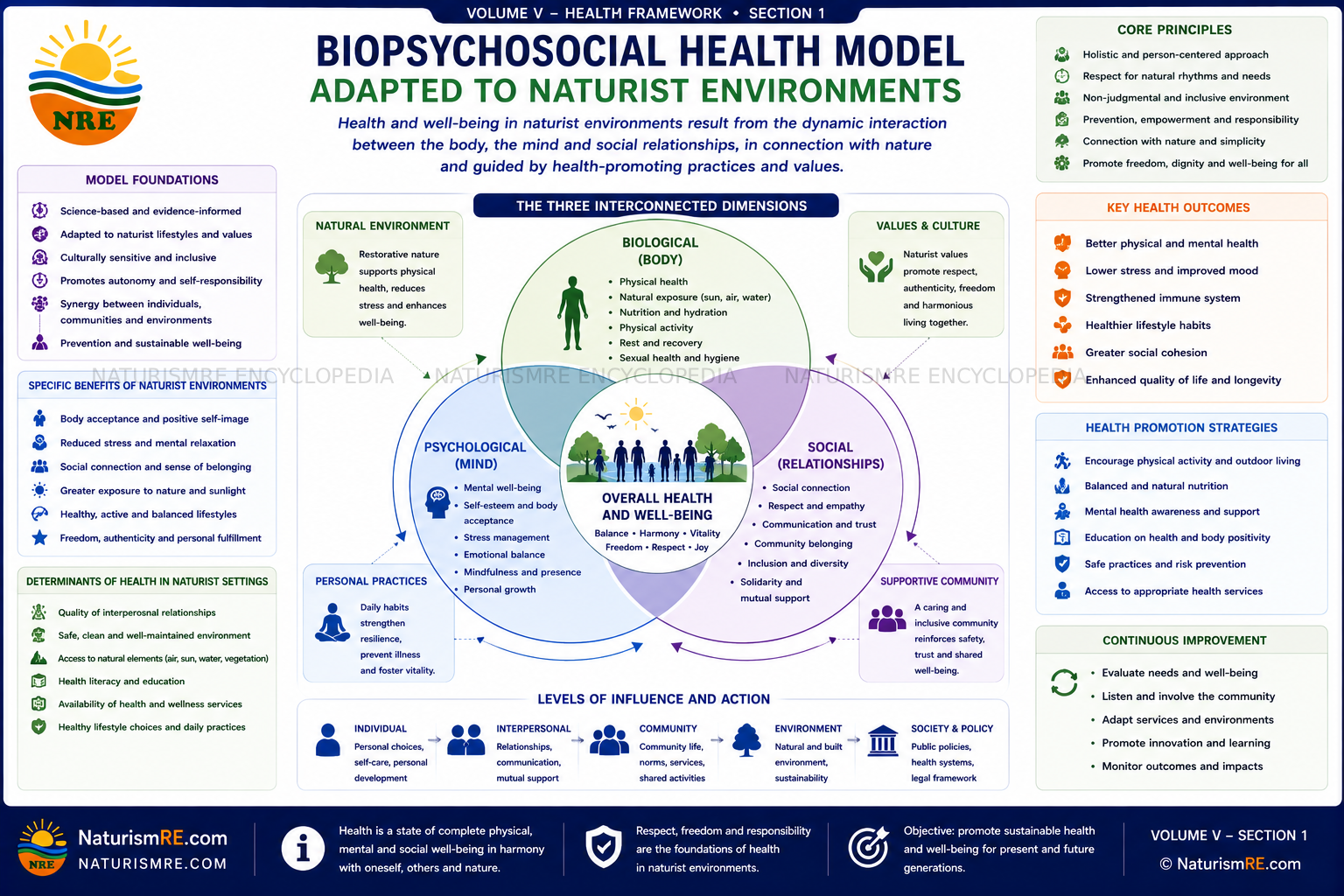
Contemporary health discourse increasingly adopts a biopsychosocial model, integrating biological processes, psychological dynamics, and social and environmental conditions. This model recognises that health is not solely a function of internal physiology, but of continuous interaction between the individual and their surroundings.
Within this framework, naturist environments are not examined as lifestyle preferences, but as contextual systems that modify human-environment interaction in measurable ways.
1.2 The Body as an Interface with Environment
The human body functions as the primary interface through which environmental conditions are experienced and regulated.
Clothing acts as a mediating layer, influencing thermal regulation, protecting against environmental exposure, modifying sensory input, and shaping social signalling. Its presence alters both physiological processes and behavioural responses.
Naturist practice reduces or removes this mediating layer, resulting in increased direct exposure to environmental variables and altered sensory engagement. This produces a different interaction profile between body and environment.
This shift does not produce inherent benefit or harm. It modifies the conditions under which physiological and behavioural responses occur. These responses must therefore be evaluated relative to context, duration, environmental conditions, and individual variability.
Understanding the body as an adaptive interface is essential for interpreting potential health-related effects.
1.3 Environmental Exposure and Physiological Interaction
Direct exposure to environmental elements introduces measurable physiological interactions.
Thermoregulatory Response
Environmental exposure modifies heat exchange and physiological adaptation to temperature variation.
Dermal Exposure
Interaction with sunlight, airflow, and environmental surfaces alters sensory and physiological conditions.
Circulatory and Sensory Effects
Environmental interaction may influence circulation, sensory perception, and adaptive physiological response.
Conditional Risk Factors
Outcomes depend on duration, intensity, environmental conditions, and protective measures.
Controlled exposure may align with adaptive physiological processes, while excessive or poorly managed exposure may introduce risk.
Naturist environments must therefore be understood as variable exposure systems in which physiological responses are shaped by conditions rather than by nudity itself.
1.4 Psychological Dimensions of Body Perception
The psychological dimension represents one of the most significant variables within naturist environments.
Contemporary societies are characterised by elevated levels of body image sensitivity, social comparison, and internalised appearance standards. These conditions contribute to anxiety, reduced self-esteem, and constrained social interaction.
Contextualised naturist environments alter these conditions by modifying the visual and social reference framework. Reduced emphasis on clothing diminishes certain forms of status signalling and may shift attention toward behavioural interaction rather than appearance.
Empirical observations suggest associations with changes in body perception, reduced comparative pressure, and increased exposure to body diversity. However, these effects are neither uniform nor immediate.
Initial responses may include discomfort, heightened self-awareness, or perceived vulnerability. Adaptation occurs over time and varies between individuals.
Psychological outcomes must therefore be interpreted as dynamic and context-dependent processes rather than fixed effects.
1.5 Social Interaction and Behavioural Modulation
Clothing functions as a primary system of social signalling, conveying identity, status, and role differentiation.
In its absence, social interaction relies more heavily on behavioural cues. This alters interaction dynamics, potentially reducing visible hierarchy while increasing reliance on conduct as a signalling mechanism.
Structured naturist environments compensate for the absence of traditional signals through clearly defined behavioural expectations. These expectations reduce ambiguity, support predictable interaction patterns, and maintain participant comfort.
Where such structure is absent, the reduction of signalling mechanisms may increase uncertainty, variability in interpretation, and potential discomfort.
Social interaction within naturist environments is therefore contingent on the alignment between environmental definition and behavioural governance.
1.6 Variability and Individual Response Profiles
A defining characteristic of naturist environments is the variability of individual response.
Physiological, psychological, and behavioural reactions differ based on biological characteristics, personal disposition, prior exposure, and cultural background.
This variability means that no singular outcome can be assumed. Responses may range from adaptation and comfort to discomfort and withdrawal.
The absence of uniformity is not a limitation of the system. It is an inherent feature of human-environment interaction.
Structured systems must therefore avoid generalised claims and instead support informed, voluntary participation within clearly defined parameters.
1.7 Contextual Boundaries and Health Interpretation
The interpretation of health-related outcomes in naturist environments depends fundamentally on context.
Key distinctions include structured versus unstructured environments, controlled versus uncontrolled exposure, and voluntary versus imposed participation.
Environments that are clearly defined, behaviourally governed, and aligned with safety considerations provide conditions under which outcomes can be consistently interpreted.
Environments lacking these characteristics introduce variability, increase risk, and reduce analytical clarity.
Context is therefore not a secondary variable. It is the primary determinant of interpretability in health analysis.
1.8 Analytical Conclusion
The relationship between naturism and health must be understood within a biopsychosocial framework that integrates environmental, behavioural, and perceptual variables.
Naturist environments modify the interaction between body and environment, influencing physiological responses, psychological processes, and social dynamics. These effects are context-dependent, variable, and shaped by individual and environmental conditions.
Structured environments provide the necessary conditions for consistent interpretation by reducing ambiguity and stabilising behavioural expectations.
Naturism, within this framework, is not a health intervention in itself. It is a contextual modifier of human-environment interaction.
This establishes the foundational principle for Volume V:
Health outcomes associated with naturist practice cannot be generalised. They must be analysed as context-dependent interactions within a structured biopsychosocial system shaped by environment, behaviour, and individual variability.
Primary Supporting Articles
Health as Contextual Interaction, The Biopsychosocial Basis of Naturist Environments
Interpretation, Variability, and Structural Stabilisation in Health Outcomes
Health as Environmental Alignment, Reframing Naturism Beyond Lifestyle
Body Perception as a Dynamic Construct in Contextualised Exposure Environments
Secondary Supporting Articles
Social Comparison and Perceptual Recalibration in Exposure-Based Contexts
Transitional Psychological States, Discomfort, Adaptation, and Perceptual Stabilisation
Dermal Interface and Sensory Processing in Direct Exposure Environments
Environmental Design as a Behavioural Regulation Tool
From Social Interaction to Social Order, How Structured Environments Produce Predictable Behaviour