Legal Recognition of Non‑Sexual Social Nudity: Comparative Models and a Health‑Zoned Implementation Framework — SHZ
Prepared for: NRE Health Institute
Document type: Government‑grade policy and governance white paper
Date of research cut: 28 February 2026 (Australia/Sydney)
Standard: Primary‑source verification prioritized; non‑English legal texts summarized with translations where used
Executive Summary
Non‑sexual social nudity exists in a persistent policy blind spot: it is widely practiced (especially in coastal recreation contexts), but legal systems often regulate it indirectly through broad “public order,” “offensive conduct,” or “indecency” provisions. Where governments have moved beyond ambiguity, the pattern is consistent: define the conduct, separate it from sexual offending, confine it to clearly designated places, and govern it through signage, boundaries, and enforceable conduct codes. This approach reduces public confusion, reduces discretionary enforcement, improves safety outcomes, and creates a stable basis for community coexistence.
This white paper advances a clear thesis:
Thesis: Governments can lawfully and safely accommodate non‑sexual social nudity by adopting a zoning‑plus‑standards model—Structured Health Zones (SHZ)—that operationalizes “recognition” as an administrative and enforcement framework (not a cultural preference), with built‑in safeguards and measurable outcomes.
The practical problem governments face is not “nudity” as such; it is legal ambiguity and governance inconsistency, which create:
uneven policing and complaints handling (high discretion, unclear thresholds),
weak separation between lawful naturist recreation and unlawful sexual exhibitionism/exposure offenses,
heightened risks of community conflict, safety incidents, and privacy harms (especially via non‑consensual photography), and
avoidable costs (reactive enforcement, litigation risk, signage retrofits, unmanaged tourism externalities).
The comparative legal review identifies seven recurring recognition models across jurisdictions (from explicit naturism statutes to general public indecency norms). This paper then proposes a Legal Stability Index (LSI)—a decision tool to rate the predictability and durability of non‑sexual social nudity governance. The LSI is applied (sample scoring) to a representative global set of jurisdictions using primary sources wherever accessible.
The policy rationale for SHZ is anchored in two evidence-grounded propositions:
Body image is a global mental health concern linked to psychological well‑being.
Naturist and communal non‑sexual nudity interventions show measurable associations with improved body image, self‑esteem, and life satisfaction, including experimental and prospective evidence.
The SHZ model is not a “free‑for‑all.” It is a regulated public-space instrument with:
enabling legal language (statute/regulation templates),
designation criteria and licensing (where appropriate),
standardized signage and boundary controls,
a conduct code and complaint process,
enforcement standard operating procedures (SOPs),
a stakeholder engagement plan, and
monitoring and evaluation metrics.
Risk management is central. In particular, SHZ must explicitly address:
UV exposure risks (sun safety requirements and infrastructure),
harassment and sexual misconduct prevention (clear separation from sexual offenses; enforcement protocols),
privacy protection and non‑consensual imaging controls (signage + enforcement + reporting pathways), aligned with established rights balancing principles where applicable.
The result is an institution-grade framework that a government can pilot within 12 months, with defendable governance design, legal drafting options, and measurable outcomes.
Thesis, Problem Statement, Definitions, and Scope
Thesis (restated): A zoning‑plus‑standards framework (SHZ) is the most legally resilient and operationally effective way for governments to recognize non‑sexual social nudity while preserving public order, protecting minors, and minimizing discretionary enforcement. This thesis is supported by jurisdictions that already implement explicit permission through designated areas and suitability tests (e.g., dedicated naturism statutes or prescribed‑area laws), and by jurisdictions that regulate primarily through “harm‑based” thresholds such as harassment, alarm, or sexual intent.
Problem statement
Across many legal systems, enforcement practice is forced to answer an ill‑posed question: “Is nudity illegal?” The more accurate and administrable question is: “Under what conditions is non‑sexual nudity tolerated or permitted, and what controls ensure safety and public clarity?”
Where the law relies on general clauses—offensive conduct, public order, indecency—outcomes depend on discretionary judgments and complaint dynamics. This is visible in public order statutory designs that criminalize conduct when it is likely to cause serious offense/annoyance or harassment/alarm/distress, rather than defining nudity itself as unlawful.
By contrast, where governments define designated naturist spaces, the legal system gains:
administrable boundaries and signage duties,
explicit “lawful excuse” or “prescribed area” defenses,
predictable enforcement triggers, reducing ambiguity and conflict.
Definitions
Non‑sexual social nudity: The voluntary state of being nude (or substantially unclothed) in the presence of others in a social, recreational, cultural, or wellbeing context, without sexual intent, sexual conduct, harassment, or coercion, and not imposed on non‑consenting viewers in a manner that constitutes a sexual offense or public harm threshold.
Legal recognition (for policy purposes): A statutory, regulatory, administrative, or authoritative enforcement framework that:
clarifies when non‑sexual social nudity is lawful or tolerated, and
provides enforceable location and conduct controls (boundaries, signage, and rules), thereby reducing discretionary enforcement.
Structured Health Zones (SHZ): A regulated public-space instrument that permits non‑sexual social nudity within geographically defined zones under a governance standard designed to support wellbeing outcomes (including stigma reduction and body acceptance), while applying safety, privacy, and public order controls.
Scope and jurisdictional coverage
This white paper uses a representative global sample (20 jurisdictions) spanning Europe, North America, Oceania, Latin America, Africa, and Asia, selected for the availability of primary legal texts and/or authoritative official materials. The sample includes designated‑area regimes (e.g., prescribed beaches), explicit naturism legislation, suitability tests, and public order frameworks.
Methodology and Verification Limits
Search strategy and source prioritization
Legal and policy sources were collected using targeted retrieval of:
official gazettes and national legislation portals (e.g., statutes as published/maintained by governments),
official parliamentary records where designation mechanisms are discussed (e.g., bills and explanatory material),
official court databases and judgments where available (e.g., decisions interpreting suitability tests or defining common law offenses),
authoritative policing/prosecution guidance where published by official institutions (e.g., policing decision aids referencing prosecutorial approaches).
Health and social science literature was prioritized from:
peer‑reviewed journal platforms and indexed biomedical databases (e.g., PubMed records and open access journal pages),
major public health agencies for risk controls relevant to outdoor nudity (UV exposure, skin cancer prevention).
Verification approach
A jurisdiction was marked primary‑verified when this report cites:
the statute/regulation text from an official government portal, or
a court judgment from an official court database or a widely recognized legal repository.
Where a law is non‑English, the report cites the primary text and provides a translation summary.
Verification limits and assumptions
Sub‑national ordinances are unevenly available and frequently change. For some jurisdictions, municipal “naturist beach” designations are partially evidenced through official local government/parks pages rather than consolidated statute lists.
Not all court databases provide full public access or searchable English translations; where case access is constrained, this report limits claims and flags gaps.
“Recognition” is operationalized as governance clarity, not as cultural endorsement. A jurisdiction may be scored as relatively stable if its legal system clearly separates non‑sexual nudity from sexual offending and provides predictable enforcement criteria, even without explicitly “promoting” naturism.
Comparative Legal Model Typology and Legal Stability Index
Comparative legal model typology
Across the sample, seven models recur:
Model A: Explicit naturism statute with licensing and conduct limits.
A dedicated law defines naturism and permits its practice under specified conditions and licensing. Example: Portugal’s naturism law permits naturism while requiring it to be free of scandalous conduct and provides for licensing of naturist facilities.
Model B: Prescribed‑area statute (clothing‑optional zones by designation).
The law provides that being nude in designated places/times is not an offense “by reason only” of nudity and establishes an administrative designation mechanism. Example: Victoria’s prescribed‑areas framework.
Model C: Suitability test with municipal designation (hybrid zoning).
Nude recreation is regulated through a combination of municipal designation and a “suitability” concept; case law may interpret suitability. Example: the Netherlands’ criminal code provision on nude recreation and the Dutch Supreme Court’s interpretation of “not suitable.”
Model D: Statutory designation via local government power and public notice requirements.
Legislative frameworks authorize nude bathing at named locations and may require signage/notice. Example: New South Wales parliamentary materials describing designated beaches and notice requirements.
Model E: Public order threshold model (harm‑based triggers).
Nudity is not automatically illegal; criminality attaches where conduct is threatening/disorderly or causes harassment/alarm/distress. Example: England and Wales Public Order Act section 5.
Model F: Sexual intent separation model (exposure/exhibitionism offenses require intent, coercion, or sexual elements).
Criminal law focuses on sexual exposure/exhibitionism, often requiring intent to cause alarm/distress or involving minors. Examples: UK exposure offense requiring intent to cause alarm/distress; France’s “sexual exhibition imposed” offense; Spain’s exhibitionism provisions focused on minors; Norway’s sexually offensive conduct; Denmark’s modesty violation provision.
Model G: Public indecency or obscene act general clause (broad discretion).
“Obscene act” or “public indecency” provisions can be applied to nudity depending on interpretation; predictability is lower absent zoning/guidance. Examples: Brazil’s “obscene act” article; South Africa’s common law definition emphasizing moral depravity tendencies.
Legal Stability Index design
The Legal Stability Index (LSI) is a scoring tool (0–100) to estimate how predictably a jurisdiction can govern non‑sexual social nudity without excessive discretion or conflict.
LSI criteria (weights):
Clarity of legality (0–20): Is non‑sexual social nudity clearly addressed (explicit permission or clear thresholds)?
Designation and boundary machinery (0–15): Is there a defined zoning/licensing process and public notice mechanism?
Separation from sexual offending (0–15): Does the legal framework clearly distinguish non‑sexual nudity from sexual exposure/exhibitionism?
Enforcement guidance and jurisprudence (0–15): Are there authoritative guidelines/case law clarifying practice?
Procedural safeguards (0–10): Are prosecution/enforcement triggers constrained (e.g., Attorney General consent, police request to desist)?
Governance controls embedded (0–10): Are signage, conduct limits, or municipal competencies explicit?
Temporal durability (0–15): Is the framework relatively resistant to rapid reversal (statutory grounding > informal tolerance)?
Interpretation: LSI is a structured estimate for policy comparison, not a legal opinion. It must be validated by local counsel and enforcement stakeholders before use in formal legal risk assessments.
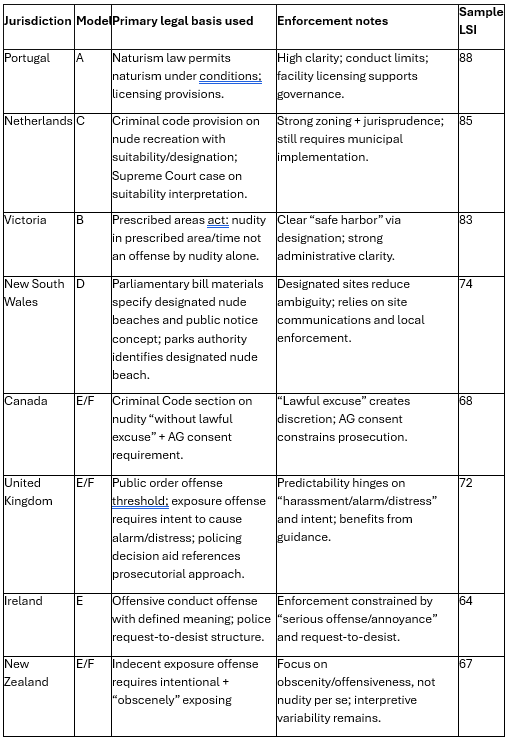
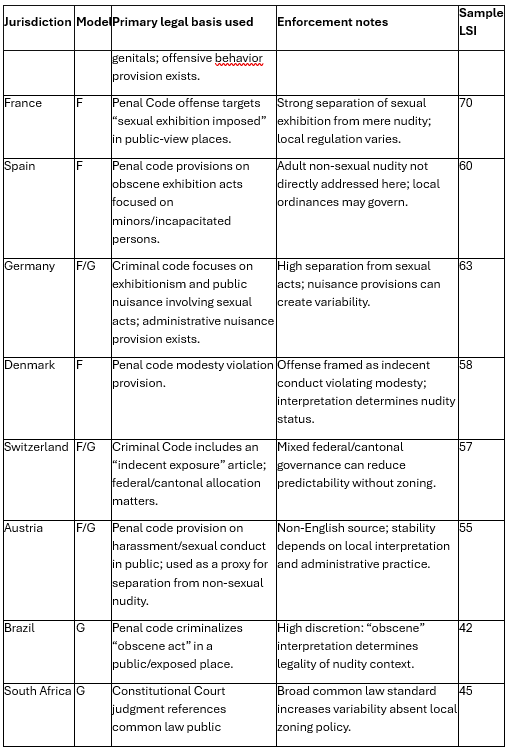
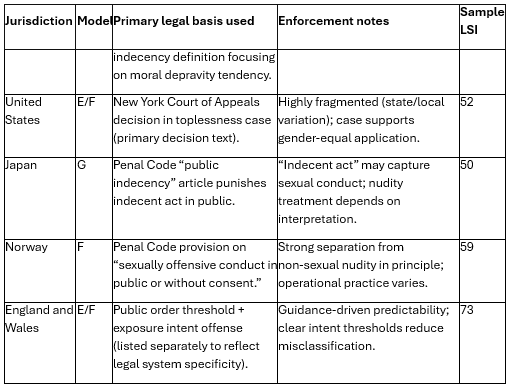
Comparative jurisdiction matrix with model and sample LSI scores
The table below lists a representative global sample (20 jurisdictions). Each row cites at least one primary or authoritative source used in scoring.
Notes on the matrix:
Some entries reflect national frameworks; others reflect sub‑national designation instruments where those are the primary governance mechanism (e.g., Australian states).
Scores are illustrative and must be validated with local counsel and enforcement stakeholders before operational use.
Legal Stability Index distribution
Based on the sample scoring above, stability clusters as follows (illustrative):
High stability (≥75): explicit statute or robust zoning + jurisprudence
Moderate (55–74): harm‑based public order thresholds with guidance or constrained prosecution triggers
Lower (≤54): broad indecency/obscene act provisions without zoning or authoritative guidance
A simple distribution view (count of jurisdictions by band):
40–54: ■■■■
55–64: ■■■■■■■
65–74: ■■■■■
75–89: ■■■■
This pattern is not accidental: legal stability tracks governance design, not cultural attitudes.
Governance Controls Observed in Primary‑Verified Jurisdictions
Across jurisdictions with clearer recognition, the recurring governance controls are strikingly consistent.
Designation, boundaries, and notice
Designated‑area frameworks reduce discretionary enforcement by creating a clear “where” and “when.” Victoria’s prescribed‑areas approach is explicit: in effect, nudity in a prescribed area/time is not criminal “by reason only” of being naked.
New South Wales parliamentary material provides a “named beaches” model and explicitly links legality to public notice at the place. In practice, official parks information can reinforce designation status (and safety caveats) for specific sites.
The Netherlands model combines municipal designation authority with a suitability concept—an approach that not only enables zones but also supports judicial interpretation when disputes arise.
Licensing and facility governance
Portugal’s naturism framework illustrates the “licensed facility” approach: naturism is permitted under the law, with licensing processes relevant to naturism fields/camps and conduct restrictions that prevent scandalous behavior.
This licensing‑plus‑standards structure is directly portable to SHZ, especially where governments want to regulate not just beaches but also wellness‑adjacent outdoor facilities.
Conduct limits and separation from sexual offenses
A recurring best practice is explicit separation of non‑sexual nudity from sexual exposure/exhibitionism.
Illustrations from primary texts:
England and Wales: the exposure offense requires intentional genital exposure with intent that someone will see and be caused alarm/distress—structurally distinguishing naturist intent from “flashing.”
France: the offense targets “sexual exhibition imposed” in a public‑view place, highlighting “imposition” and sexual character.
Norway: the penal code provision is framed as “sexually offensive conduct” in public or without consent.
Denmark: the modesty violation provision similarly frames the wrongdoing as indecent conduct violating modesty, not mere unclothed existence.
This separation is essential for SHZ legitimacy. Without it, zones can be politically attacked as enabling sexual misconduct, even where evidence and law distinguish the categories.
Enforcement thresholds and constrained discretion
Public order frameworks frequently hinge enforcement on harm indicators:
harassment/alarm/distress thresholds (Public Order Act section 5),
“offensive conduct” definitions and “request‑to‑desist” procedural triggers (Ireland),
“obscenely” exposing genitals standards (New Zealand).
While these can protect against over‑criminalization, they may also produce inconsistent application if governments do not supply operational guidance. Official policing decision aids in the UK context explicitly address public nudity handling, reinforcing the role of institutional guidance in stabilizing enforcement.
SHZ Framework: Health‑Framed Rationale, Legal Templates, Signage, Conduct Codes, and Enforcement SOPs
Health‑framed policy rationale
This paper adopts a conservative evidentiary stance: SHZ should not be justified by speculative medical claims. It should be justified by credible wellbeing evidence, stigma reduction logic, and governable public order outcomes, while explicitly managing known health risks (UV exposure).
Body image and mental health: Body image concerns are widely recognized as a major mental health issue and correlate with adverse psychological outcomes.
Naturist activity and wellbeing evidence: Peer‑reviewed research indicates that greater engagement in naturist activities is associated with improved life satisfaction, mediated by more positive body image and self‑esteem, including prospective studies suggesting changes after participation. Experimental evidence also reports increased body appreciation in the naked condition, mediated by reduced social physique anxiety.
Stigma measurement is emerging: Recent peer‑reviewed work includes instruments designed to measure stigma toward naturists, indicating a maturing evidence base for stigma reduction interventions and evaluation.
Nature co‑benefits: Independent of nudity, nature exposure is associated with positive body image and wellbeing; SHZ sites are often nature‑adjacent, enabling synergistic design.
Health risk management (UV): Outdoor nudity does not change the epidemiology of UV radiation risk; it can increase exposure surface area. WHO identifies UV exposure as a primary cause of skin cancers and notes broader UV harms including cataracts. Accordingly, SHZ policy must embed sun safety standards, including shade, timing guidance, and protective measures.
SHZ enabling legal architecture
SHZ is designed to be legally implementable under multiple legal systems. This section provides three drafting patterns, each mapped to the comparative models above.
Drafting pattern for a prescribed‑area statute or regulation
This pattern mirrors the operational effect of prescribed‑area laws: within a designated zone, non‑sexual social nudity is lawful “by reason only” of nudity, subject to conduct rules.
Template provisions (model language, policy draft):
Purpose clause:
The purpose of this instrument is to (a) reduce legal ambiguity and enforcement inconsistency regarding non‑sexual social nudity, (b) establish Structured Health Zones as regulated public spaces, and (c) protect public safety, minors, privacy, and public order.
Definitions clause:
Define “non‑sexual social nudity,” “Structured Health Zone,” “designated authority,” “sexual conduct,” “harassment,” “non‑consensual imaging,” and “minor.”
Designation power:
The Minister/Local Authority may, by published notice, designate an SHZ and specify boundaries and operating conditions. The notice must include a map, coordinates, hours/seasonality, and the conduct code.
Safe‑harbor rule:
A person does not commit an offense by reason only of being nude or partially nude within an SHZ, provided they comply with the SHZ conduct code.
Conduct code incorporation:
The SHZ conduct code has legal effect and is enforceable by authorized officers.
Enforcement and discretion:
Enforcement is graduated (education → direction → penalty), except for sexual offenses and serious harassment which trigger immediate escalation consistent with existing sexual offense and public order laws.
This pattern is strongest where governments want high clarity and low discretion, consistent with Model B and Model D.
Drafting pattern for a “suitability plus designation” hybrid
This pattern draws from the Dutch approach: municipal designation plus a suitability standard, supported by interpretive jurisprudence.
Template provisions (model language, policy draft):
A municipal authority may designate SHZ locations.
Outside a designated SHZ, non‑sexual public nudity is presumed non‑permissible only where the location is not suitable and the conduct is likely to cause public disturbance, with suitability assessed against published criteria (distance from sensitive facilities, visibility, complaint history, signage feasibility).
A review and appeal mechanism is established for designation decisions.
This pattern is useful where governments desire broader flexibility, while still limiting discretion through published suitability criteria and maps.
Drafting pattern for a prosecutorial/enforcement policy instrument
Where legislative amendment is slow, an interim instrument can stabilize enforcement without changing substantive law—mirroring the role of policing decision aids and prosecutorial guidance.
Core elements:
a public decision tool for officers and complaint handlers,
a defined SHZ pilot area with signage and local administrative backing,
explicit separation from exposure offenses that require sexual intent or intent to cause alarm/distress,
standardized reporting, incident categorization, and escalation pathways.
This is weaker than a statute for durability, but can be a pragmatic pre‑pilot stabilizer.
SHZ signage and boundary standards
SHZ depends on signage as a governance control (clarity for entrants, non‑participants, and enforcement). Designation and notice are explicitly contemplated in designated‑area approaches.
Signage minimum specification (policy standard):
Placement: all formal entry points; intermediate markers every 100–200 meters (terrain dependent); boundary “end zone” markers at exits.
Clarity: plain‑language statement that non‑sexual social nudity may occur; “you are entering/leaving an SHZ.”
Conduct highlights: no sexual activity; no harassment; no non‑consensual photography; respect personal space; towel use where seated; comply with directions of authorized officers.
Safety: UV index warnings, shade locations, hydration reminders, and emergency contact information, aligned with public health guidance emphasizing UV risk and sun protection.
Accessibility: pictograms, multilingual secondary text where tourism volume warrants, and QR code to full code and complaint process.
SHZ conduct code
The conduct code should be short enough to be enforceable and long enough to be meaningful. It must be drafted to preserve the separation between lawful non‑sexual nudity and unlawful sexual exposure/exhibitionism frameworks.
Core conduct rules (policy standard):
Non‑sexual social nudity is permitted; sexual acts are prohibited.
Harassment, intimidation, persistent following, and unwanted sexualized behavior are prohibited (zero tolerance).
Photography/filming of identifiable individuals without explicit consent is prohibited; enforcement action escalates where non‑consensual imagery is suspected.
No intentional “imposition” conduct (approaching clothed non‑participants to provoke alarm/distress). This aligns with harm‑based and intent‑based legal standards.
Alcohol and drug rules follow local park/beach regulations; intoxication that contributes to disorderly behavior triggers removal.
Hygiene norms (towel use on shared seating, waste disposal, toileting rules).
Child safeguarding: SHZ may be “family‑allowed” or “adult‑only” depending on site selection; regardless, photographing minors is prohibited and enforcement is strict.
Enforcement SOPs for SHZ
Enforcement must be predictable, bias‑resistant, and complaint‑capable. Public order laws often depend on perceived offensiveness, distress, or disorder thresholds; SOPs reduce inconsistency.
SOP structure (policy standard):
Triage: identify whether the matter is (a) lawful SHZ conduct, (b) SHZ rule breach, (c) public order nuisance, or (d) sexual offense/non‑consensual imaging.
Engage and educate (default): for low‑risk conflicts (boundary confusion, signage misunderstanding).
Direction: issue a formal direction to comply with conduct code or leave zone.
Escalation: immediate escalation for exposure offenses with intent to cause alarm/distress (where relevant), sexual exhibition imposed on non‑consenting persons, harassment, stalking behavior, or suspected child exploitation.
Documentation: standardized incident form capturing time, location, observed conduct, complainant type (participant/non‑participant), and resolution.
Prosecution constraint awareness: where relevant, note statutory constraints such as Attorney General consent requirements (Canada) or request‑to‑desist triggers (Ireland).
Stakeholder engagement plan
SHZ cannot be implemented as a “parks only” project. It is a multi‑stakeholder governance instrument.
Primary stakeholders: local government and parks agencies (designation, infrastructure), police/enforcement entities (SOPs), public health agencies (UV and safety messaging), community residents and business associations (impact management), tourism bodies (communications), women’s safety advocates (harassment prevention design), disability advocates (accessibility), and civil liberties stakeholders (rights balancing). Rights balancing is particularly relevant in jurisdictions where expression/privacy frameworks are prominent in legal reasoning.
Engagement sequence (recommended):
pre‑consultation design workshops with enforcement and public health leads,
community briefing with clear SHZ scope and conduct code,
pilot feedback loop and transparent reporting.
Monitoring and evaluation metrics
Evaluation must measure both safety and wellbeing, while tracking unintended consequences.
Operational metrics:
incident rate per 1,000 visits (harassment, disorder, boundary disputes),
complaint volume by category and resolution time,
enforcement actions: education vs direction vs penalties,
non‑consensual imaging reports and outcomes.
Wellbeing metrics (survey‑based, ethics‑reviewed):
body appreciation / social physique anxiety measures (leveraging constructs consistent with published intervention work),
self‑esteem and life satisfaction measures consistent with naturism research.
Health risk controls:
sun safety compliance indicators (shade usage, sunscreen availability, educational reach) aligned to UV risk guidance.
Implementation Roadmap, Pilot Design, Budget Estimate, and Timeline
Pilot design principles
A credible SHZ pilot should:
begin with one to three sites (not a blanket rollout),
select locations with natural separation, manageable entry points, and feasible signage, consistent with designated‑area governance logic,
treat enforcement and safety protocols as first‑order deliverables, not afterthoughts, and
publish a transparent evaluation plan from day one.
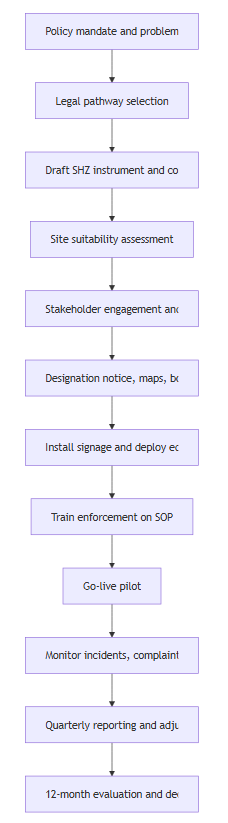
Phased roadmap
Phase: Legal and governance design
Draft enabling instrument (statute/regulation or administrative order), finalize conduct code, signage, enforcement SOPs, and data governance plan. This phase should explicitly map how SHZ interacts with existing exposure/sexual exhibition/public order provisions to preserve legal separation.
Phase: Site selection and consultation
Select sites using criteria derived from stable models: boundaries, suitability, notice feasibility, and enforcement access. Dutch suitability jurisprudence supports the principle that suitability criteria matter and can be judicially tested.
Phase: Operational launch
Install signage and boundary markers, run multi‑agency training, and launch communications emphasizing safety, consent, and non‑sexual framing.
Phase: Evaluation and decision
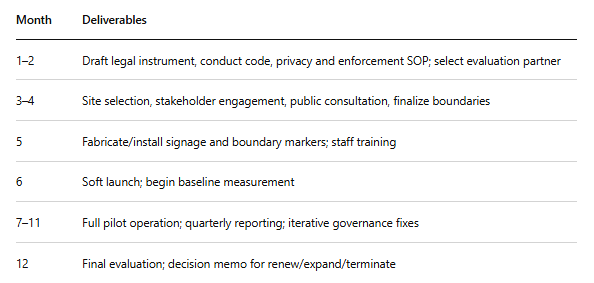
Publish quarterly reports; at 12 months, decide to renew, expand, modify, or terminate based on metrics.
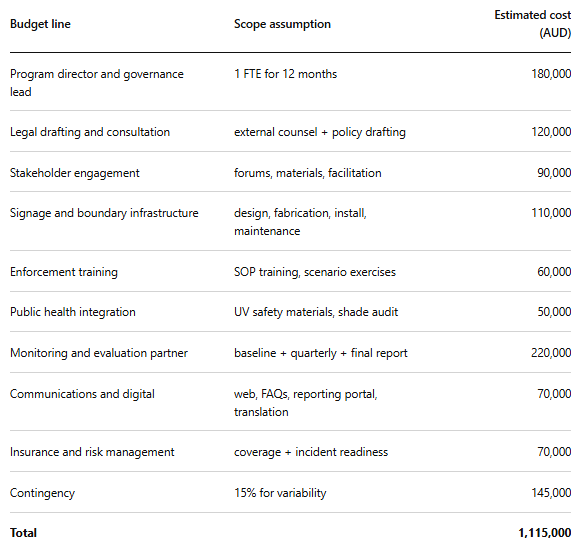
Twelve‑month pilot budget estimate
This estimate is intentionally conservative and assumes: 1–2 sites, moderate visitor volume, full signage build, formal training, and an external evaluation partner. Figures are illustrative planning ranges (currency: AUD; convert at prevailing rate if needed).
Timeline table
Mermaid framework flow diagram
Mermaid timeline diagram
Bibliography and Annex
Bibliography
Primary legal and official governance sources (selected):
Portugal naturism law (Diário da República).
Victoria prescribed areas framework (legislation portal; consolidated text via legal repository).
New South Wales designated beach parliamentary materials; parks authority designation statement.
Canada Criminal Code section 174 (Justice Laws).
England and Wales Public Order Act section 5; Sexual Offences Act exposure offense section 66; policing decision aid referencing prosecutorial approach.
Ireland Criminal Justice (Public Order) Act section 5.
New Zealand Summary Offences Act section 27; public order chapter including offensive behavior.
France Penal Code article 222‑32 (Légifrance).
Spain Penal Code (BOE) article 185 context.
Netherlands criminal code article on nude recreation (wetten.overheid.nl) and Supreme Court decision (rechtspraak.nl).
Denmark penal code (Retsinformation) section 232.
Germany criminal code sections on exhibitionism/public nuisance; nuisance provision (Gesetze im Internet).
Brazil Penal Code article 233 (Planalto).
South Africa Constitutional Court judgment (SAFLII) referencing common law public indecency definition.
Japan Penal Code official translation (Japanese Law Translation).
Norway Penal Code (Lovdata) section 298.
European Court of Human Rights decision acknowledging public nudity as expression under Article 10 context (HUDOC), and Convention text.
Peer‑reviewed health and social science sources (selected):
West, naturist activity and life satisfaction mediated by body image and self‑esteem (open access).
West, communal naked activity increasing body appreciation via reduced social physique anxiety (PubMed).
Rodgers, body image as a global mental health concern (open access review).
Merino, body perceptions and psychological well‑being (review).
Nature exposure and positive body image evidence base (open access synthesis).
Stigma measures and stigma impacts references (including naturism stigma scale development and broader stigma health associations as context).
Public health risk controls:
WHO ultraviolet radiation fact sheet; sun protection guidance; national position statement relevant to UV risk.
Annex: statutory excerpts and case citations with translations
To remain within excerpting constraints, excerpts are limited to short phrases and accompanied by translation summaries.
Portugal naturism law (Portuguese; translation summary)
Excerpt (Portuguese): “A prática do naturismo é permitida…”
Translation summary: The law permits naturism under the statute, conditioned on being free from scandalous conduct, and includes licensing mechanisms for naturist facilities.
Victoria prescribed areas (English; summary)
Excerpt (short statutory effect): nudity in prescribed areas is not an offense “by reason only” of nudity.
Summary: A designation mechanism creates clothing‑optional public zones, reducing enforcement ambiguity.
New South Wales designated beaches (English; parliamentary record)
Excerpt (short): bill object is to allow “five designated beaches…to be used for…nude bathing.”
Summary: Parliamentary materials specify named beaches and link legality to notice/signage, demonstrating a designation‑by‑instrument approach.
Netherlands nude recreation provision and jurisprudence (Dutch; translation summary)
Summary: The Dutch system regulates nude recreation through designation and suitability; the Supreme Court decision addresses interpretation of “not suitable” in a specific location dispute.
England and Wales exposure offense (English; summary)
Excerpt (short): exposure offense requires intent someone will see and be caused “alarm or distress.”
Summary: Intent threshold structurally separates naturist activity from criminal exposure intended to alarm or distress.
France sexual exhibition offense (French; translation summary)
Excerpt (short): “L’exhibition sexuelle imposée…”
Translation summary: The offense targets sexual exhibition imposed on others in a public‑view place; the framing supports separation between sexual misconduct and mere nudity.
Norway sexually offensive conduct (Norwegian; translation summary)
Summary: The provision targets sexually offensive conduct in public or without consent; it is a structural separation point between non‑sexual nudity and sexual misconduct.
South Africa common law public indecency (English; case citation)
Case citation context: SAFLII judgment references public indecency as conduct in public tending to moral depravity.
Policy implication: broad common law phrasing increases discretion; zoning policy is the stabilizer.
United States case citation (New York Court of Appeals)
Citation: People v. Santorelli (decision text available via Cornell legal repository).
Policy implication: illustrates how courts may construe public nudity statutes through equality and statutory interpretation lenses; however, US governance is fragmented by state/local law.
Jurisdictions or elements not fully verified
Municipal ordinances for naturist areas in several European jurisdictions (e.g., specific local decrees establishing naturist beaches) were not exhaustively captured due to fragmentation and change frequency; national criminal code provisions and official portals were prioritized.
Some jurisdictions have important administrative practice (tourism‑based recognition) that is not consistently published as consolidated primary law; where official government pages exist, they were used as the best available public evidence.
Bottom line: The legal evidence supports a strong conclusion: where governments want stability, they should not rely on vague “offensiveness” standards alone. They should designate zones, publish rules, train enforcement, and evaluate outcomes—exactly what the SHZ model provides.