

Economic Framework: System Drivers, Constraints, and Value Formation
Examining the mechanisms through which naturist systems generate economic value, interact with infrastructure and tourism environments, and remain constrained by governance, regulation, and social perception.
Naturism is neither economically insignificant nor universally scalable. It is a context-dependent economic system whose viability is determined by structure, regulation, and social alignment.
8.1 Purpose
This section defines the economic framework through which nudism and naturism are analysed as structured activities with measurable implications across tourism and hospitality systems, land use and infrastructure, and regulatory and policy environments.
It does not present project-specific financial modelling. Instead, it establishes the mechanisms that generate economic value, the structural constraints that limit scalability, and the conditions under which economic activity becomes viable.
8.2 Nudity as a Non-Product Variable
Nudity is not an economic product. Economic value does not arise from the absence of clothing itself, but from the environments in which nudity occurs, the systems that structure participation, and the conditions that enable safe and interpretable interaction.
Naturism therefore functions as an enabling variable within broader economic systems. Its primary interaction is with tourism and hospitality, leisure and recreation, wellness-oriented services, and event-based or community activities.
Value is derived from environment, experience, and governance, rather than from nudity as an isolated condition.
8.3 Demand Drivers and Participation Dynamics
Participation is influenced by identifiable but non-uniform demand drivers.
Experiential Differentiation
Participants may seek environments characterised by reduced formality, altered interaction patterns, and perceived authenticity of experience.
Psychological and Social Drivers
Participation may relate to body perception dynamics, reduced appearance-based comparison, and non-competitive social interaction.
Environmental Orientation
Participation may be linked to outdoor activity, interaction with natural environments, and low-artifice settings.
Community Reinforcement
Structured environments encourage repeat participation, stable engagement patterns, and cyclical demand formation.
Collectively, these drivers generate consistent but niche demand structures.
8.4 Supply Structures and Delivery Models
Economic activity is delivered through two primary supply models.
Organised systems include resorts, accommodation facilities, designated beaches, controlled environments, membership-based clubs, and structured events. These systems provide governance, infrastructure, and behavioural control.
Informal systems include independent travel to clothing-optional environments, private property use, and non-commercial participation.
In most regions, informal participation exceeds formal membership. This produces diffuse economic activity that is partially unmeasured but structurally significant.
8.5 Spending Behaviour and Economic Patterns
Observed patterns indicate extended stays within destination-based environments, high levels of repeat visitation, and clustered spending within local economies. Expenditure tends to prioritise experience rather than status-based consumption.
These characteristics produce moderate but stable economic activity, often concentrated within defined geographic areas. Economic intensity remains consistent but generally lower than in mass tourism sectors.
8.6 Tourism and Destination-Level Impact
Naturism contributes to destination economies through inbound travel associated with clothing-optional environments, extended stays relative to average tourism patterns, and concentration of spending within localised areas.
In established regions, these dynamics may support small and medium enterprises, contribute to seasonal demand balancing, and enable niche destination positioning.
However, these outcomes depend on regulatory clarity, infrastructure quality, accessibility, and social acceptance.
8.7 Measurement Constraints and Controlled Quantification
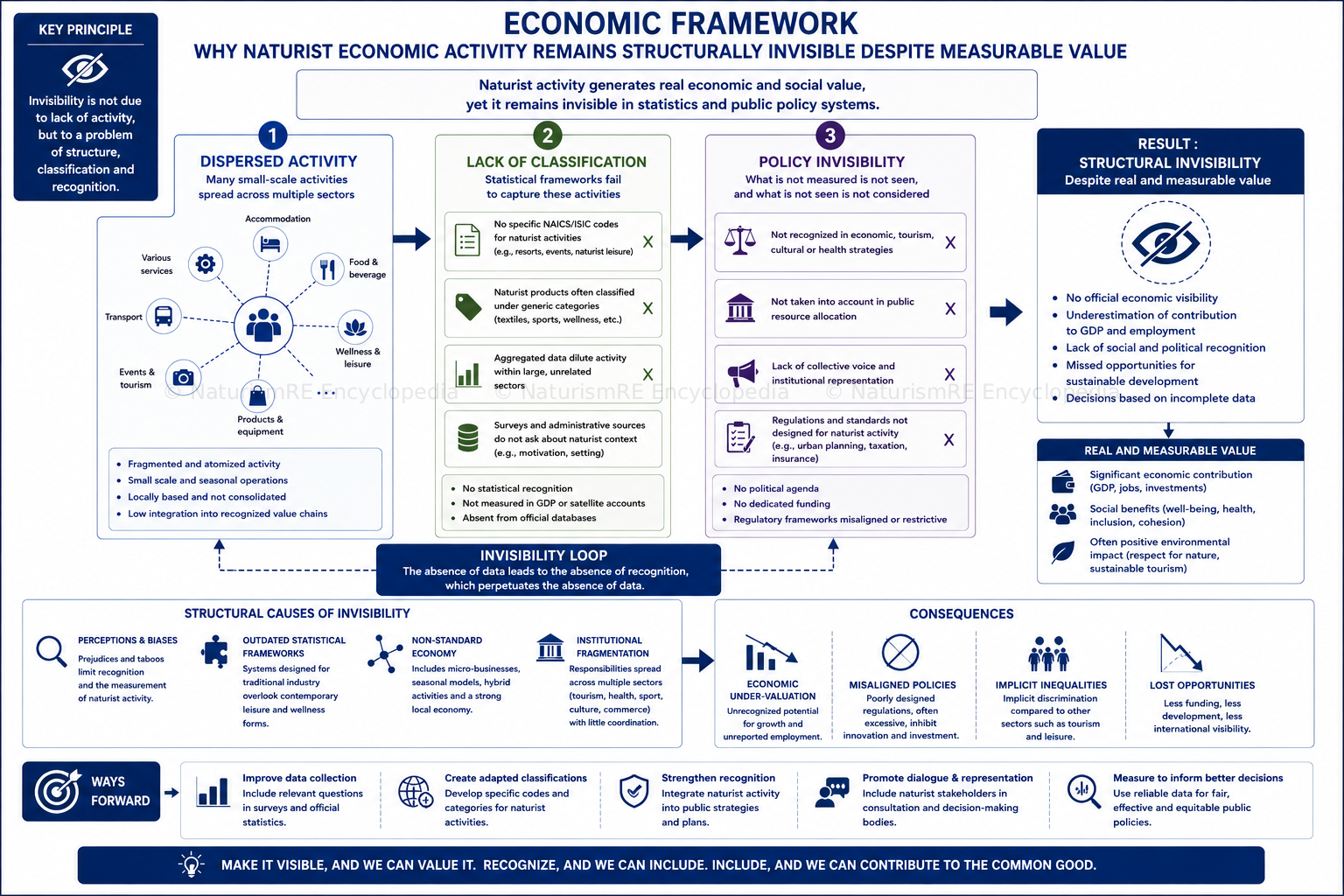
Available data indicates that naturist participation is materially present but systematically underreported due to the prevalence of informal participation.
Across multiple regions, engagement in clothing-optional activity represents a non-negligible minority of adult populations, while formal membership accounts for only a small proportion of total participation.
This creates a consistent structural condition in which economic activity exceeds what formal systems are able to capture.
Precise global valuation is not attempted due to variability in data, inconsistency in measurement, and the distributed nature of participation.
8.8 Infrastructure and Land Use Dependencies
Economic viability depends on specific spatial and regulatory conditions, including controlled access or natural privacy, clearly defined boundaries, sanitation and safety infrastructure, and the availability of accommodation and supporting services.
Land use considerations include zoning compliance, environmental impact, proximity to population centres, and local acceptance.
These requirements limit unstructured expansion and increase dependency on planning systems.
8.9 Investment Logic and Economic Feasibility
Investment decisions are shaped by a balance between identifiable drivers and structural constraints.
Drivers include repeat participation patterns, niche market differentiation, and community-based retention. Constraints include regulatory uncertainty, reputational sensitivity, land and infrastructure requirements, and dependence on social acceptance.
Successful investment typically requires defined governance systems, legal compliance, and controlled positioning within the broader economic environment.
8.10 Risk and Liability Environment
Naturist economic systems operate within a defined risk profile that includes public liability exposure, safeguarding requirements, compliance obligations, and reputational sensitivity.
Operators must demonstrate behavioural control, enforceable rules, and participant awareness. These factors directly influence insurance viability, regulatory approval, and long-term operational stability.
8.11 Social Perception as a Primary Economic Variable
Social perception is a determining factor in economic viability.
Where naturism is understood as non-sexual, integrated within policy frameworks, and socially recognised, economic activity is more likely to expand. Where it is misinterpreted, stigmatised, or politically sensitive, development becomes constrained.
Economic outcomes are therefore directly linked to perception as well as to demand.
8.12 Scalability Constraints
Naturist economic systems are structurally constrained by the requirement for controlled environments, dependence on legal and social tolerance, limited availability of suitable locations, and sensitivity to changes in perception.
When conditions are favourable, systems demonstrate stability, repeat demand, and resilience within niche markets. However, scalability remains conditional rather than unlimited.
8.13 Policy and Planning Interaction
Naturist activity intersects with tourism policy, land use planning, environmental regulation, and public space management.
Policy decisions influence the availability of designated environments, the feasibility of investment, and the clarity of regulatory frameworks. In turn, naturist systems may contribute to economic diversification, tourism segmentation, and infrastructure utilisation.
8.14 Economic Interpretation Framework
Within this encyclopedia, naturism is interpreted as a context-dependent economic system embedded within broader sectors and dependent on governance and structural conditions.
This framework avoids both overstatement of economic impact and dismissal of economic relevance, ensuring proportionate and defensible analysis.
8.15 Conclusion
Economic value in naturist systems does not arise from nudity itself. It emerges from structured environments, regulated participation, and defined behavioural frameworks.
Where these conditions are present, naturism is associated with identifiable demand patterns, repeat participation, and localised economic activity. At the same time, outcomes remain constrained by legal frameworks, social perception, infrastructure requirements, and governance quality.
This establishes a defining principle:
Naturism is neither economically insignificant nor universally scalable. It is a context-dependent economic system whose viability is determined by structure, regulation, and social alignment.
Understanding this ensures that economic analysis remains proportionate, defensible, and resistant to both exaggeration and dismissal, while providing a stable basis for policy evaluation, investment assessment, and system development.
Primary Supporting Articles
Why Economic Activity Does Not Translate Into Structural Power
Why Economic Dispersion Prevents Infrastructure Formation
Why Infrastructure Investment Requires Structural Certainty
Why Investment Does Not Flow Into Naturist Systems Despite Demonstrable Demand
Why Naturism Is Economically Invisible Despite Measurable Impact
Secondary Supporting Articles
Why Naturism Is Economically Misclassified in Public Systems
Why Naturism Lacks Economic Identity as a Distinct Sector
Why Revenue Generation Does Not Translate Into System Development
Why Revenue Leakage Prevents System Growth
Why the Naturist Economy Is Larger Than It Appears (and Why It Matters)