

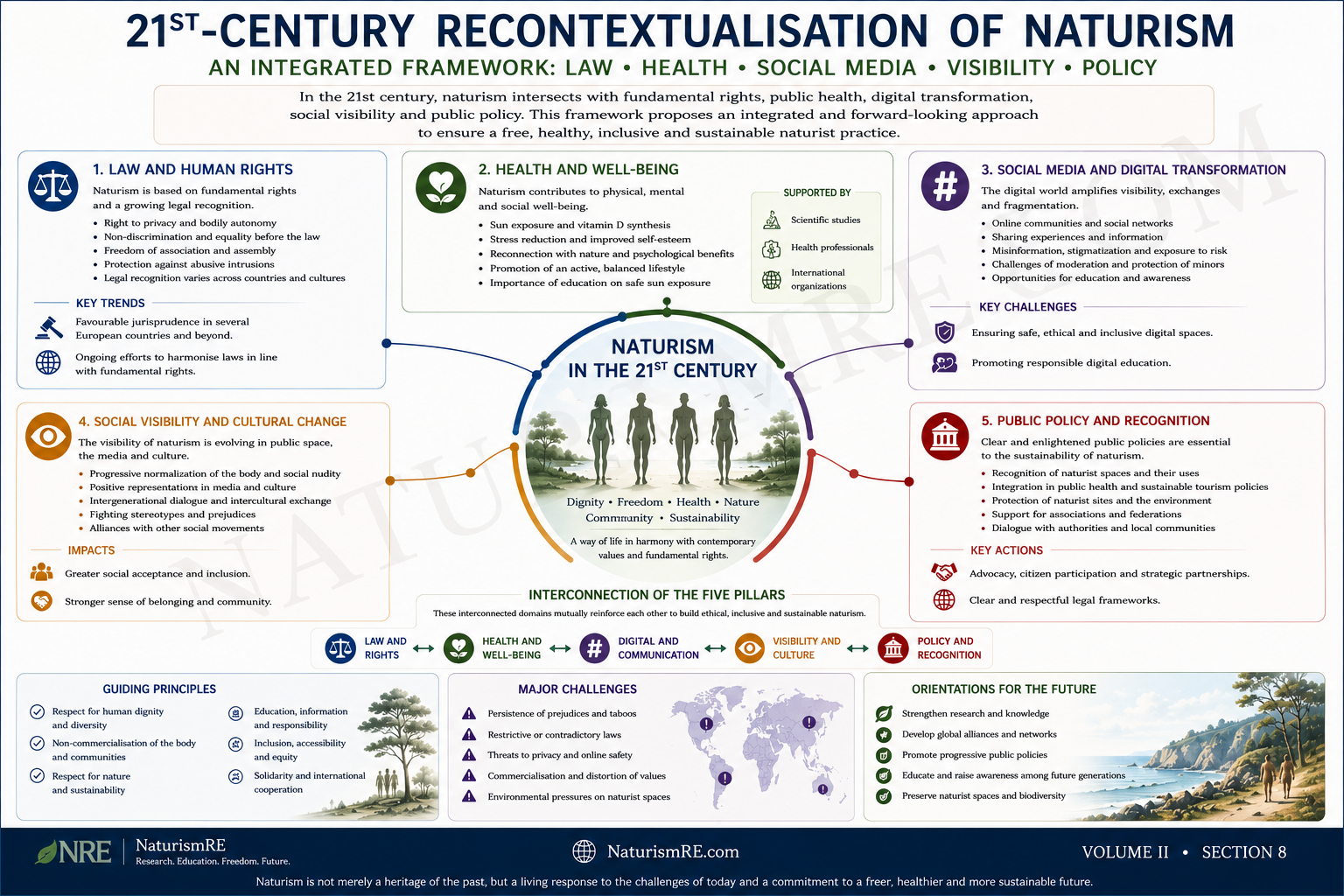
21st Century Recontextualisation: Legal, Health, and Digital System Transformation
Examining how digital connectivity, evolving legal systems, technological governance, and health-related discourse reshape the operational conditions of naturism in the twenty-first century.
Naturism persists through adaptation, but remains constrained by external systems that shape its visibility, interpretation, and viability.
8.1 Purpose
This section analyses the twenty-first century as a phase of system recontextualisation in which naturism evolves within conditions shaped by global digital connectivity, shifting legal interpretation, and emerging health-related discourse.
Its purpose is to define how the structural conditions of participation have changed, to identify new constraints introduced by technological and regulatory systems, and to establish the operational implications of these transformations.
This section does not redefine naturism. It examines how external systems reshape the conditions under which it operates.
8.2 Transition from Localised Practice to Networked Systems
A defining characteristic of the twenty-first century is the transition from geographically isolated participation to networked visibility and distributed interaction.
Digital technologies enable global communication between participants, rapid dissemination of information, and decentralised coordination of activities. This reduces dependence on physical proximity and reliance on localised knowledge.
However, it does not eliminate the need for physical environments or the requirement for contextual clarity.
This establishes a dual structure:
Naturism operates simultaneously as a physical practice and as a networked information system.
8.3 Digital Participation and Decentralisation
Digital platforms have altered participation dynamics by lowering entry barriers, enabling discovery without institutional mediation, and facilitating informal organisation.
Online Communities
Participation increasingly occurs through digital discussion spaces and distributed communication networks.
Event Coordination
Activities can be organised rapidly through decentralised digital communication systems.
Reduced Institutional Mediation
Entry pathways increasingly bypass traditional organisations and formal membership structures.
Distributed Engagement
Participation becomes more flexible, decentralised, and geographically dispersed.
However, digital engagement does not constitute practice. Physical environments remain essential for actual participation.
This creates a structural distinction between engagement as a digital condition and participation as a physical activity.
8.4 Platform Regulation and Structural Constraint
Digital expansion introduces non-negotiable platform constraints.
Most platforms apply policies that restrict or remove nudity-related content and do not consistently distinguish between sexual content, non-sexual nudity, and contextual or educational material.
This results in suppression of non-sexual naturist content, reduced visibility of structured environments, and misclassification of intent.
This creates a systemic tension:
Naturism becomes globally visible while simultaneously constrained by digital governance systems.
These constraints are structural rather than temporary.
8.5 Legal Recontextualisation in Contemporary Systems
Legal frameworks in the twenty-first century demonstrate gradual evolution toward increased reliance on intent-based interpretation, greater recognition of contextual differentiation, and refinement of distinctions between nudity and indecency.
In some jurisdictions, this results in expanded tolerance within defined environments, increased use of designated zones, and reduced reliance on blanket prohibition.
However, variability remains significant, and outcomes continue to depend on jurisdiction, cultural context, and enforcement practices.
This confirms that legal systems evolve but do not converge into uniform treatment.
8.6 Emergence of Health-Related Discourse
The twenty-first century introduces increased empirical attention to naturist contexts, particularly in relation to body image, self-perception, and social interaction.
Observational and research-based discussions suggest that, within structured and non-sexual environments, participation may be associated with shifts in body perception, reduced emphasis on appearance-based evaluation, and increased comfort with physical diversity.
However, these observations remain context-dependent, variable across individuals, and not universally generalisable.
This represents a transition from anecdotal claims to evidence-informed but limited analysis. Deterministic health outcomes cannot be assumed.
8.7 Evolution of Participation Patterns
Participation patterns continue to shift and are characterised by growth of informal and decentralised engagement alongside the continued presence of structured environments.
Observed trends include increased participation through non-institutional pathways, diversification of engagement types, and coexistence of traditional and emerging models.
This reflects a transition from membership-based participation toward experience-based and flexible engagement.
8.8 Social Perception and Non-Linear Acceptance
Social perception remains a central constraint.
The twenty-first century demonstrates increased exposure to diverse representations of the body alongside the continued presence of stigma and misinterpretation.
Acceptance does not progress uniformly. It varies across geography, culture, generational groups, and levels of exposure.
This creates a non-linear dynamic in which increased visibility does not automatically result in increased acceptance.
8.9 Economic Integration and System Positioning
Naturism continues to integrate into economic systems, particularly through tourism, specialised recreational environments, and niche service sectors.
This integration is characterised by context-dependent operation, reliance on regulatory acceptance, and concentration within specific geographic regions.
Economic activity remains unevenly distributed, structurally constrained, and dependent on legal and social conditions.
8.10 Privacy, Surveillance, and Risk Transformation
Technological advancement introduces new participation risks.
These include widespread recording capability, unauthorised image capture, and digital distribution beyond the original context.
These factors reduce control over exposure, increase perceived risk for participants, and influence behaviour within environments.
This represents a structural shift from physical privacy to persistent digital exposure risk.
Structured environments must increasingly account for this variable.
8.11 Institutional Adaptation and Structural Tension
Traditional naturist organisations are adapting through digital communication, expanded outreach, and modified participation models.
However, they face structural challenges including reduced participant dependence, competition from decentralised engagement, and pressure to evolve operational frameworks.
This creates an ongoing tension between institutional structure and decentralised participation.
Neither replaces the other. Both operate simultaneously within the system.
8.12 Analytical Implications
The twenty-first century introduces several defining system conditions.
Digital Connectivity
Naturism operates within globally connected but digitally constrained communication systems.
Decentralised Participation
Participation increasingly shifts toward non-institutional and flexible engagement models.
Context-Based Legal Evolution
Legal frameworks evolve incrementally toward contextual interpretation while remaining fragmented.
Persistent Structural Dependency
Naturism continues to depend on governance, behavioural clarity, and controlled environments despite technological change.
These developments redefine naturism as a networked, adaptive system operating within overlapping technological, legal, and social constraints.
Despite these changes, core structural dependencies remain unchanged. Naturism continues to depend on controlled environments, behavioural clarity, and governance.
8.13 Conclusion
The twenty-first century does not fundamentally redefine naturism. It recontextualises the conditions under which it operates.
Technological, legal, and social developments alter how participation is accessed, how environments are perceived, and how systems are regulated, but they do not alter core structural principles.
Naturism remains context-dependent, behaviourally defined, and reliant on structured environments.
What changes is the system within which it operates: a globally connected, digitally mediated, and increasingly regulated environment.
This leads to a defining principle:
Naturism persists through adaptation, but remains constrained by external systems that shape its visibility, interpretation, and viability.
The twenty-first century therefore confirms naturism as a resilient and adaptive system capable of evolving within changing external conditions while maintaining its fundamental operational structure.
Primary Supporting Articles
From Fragmentation to Recontextualisation, Naturism in the 21st Century
From Visibility to Measurement, Data-Driven Reframing of Naturism in the 21st Century
Hybrid Systems, Digital and Physical Integration