

Health Framework: Environmental Exposure, Behavioural Context, and Evidence Boundaries
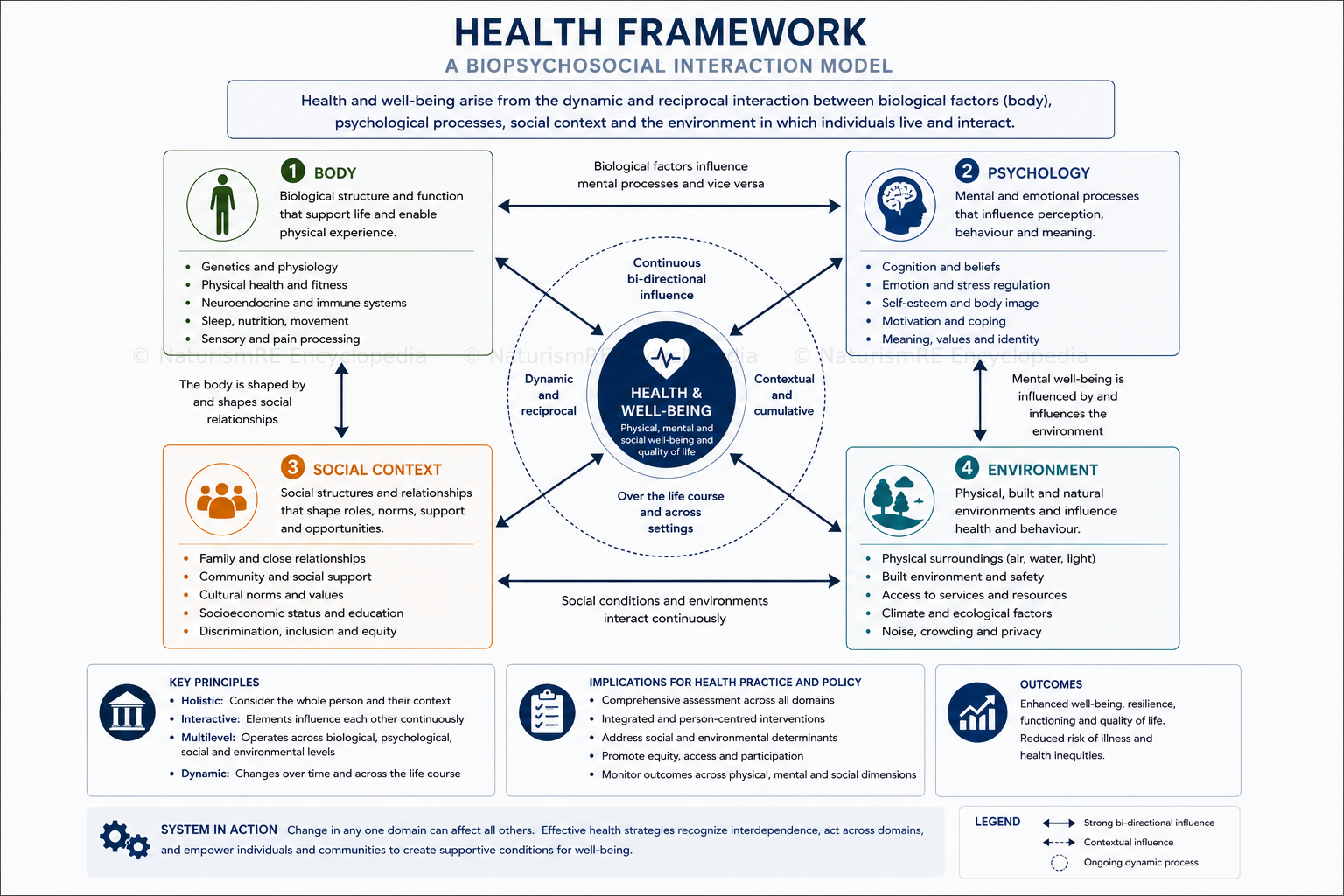
Establishing the analytical framework through which nudity, nudism, and naturism are evaluated across physical, psychological, behavioural, and environmental health systems.
Nudity does not produce health outcomes independently. It operates within systems that may influence outcomes under specific conditions.
6.1 Purpose
This section defines the health-related analytical framework through which nudity, nudism, and naturism are evaluated.
Its purpose is to establish how nudity interacts with physical, psychological, and social health variables, to define evidentiary limits and interpretative constraints, and to ensure that all health-related conclusions remain evidence-informed, non-prescriptive, and legally and clinically defensible.
This section does not promote or prescribe health outcomes. It positions nudity as a context-dependent variable within broader health systems.
6.2 Analytical Position
Within this encyclopedia, nudity is treated as an environmental and behavioural variable rather than as a standalone therapeutic intervention.
Observed outcomes are interpreted in relation to environmental conditions, including sunlight, temperature, airflow, and surfaces, as well as behavioural context such as duration, activity, and social setting, and individual variability including health status and sensitivity.
This approach prevents over-attribution of effects to nudity and avoids misclassification of causation.
6.3 Evidence Framework and Interpretation Limits
Health-related claims are evaluated through a structured hierarchy of evidence, including systematic reviews, meta-analyses, controlled experimental studies, longitudinal observational research, and structured survey data.
Lower-tier evidence may provide contextual insight but is not treated as definitive.
A strict distinction is maintained between correlation and causation. Where causation is not established, conclusions are explicitly qualified to reflect association rather than demonstrated effect.
This ensures that all interpretations remain proportionate to the available evidence.
6.4 Physical Health Variables
Environmental Exposure
Nudity increases exposure to sunlight, airflow, temperature, and surfaces. Outcomes remain dose-dependent and context-specific.
Thermoregulation
The absence of clothing alters heat exchange between the body and the environment, producing context-dependent physiological responses.
Hygiene and Skin Interaction
Observed outcomes depend primarily on hygiene practices, environmental management, and exposure conditions rather than nudity itself.
6.4.1 Environmental Exposure
Nudity increases exposure to environmental factors including sunlight, ambient temperature, airflow, and contact with surfaces.
These exposures may produce adaptive physiological responses or present risks depending on conditions. For example, controlled exposure to sunlight may support vitamin D synthesis, while excessive exposure increases the risk of skin damage.
Outcomes are therefore dose-dependent and context-specific rather than inherent to nudity.
Primary Supporting Articles
Health as Environmental Alignment, Reframing Naturism Beyond Lifestyle
Health as Contextual Interaction, The Biopsychosocial Basis of Naturist Environments
Interpretation, Variability, and Structural Stabilisation in Health Outcomes