

Social Acceptance, Perception Dynamics, and the Normalisation Threshold
Examining how social perception, familiarity, demographic variability, and structured exposure influence the long-term acceptance and operational viability of naturist systems.
The normalisation of naturism is not achieved through visibility alone, but through the systematic reduction of ambiguity, perceived risk, and social friction across repeated and structured interactions.
5.1 Social Acceptance as a System Constraint
The expansion of structured naturist systems is not determined solely by governance, risk, or economic capacity. It is fundamentally constrained by social acceptance, which operates as a dynamic and non-linear variable.
Social acceptance does not function as a binary condition of approval or rejection. It exists along a continuum shaped by cultural norms, historical exposure, media narratives, personal experience, and perceived risk or discomfort.
As a result, naturism encounters variable acceptance thresholds rather than uniform support or resistance. These thresholds differ across jurisdictions, demographic groups, and situational contexts.
Structured system development must therefore align not with assumed acceptance, but with observable tolerance levels within specific environments.
5.2 Perception Formation and Interpretative Frameworks
Public perception of naturism is constructed through interpretative frameworks applied when individuals encounter nudity.
These frameworks are influenced by social conditioning regarding the body, associations between nudity and sexuality, norms of privacy and modesty, and media-driven cultural narratives.
Consequently, identical environments may be interpreted differently depending on the observer’s internal framework.
This introduces several operational implications. Intent alone does not guarantee interpretation. Behavioural clarity reduces ambiguity but does not eliminate it. Visual context plays a dominant role in shaping immediate perception.
Structured systems must therefore prioritise interpretability, ensuring that environments can be understood without reliance on extended explanation.
5.3 The Role of Familiarity and Exposure
Across multiple social contexts, familiarity reduces perceived risk and discomfort.
In naturism, limited exposure contributes to heightened sensitivity, while repeated, non-negative exposure can produce gradual shifts in perception.
However, exposure alone is insufficient. The quality and structure of exposure are critical.
Predictability
Structured and predictable environments reduce uncertainty and facilitate interpretative stability.
Behavioural Consistency
Stable and non-disruptive conduct reinforces non-sexual interpretation over time.
Defined Purpose
Alignment with recreation, health, or wellbeing increases contextual legitimacy.
Controlled Exposure
Structured exposure reduces ambiguity while limiting conditions likely to reinforce negative perception.
Unstructured or ambiguous exposure may reinforce negative perception rather than reduce it.
5.4 The Normalisation Threshold Concept
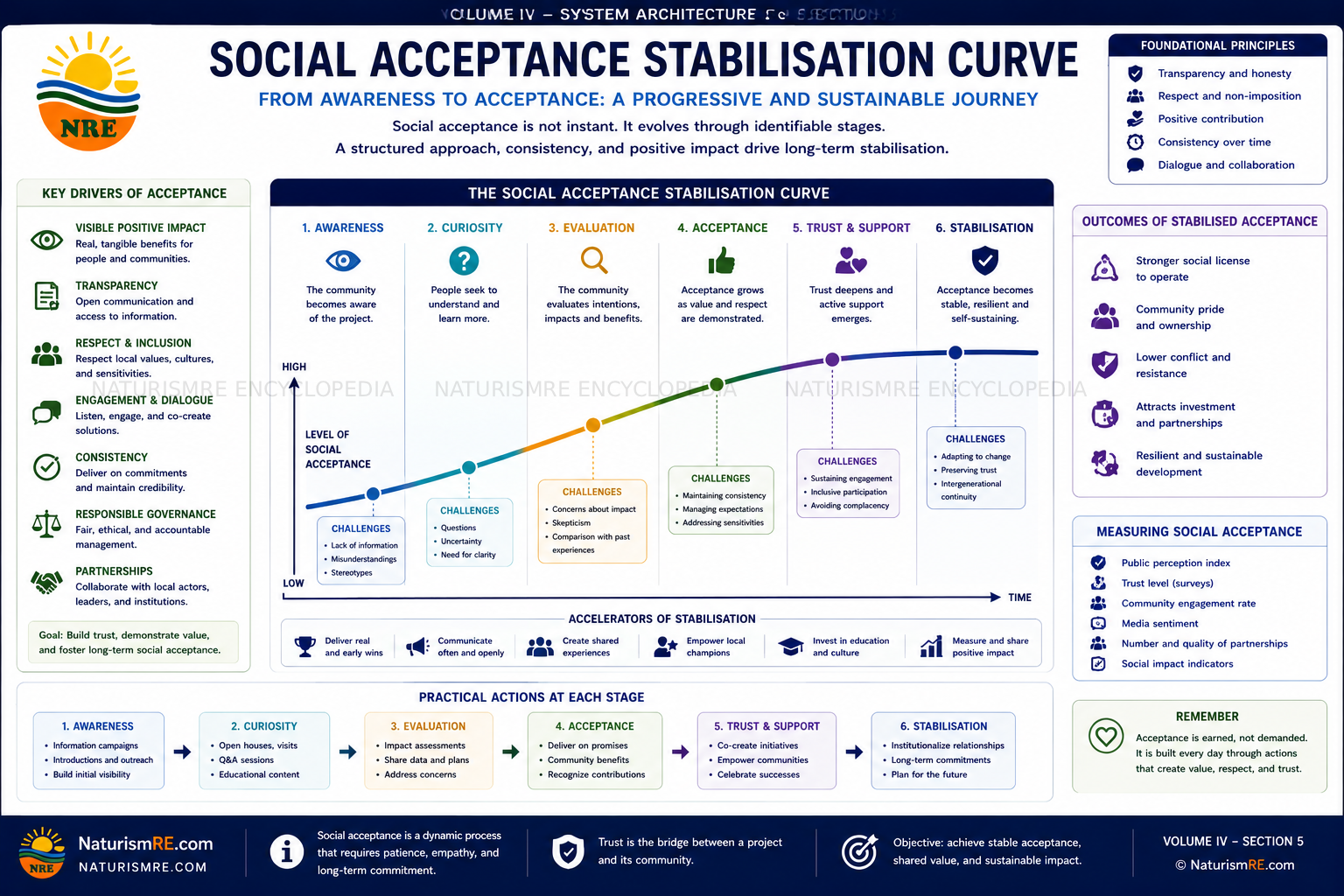
The concept of a normalisation threshold provides a framework for understanding how social acceptance evolves.
The normalisation threshold can be defined as the point at which an activity transitions from being perceived as exceptional or controversial to being regarded as situationally acceptable within defined contexts.
For naturism, this threshold is not achieved through advocacy alone, increased participation, or visibility without structure.
It is reached through the consistent presence of environments that demonstrate clear purpose, behavioural integrity, low incident frequency, and stable interaction with the public.
Until this threshold is approached, naturist systems remain subject to heightened scrutiny, reduced tolerance for deviation, and increased susceptibility to reputational impact.
System development must therefore focus on gradual threshold progression rather than immediate normalisation.
5.5 Demographic Variability in Acceptance
Acceptance of naturism varies significantly across demographic dimensions, including age, gender perspectives, cultural and religious background, and urban or rural context.
These variations influence willingness to participate, tolerance for public or semi-public environments, and interpretation of intent and behaviour.
Some demographics prioritise safety and predictability, while others emphasise autonomy and personal freedom. Certain groups may exhibit heightened sensitivity to perceived boundary violations.
Structured systems must account for this variability by designing environments that minimise exclusionary perception, ensure voluntary participation, and avoid assumptions of uniform acceptance.
Failure to account for demographic variability increases the risk of misalignment between system design and public response.
5.6 The Influence of Media and Narrative Reinforcement
Media plays a significant role in shaping and reinforcing perception.
Observed dynamics include amplification of atypical or controversial events, simplification of complex behavioural contexts, and limited representation of structured and well-governed environments.
This results in a perception landscape in which negative or ambiguous narratives are disproportionately visible, while neutral or positive experiences receive limited attention.
Structured naturist systems must therefore operate with the understanding that external narratives may not reflect operational reality and that perception is influenced by indirect exposure as much as direct experience.
Although media cannot be controlled, system design can reduce vulnerability to misrepresentation by ensuring consistency of behaviour, clarity of purpose, and the absence of elements that can be easily decontextualised.
5.7 Social Friction and Boundary Management
The introduction of naturist environments into broader societal contexts inevitably produces social friction.
This friction arises from differing expectations of public space usage, variability in comfort levels, and perceived intrusion into established norms.
Effective systems manage this friction through boundary definition, including spatial separation where necessary, clear communication of purpose, and respect for non-participating individuals.
Boundary management does not imply exclusion. It provides a mechanism for coexistence between differing preferences.
Environments that fail to manage boundaries increase the likelihood of complaints, escalation to regulatory intervention, and reinforcement of negative perception.
5.8 Analytical Conclusion
Social acceptance is a determining variable in the evolution of structured naturist systems.
Acceptance operates on a continuum and varies across contexts and demographics. Perception is shaped by interpretative frameworks that extend beyond intent. Familiarity and controlled exposure contribute to gradual shifts in perception. The normalisation threshold is achieved through consistent and well-defined environments. Media narratives influence perception independently of operational reality. Social friction must be managed through clear boundaries and communication.
The viability of naturist systems depends on their ability to align with existing tolerance levels, facilitate gradual progression toward broader acceptance, and maintain environments that are consistently interpretable and low-risk.
Naturism, in this context, does not advance through confrontation with societal norms, but through structured integration within them.
This establishes a defining principle:
The normalisation of naturism is not achieved through visibility alone, but through the systematic reduction of ambiguity, perceived risk, and social friction across repeated and structured interactions.
Primary Supporting Articles
The Normalisation Threshold, When Acceptance Actually Shifts
Why Behaviour Remains Interpreted as Exception Rather Than Norm
From Representation to Reality, Why Most Naturists Are Invisible to the System
Why Visibility Without Structure Reinforces the Problem
Why Context Fragmentation Prevents Consistent Interpretation