

Global Data Systems, Measurement Integration, and Evidence Infrastructure
Examining how integrated data infrastructures transform fragmented observations into coordinated, evidence-based system intelligence across global naturist environments.
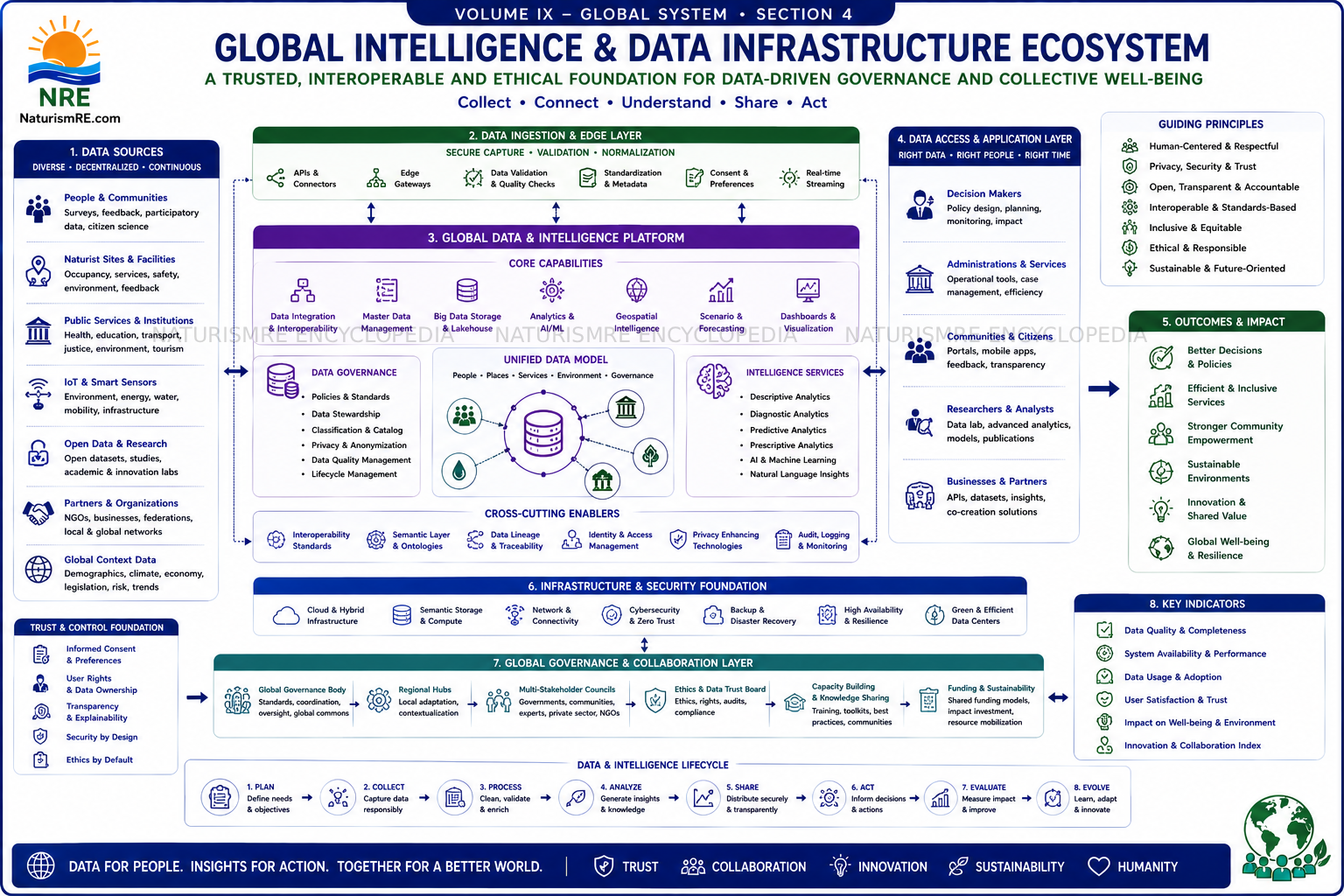
The development of a coherent global naturist system depends on the creation of integrated, standardised, and ethically governed data infrastructures that transform distributed observations into reliable, context-aware evidence capable of supporting continuous improvement and institutional engagement.
4.1 From Isolated Data to System-Level Intelligence
Previous volumes established that measurement is essential for credibility, that data remains fragmented across environments, and that evidence is often localised and non-comparable.
At a global level, the primary challenge is not scarcity of data, but fragmentation.
Future system development requires a transition toward integrated data systems in which information is aggregated, standardised, and interpreted across environments.
This transformation converts data from isolated observations into system-level intelligence capable of informing policy, guiding scaling decisions, and supporting long-term system evolution.
4.2 Architecture of a Global Data System
A global data system requires a structured architecture composed of interdependent layers.
Standardised Data Inputs
Consistent measurement criteria and aligned indicator definitions enable comparable datasets across environments.
Distributed Data Collection
Local environments gather operational information within their specific contextual conditions.
Aggregation and Integration Layer
Consolidation of data across environments enables identification of large-scale trends and recurring patterns.
Analytical Framework
Data interpretation occurs within context-aware models that distinguish correlation from causation.
Feedback Mechanism
System insights are returned to operational environments to support continuous refinement and adaptation.
This architecture enables scalable, adaptive, and coordinated system learning.
4.3 Standardisation of Measurement Across Systems
Standardisation is essential to ensure comparability, consistency, and reliability of data across environments.
This includes shared definitions of behavioural indicators, consistent categorisation of environmental conditions, and uniform reporting of incidents and deviations.
Standardisation does not eliminate contextual variation. It ensures that variation remains measurable and interpretable rather than arbitrary.
4.4 Data Integrity, Quality Control, and Bias Management
Global data systems must address challenges related to data quality and bias.
Risks include variability in collection methods, selection bias, inconsistent application of measurement protocols, and incomplete datasets.
Mitigation requires transparent methodology, clear documentation of limitations, and periodic validation of data collection processes.
Maintaining data integrity is critical for credibility, institutional engagement, and policy relevance.
4.5 Privacy, Ethics, and Data Governance
Data systems must operate within ethical and legal boundaries, particularly regarding participant privacy, data protection, and consent.
Key principles include minimisation of personal data collection, anonymisation where applicable, and transparency in data usage.
Ethical data governance supports participant trust, ensures regulatory compliance, and contributes to the long-term sustainability of data systems.
Failure to address these considerations may reduce participation, increase legal exposure, and undermine system legitimacy.
4.6 Evidence Construction and Policy Relevance
Data becomes evidence when it demonstrates consistent patterns, is replicable across environments, and aligns with recognised analytical frameworks.
Global data systems enable identification of recurring trends, evaluation of system performance, and informed engagement in policy discussions.
Evidence must remain proportionate to available data, context-aware, and free from overgeneralisation.
This ensures that conclusions remain defensible and credible.
4.7 Data-Driven System Evolution
Integrated data systems support continuous refinement of operational models, identification of effective practices, and early detection of emerging risks.
Data-driven evolution allows naturist systems to adapt proactively, improve efficiency, and align with changing environmental and regulatory conditions.
This transforms systems from reactive structures into adaptive, learning-based frameworks.
4.8 Analytical Conclusion
Global data systems are essential for transitioning naturist practice from fragmented observation to coordinated, evidence-based operation.
Data fragmentation limits scalability and institutional recognition. Integrated data architecture enables system-level intelligence. Standardisation ensures comparability and interpretability. Data integrity and bias management are essential for credibility. Privacy and ethical governance underpin sustainability. Evidence construction supports policy engagement. Data-driven adaptation enables continuous system evolution.
Naturist systems that leverage integrated data frameworks move beyond anecdotal evidence, support structured analysis, and enable informed decision-making at both local and global levels.
This establishes a defining principle for Volume IX:
The development of a coherent global naturist system depends on the creation of integrated, standardised, and ethically governed data infrastructures that transform distributed observations into reliable, context-aware evidence capable of supporting continuous improvement and institutional engagement.
Primary Supporting Articles
Global Data Infrastructure for Behavioural Systems
Data Integrity and Validation Logic in Contextualised Naturist Measurement Systems