

Historical Foundations: Contextual Variability and the Emergence of Bodily Regulation
Examining the historical conditions through which nudity evolved from contextual human exposure into structured systems of interpretation, regulation, and governance.
Nudity has no universal meaning outside the system that interprets it.
2.1 Purpose
This section establishes the historical foundation necessary to understand nudism and naturism as structured developments rather than isolated phenomena.
Its function is to identify how human societies have interpreted the unclothed body across time, to demonstrate the absence of universal norms governing nudity, and to define the historical conditions under which modern regulatory, social, and conceptual systems emerged.
This section does not attempt to provide a complete chronological history. Instead, it isolates the structural conditions that allow modern systems of interpretation, classification, and governance to form.
2.2 Historical Variability and Non-Uniform Interpretation
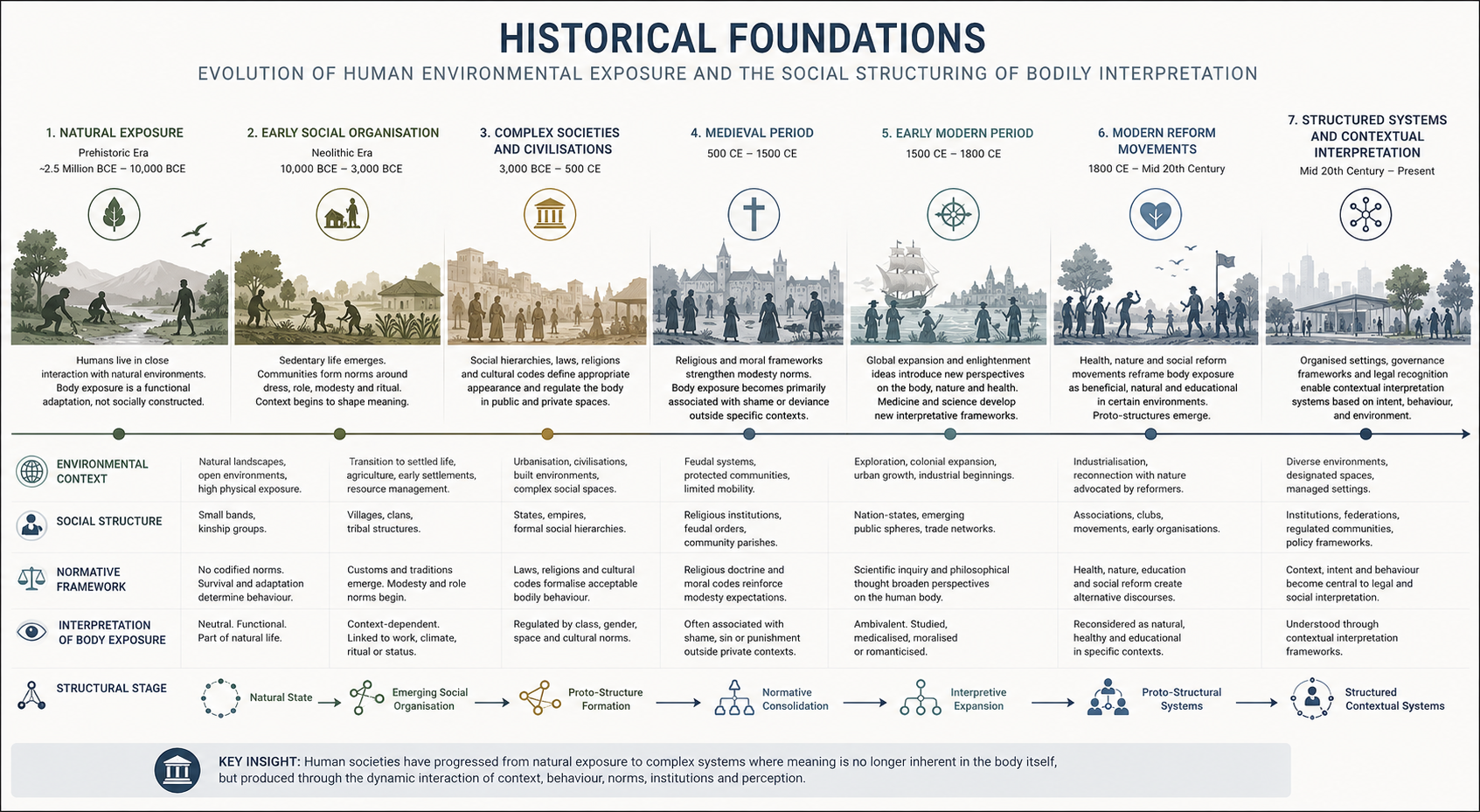
Across pre-modern and early historical societies, nudity did not carry a fixed or universal meaning. The unclothed body appeared in everyday, symbolic, and functional contexts without consistent moral classification.
Archaeological and anthropological evidence from regions such as Neolithic Anatolia, Jōmon-period Japan, the Indus Valley, and prehistoric Saharan cultures demonstrates that bodily exposure could exist without systematic association with shame, disorder, or deviance. Interpretation was contingent upon environmental conditions, cultural systems, and social organisation.
This establishes a foundational principle that remains valid across all subsequent analysis:
Nudity has no universal meaning outside the system that interprets it.
2.3 Functional and Symbolic Roles of Nudity
Historically, nudity operated within identifiable frameworks rather than as an unstructured condition. Two primary modes can be distinguished.
In functional contexts, bodily exposure was determined by environmental and material conditions. Climate, labour requirements, mobility, and resource availability shaped the degree and form of clothing. In such settings, clothing was often partial, situational, and non-essential. Nudity functioned as a practical condition rather than a symbolic one.
In symbolic contexts, nudity was governed by cultural rules and embedded within ritual or ceremonial systems. It could represent transformation, purity, vulnerability, or status transition. Meaning was not derived from exposure itself, but from the framework in which exposure occurred.
This duality demonstrates that nudity has historically been structured within systems of meaning. It was neither random nor inherently transgressive.
2.4 Early Modern Reclassification of the Body
Between approximately 1500 and 1800, European societies introduced a structural transformation in the interpretation of the body. The shift was not from acceptance to prohibition, but from contextual interpretation to regulated classification.
During this period, nudity became subject to moral evaluation. Bodily exposure was increasingly controlled, and distinctions between public and private space intensified. However, this did not produce uniform restriction. Instead, it created a dual system.
Nudity remained permitted within controlled domains such as art and medicine, where its meaning could be justified and contained. At the same time, it was restricted within everyday social environments, where context was less controlled.
This distinction forms the structural basis of modern legal and social classification systems.
2.5 Institutional and Cultural Reframing
The early modern reclassification of the body was reinforced by institutional systems, including religious doctrine, emerging scientific frameworks, and artistic traditions.
These systems did not eliminate nudity. They redefined its conditions of legitimacy. Nudity became acceptable when embedded within recognised frameworks and restricted when it appeared outside them.
This produced a persistent structural condition:
Nudity is acceptable when justified, but restricted when uncontrolled.
This condition continues to influence legal interpretation and social perception.
2.6 Colonial Expansion and Norm Projection
European expansion introduced encounters with societies in which nudity remained contextually integrated. These practices were interpreted through European classificatory frameworks rather than described within their own systems of meaning.
As a result, non-European forms of nudity were often labelled as uncivilised, and clothing became associated with order, hierarchy, and social regulation. This process did not reflect objective observation. It reflected the projection of an existing interpretative system onto different contexts.
Through this mechanism, classification-based models of bodily regulation were extended beyond their original cultural environments and embedded within global systems of interpretation.
2.7 Reform Movements and Reopening of Bodily Interpretation
By the nineteenth century, reform movements began to challenge earlier classifications. These movements emerged in response to industrialisation and its effects on health, environment, and social organisation.
They criticised industrial living conditions, promoted environmental exposure, and reintroduced the body as a subject of functional and physiological analysis. Within this framework, reduced clothing was explored as part of broader health systems, and bodily exposure was reconsidered under controlled conditions.
This did not normalise nudity in general society. It reintroduced it as a variable within structured systems of health, environment, and behaviour.
2.8 Transition Toward Organised Systems
By the late nineteenth and early twentieth centuries, multiple elements converged to enable system formation. These included health-based justification, philosophical reinterpretation, experimental validation of controlled environments, and the emergence of behavioural norms.
Together, these elements allowed nudity to transition from dispersed practice to organised participation. Institutional structures began to form, and defined environments were established to stabilise interpretation.
This marks a decisive structural shift:
from dispersed practice to system formation.
2.9 Structural Significance for Modern Naturism
The historical developments outlined in this section establish several conditions that remain central to modern naturism.
Nudity is context-dependent rather than inherently moral or immoral. Meaning is assigned through social, legal, and cultural systems rather than through the body itself. Classification emerges through institutional control, and structured environments enable interpretative stability.
Modern naturism must therefore be understood not as an anomaly, but as a structured continuation of historical processes of classification and regulation.
2.10 Analytical Implications
The historical framework provides a set of baseline conditions that apply across all subsequent volumes.
No universal norm governing nudity exists. Interpretation is system-dependent rather than inherent. Regulation emerges through classification rather than elimination. Acceptability is determined by context, purpose, and governance. Modern systems reflect historical evolution rather than deviation.
These principles ensure that historical analysis remains structurally aligned with legal, social, and policy interpretation.
2.11 Conclusion
The historical development of attitudes toward nudity demonstrates that the unclothed body has never held a single, fixed meaning. Its interpretation has always depended on the systems within which it is encountered.
Over time, this produced a transition from contextual variability to structured classification and regulation. Modern naturism emerges from this transformation. It does not reject historical systems. It responds to them by constructing controlled environments in which interpretation can be stabilised.
This leads to a defining principle:
Nudity becomes socially and legally meaningful only when interpreted within structured systems of context, governance, and behaviour.
Understanding this historical foundation prevents the projection of modern assumptions onto past societies, explains the emergence of contemporary legal and social frameworks, and provides continuity across all volumes of this encyclopedia.
Primary Supporting Articles
From Necessity to Structure, Early Human Exposure and the Origins of Naturist Behaviour
From Cultural Practice to Proto-Structure, The Early Organisation of Bodily Exposure
From Proto-Structure to Reform Logic, The Pre-Modern Transition Toward Naturist Systems
From Early Modern Reorientation to Reform Emergence, The Structural Origins of Modern Naturism
Secondary Supporting Articles
Industrialisation, Urbanisation, and the Biological Mismatch That Preceded Naturism