

Comparative Legal Systems: Structural Models of Nudity Regulation
Examining the principal legal architectures through which jurisdictions regulate nudity, classify exposure, and interpret behavioural and contextual conditions.
No legal system regulates nudity in isolation. All systems regulate the conditions under which nudity becomes legally relevant.
2.1 Purpose
This section establishes a comparative analytical framework for understanding how legal systems regulate nudity across jurisdictions.
Its purpose is to define the principal regulatory models used globally, to identify the structural logic underlying each model, and to provide a consistent system-level framework for analysing legal approaches.
This section does not catalogue individual countries. It defines abstract regulatory architectures that can be applied across diverse legal and cultural environments.
2.2 Basis for Comparative Framework
Despite variation in statutory language, legal systems addressing nudity exhibit recurring structural patterns.
These patterns arise from the need to regulate public behaviour, social interaction, and perceived harm, disruption, or offence. As a result, different jurisdictions often converge toward functionally similar models, even where terminology differs.
Comparative analysis can therefore be structured around four core variables: the scope of restriction, the role of intent, the degree of contextual interpretation, and the level of tolerance or recognition.
These variables define the regulatory architecture of each system.
2.3 Prohibition-Based Regulatory Model
In prohibition-based systems, nudity is broadly restricted across public contexts.
Broad Restriction
Statutory frameworks apply extensive restrictions with limited contextual differentiation.
Limited Contextual Flexibility
The presence of nudity itself may trigger legal consequences regardless of surrounding conditions.
Public Order Prioritisation
Regulatory systems prioritise predictability, moral standards, and reduction of interpretative ambiguity.
Discretionary Enforcement
Despite broad restriction, practical tolerance or selective enforcement may still occur in practice.
This model prioritises predictability and control over contextual flexibility.
2.4 Intent-Based Regulatory Model
Intent-based systems distinguish between nudity as a physical condition and conduct that gives rise to legal liability.
These systems are characterised by the requirement of demonstrable intent, such as intent to offend, distress, or arouse, differentiation between sexual and non-sexual exposure, and reliance on behavioural thresholds rather than appearance alone.
Under this model, nudity without qualifying intent may not constitute an offence. Legal outcomes depend on the interaction of intent, behaviour, and context.
This model aligns with interpretative legal systems in which meaning is derived from purpose rather than from the condition itself.
2.5 Context-Based Regulatory Model
Context-based systems prioritise situational evaluation in determining legality.
Key variables include location, environmental expectations, degree of involuntary exposure, and alignment with accepted norms.
Under this model, identical conduct may be lawful in one context and unlawful in another. Interpretation depends on whether exposure is expected, avoidable, and non-disruptive.
Context-based systems often operate in combination with intent-based frameworks, creating multi-factor models of evaluation.
2.6 Tolerance-Based Regulatory Model
Tolerance-based systems allow nudity within defined or socially accepted boundaries.
These systems are characterised by recognition of designated environments, acceptance of non-sexual nudity in controlled contexts, and reliance on practical enforcement rather than strict prohibition.
Under this model, nudity is not broadly prohibited. Legality is maintained through boundary definition rather than blanket permission.
Conditions typically include voluntary participation, absence of imposed exposure, and behavioural consistency.
This model prioritises controlled coexistence within established social and legal limits.
2.7 Hybrid Regulatory Systems
In practice, most jurisdictions operate as hybrid systems, combining elements of multiple regulatory models.
A single system may apply prohibition in general public spaces, use intent-based evaluation in legal proceedings, and allow tolerance-based exceptions in designated environments.
Hybrid systems reflect attempts to balance legal certainty, social expectations, and individual freedoms.
They also introduce variability in outcomes and complexity in interpretation.
2.8 Influence of Cultural Context
Legal models are influenced not only by structural design but also by cultural context.
Factors such as historical attitudes toward the body, religious or moral frameworks, and societal tolerance for ambiguity shape how laws are applied in practice.
As a result, similar legal structures may produce different outcomes, and enforcement practices may diverge significantly across regions.
This confirms that legal interpretation is shaped by cultural context as well as formal legal structure.
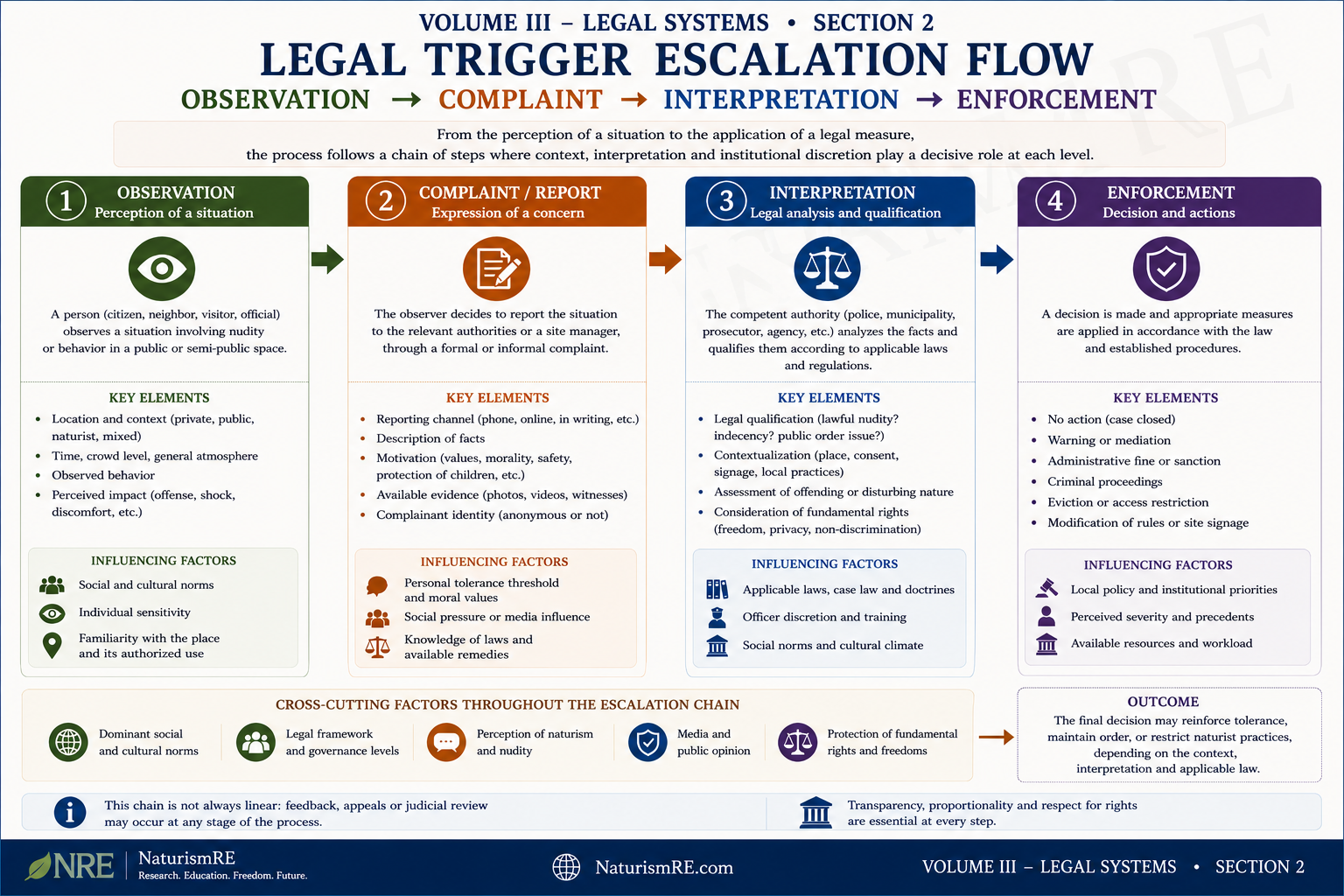
2.9 Enforcement as a Cross-Model Mechanism
Across all regulatory models, enforcement operates as a common operational layer.
Authorities typically assess the presence of complaints, perceived harm or disruption, the behaviour of the individual, and local enforcement priorities.
This produces a consistent structural condition:
Law defines the framework. Enforcement defines its application.
Discretion plays a significant role in borderline cases, context-dependent situations, and environments with unclear boundaries.
2.10 Stability and Predictability Across Models
Different regulatory models produce varying levels of stability.
Prohibition-based systems tend to offer high predictability but limited flexibility. Intent-based systems provide moderate predictability with outcomes dependent on contextual evaluation. Context-based and tolerance-based systems offer greater flexibility but lower predictability.
These differences affect individual risk exposure, system scalability, and policy design.
No model eliminates variability. Each manages it through different structural mechanisms.
2.11 Analytical Implications
The comparative framework establishes several system-level principles.
Structural Diversity
Legal treatment of nudity is diverse in application but comparable in functional structure.
Condition vs Conduct
Most systems distinguish between physical exposure and actionable behaviour.
Interpretative Variables
Intent and context remain central determinants of legal evaluation and enforcement.
Operational Enforcement
Enforcement functions as the decisive operational layer shaping practical outcomes.
These principles enable cross-jurisdictional analysis without reliance on jurisdiction-specific detail.
2.12 Conclusion
The regulation of nudity across legal systems is best understood as a spectrum of structured models rather than a single unified approach.
At one end of this spectrum, prohibition-based systems prioritise control and predictability. At the other, tolerance-based systems prioritise flexibility and contextual interpretation. Between these positions, intent-based and hybrid systems attempt to balance legal certainty, behavioural assessment, and social expectation.
The consistent element across all systems is not the treatment of nudity itself, but the requirement to interpret its meaning within defined legal and social frameworks.
This establishes a fundamental principle:
No legal system regulates nudity in isolation. All systems regulate the conditions under which nudity becomes legally relevant.
Understanding these models provides the analytical foundation for subsequent legal analysis and enables consistent comparison, structured policy development, and accurate interpretation of regulatory frameworks.
Primary Supporting Articles
Contextual Legality and Interpretive Enforcement, The United Kingdom Model of Naturist Regulation
Fragmented Regulation and Jurisdictional Divergence, The United States Model of Naturist Law
Legal Pluralism and Conditional Tolerance, The European Model of Naturist Regulation
From Legal Diversity to Structural Convergence, A Global Synthesis of Naturist Regulation