

The 11 Levels of Naturism™, also called the 11 levels of Health Restoration™
Human Environmental Interaction Framework
Human beings are not isolated organisms existing beside nature. Every second, the body exchanges air, heat, moisture, light, sound, particles, microorganisms and other environmental influences with the world around it.
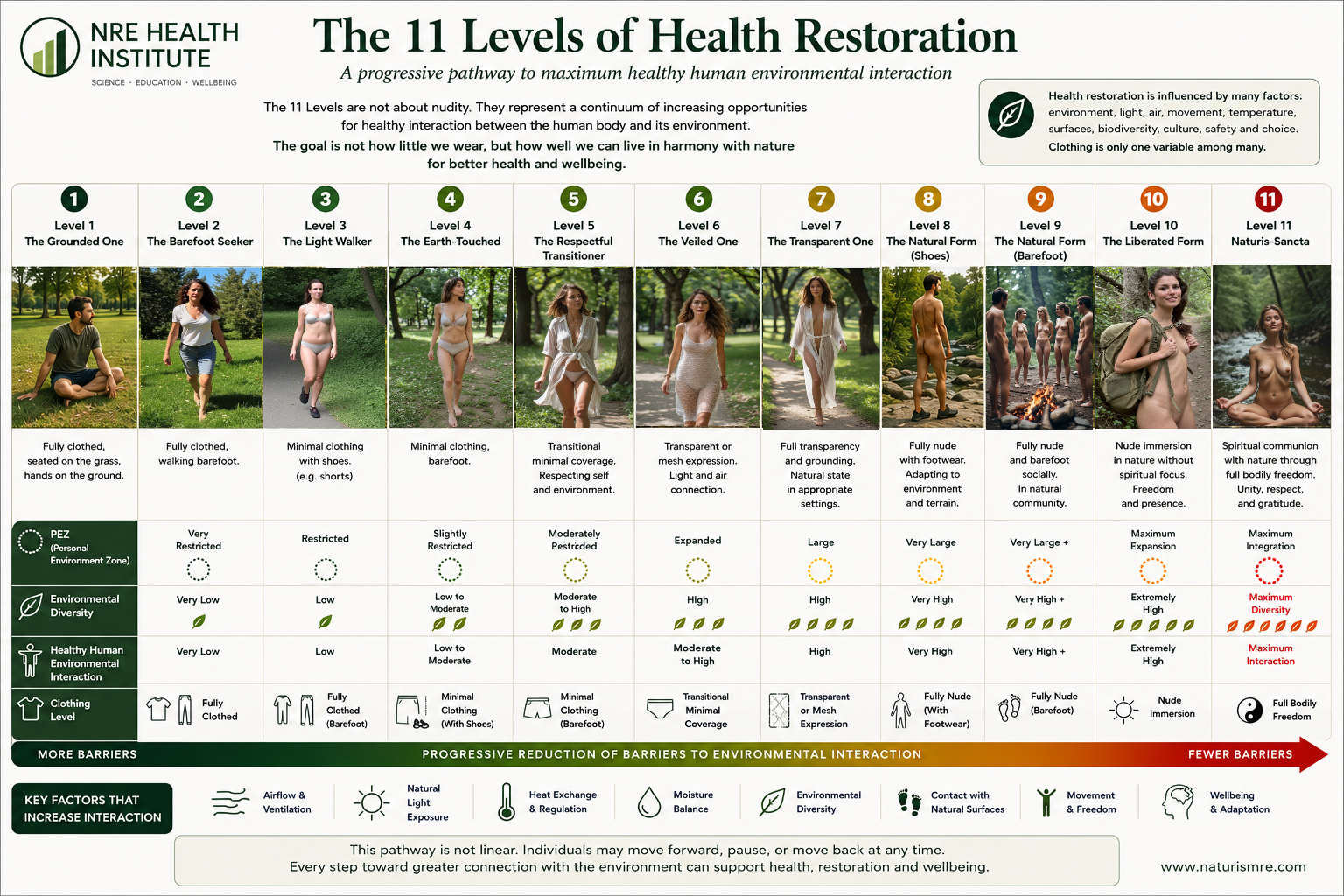
The 11 Levels of Health Restoration describe a progressive increase in opportunities for healthy human-environment interaction. They are not obligations, not a hierarchy, and not a requirement to practise nudity.
Why the 11 Levels Exist
The 11 Levels of Health Restoration™ were developed to provide a structured framework for understanding progressive human-environment interaction. Rather than viewing health restoration as a single event or a simple change in clothing, the framework recognises that restoration occurs through multiple interacting factors including environment, movement, breathing, light, biodiversity, airflow, temperature, contact with natural surfaces and personal comfort.
Every level represents an opportunity to progressively increase healthy environmental interaction while respecting personal choice, local laws, cultural expectations, safety and individual wellbeing.
Choice
Individuals decide how far they wish to progress. There is no obligation to move beyond any particular level.
Context
Different environments require different approaches. Weather, legality, safety and social context all influence the appropriate level.
Progression
Health restoration is viewed as a continuum rather than an all-or-nothing event. Small changes may still increase environmental interaction.
Integration
The framework integrates environmental science, public health, wellbeing, naturism and Safe Health Zones into one coherent educational model.
The following 11 Levels should therefore be understood as progressive opportunities for healthy human-environment interaction, not as requirements or measures of personal worth.
NRE Health & Nature Immersion Matrix™
A general comparative framework showing how environmental setting and bodily accessibility may influence opportunities for interaction with the surrounding natural environment.
| Environmental setting |
Fully clothed shoes and socks worn |
Fully clothed shoes and socks removed |
Light clothing shorts and T-shirt |
Minimal clothing underwear or similar |
No clothing where lawful and appropriate |
|---|---|---|---|---|---|
| Enclosed high-rise apartment Windows and external doors closed | AVery limited | AVery limited | AVery limited | AVery limited | AVery limited |
| Ventilated high-rise apartment Windows or balcony doors open under suitable conditions | AVery limited | AVery limited | BLimited | BLimited | BLimited |
| Enclosed house or ground-floor residence Windows and external doors closed | AVery limited | AVery limited | AVery limited | AVery limited | AVery limited |
| Ventilated house or ground-floor residence Open windows or doors with nearby vegetation or garden air | BLimited | BLimited | BLimited | BLimited | BLimited |
| Balcony, veranda or terrace Direct outdoor air and daylight, with limited natural surface contact | BLimited | BLimited | CModerate | CModerate | CModerate |
| Private garden or courtyard Vegetation, outdoor air, daylight and accessible natural surfaces | CModerate | CModerate | CModerate | DHigh | DHigh |
| Urban street or built public space Outdoor exposure with limited vegetation and possible pollution or noise | BLimited | BLimited | BLimited | CModerate | CModerate |
| Town or city park Vegetation, natural surfaces, daylight, airflow and natural sounds | CModerate | CModerate | DHigh | DHigh | DHigh |
| Large regional park or nature reserve Greater vegetation, biodiversity and separation from dense built environments | CModerate | DHigh | DHigh | EVery high | EVery high |
| Beach or coastal environment Open air, water, sand, natural sound, sunlight and broad sensory exposure | CModerate | DHigh | DHigh | EVery high | EVery high |
| Forest or woodland Dense vegetation, biodiversity, natural sounds, shade and natural surfaces | DHigh | DHigh | EVery high | EVery high | EVery high |
| National park or relatively intact natural environment Broad ecosystem interaction with limited built-environment influence | DHigh | EVery high | EVery high | EVery high | EVery high |
General classification method
Each classification reflects the combined opportunity for interaction with environmental factors rather than a guaranteed health outcome. The framework considers the overall environmental setting together with the degree to which the body can directly experience that setting.
- Outdoor air and airflow
- Natural daylight
- Appropriate skin exposure
- Temperature and thermal variation
- Humidity and moisture
- Vegetation and green-space exposure
- Water and blue-space exposure
- Natural sounds
- Biodiversity
- Natural scents and sensory variety
- Contact with safe natural surfaces
- Barefoot interaction opportunities
- Freedom of movement
- Physical activity opportunities
- Environmental pollution and noise
- Perceived safety, comfort and privacy
Clothing is treated as one modifying factor. It can alter skin exposure, airflow, moisture exchange, thermal sensation, touch and direct contact with natural surfaces. It does not independently determine the final classification. A person who is fully clothed in a rich natural environment may therefore have greater overall health and nature immersion opportunity than a person without clothing inside an enclosed building.
Disclaimer
The NRE Health & Nature Immersion Matrix™ is a comparative educational framework developed by the NRE Health Institute to estimate the relative opportunity for human interaction with natural environmental factors under standardised conditions. It is intended to compare environments and levels of health immersion rather than predict individual health outcomes.
Unless otherwise stated, all comparisons assume environmental conditions are generally comfortable and suitable for normal human outdoor activity, including appropriate temperature, humidity, wind, air quality, daylight or equivalent night-time conditions, and UV conditions appropriate for the level of skin exposure. Environmental hazards, extreme weather, pollution events and exceptional circumstances are excluded unless specifically identified.
The matrix evaluates the potential for interaction with environmental factors such as air, light, vegetation, water, natural surfaces, biodiversity and other recognised components of the human environment. It does not imply that every interaction produces a measurable health benefit, nor that greater exposure is always preferable.
Individual predispositions, age, health status, medications, disabilities, prior experiences, personal preferences, duration of exposure, cultural context and local environmental conditions will influence actual experiences and outcomes.
Matrix classifications represent comparative health immersion opportunities under standardised assumptions and should not be interpreted as absolute measures of health benefit.
The framework is designed to evolve as scientific knowledge advances and should be interpreted alongside current evidence rather than as a substitute for medical, environmental or public health advice.
2. Human Environmental Interaction
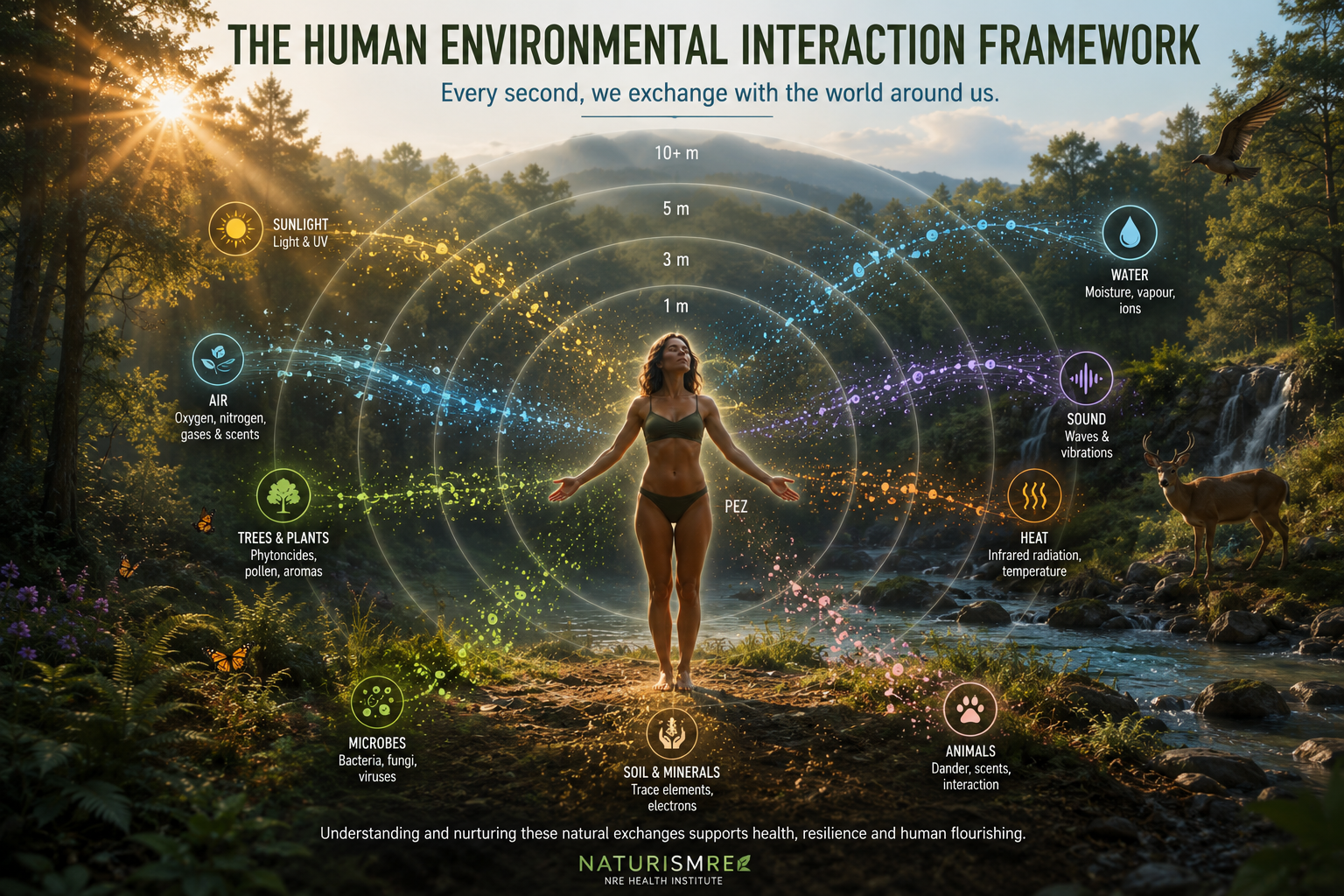
Human beings do not exist separately from their surroundings. Every second of life, the body continuously exchanges matter, energy and information with the environment. These exchanges occur whether we are indoors or outdoors, awake or asleep, clothed or minimally clothed.
Breathing, body heat, moisture, light, sound, microorganisms, airborne particles, environmental chemicals, water, plants, animals and countless physical processes constantly move between the body and the surrounding world. Many of these interactions are well established within physiology, environmental health, biology and physics, while others continue to be investigated.
Rather than viewing humans as isolated individuals moving through empty space, the NRE Health Institute considers each person to exist within a dynamic zone of continuous environmental interaction.
Why this matters
The quality, diversity and intensity of these interactions are influenced by many factors, including:
- Natural or built environments
- Air quality and ventilation
- Temperature and humidity
- Sunlight exposure
- Water availability
- Vegetation and biodiversity
- Movement and physical activity
- Distance from other people and animals
- Architecture and urban design
- The amount and type of clothing worn
The 11 Levels of Health Restoration™ were developed from this fundamental principle. They describe a progressive increase in opportunities for healthy human-environment interaction rather than simply a progression in clothing reduction. Clothing represents only one of many variables influencing the body's relationship with its environment.
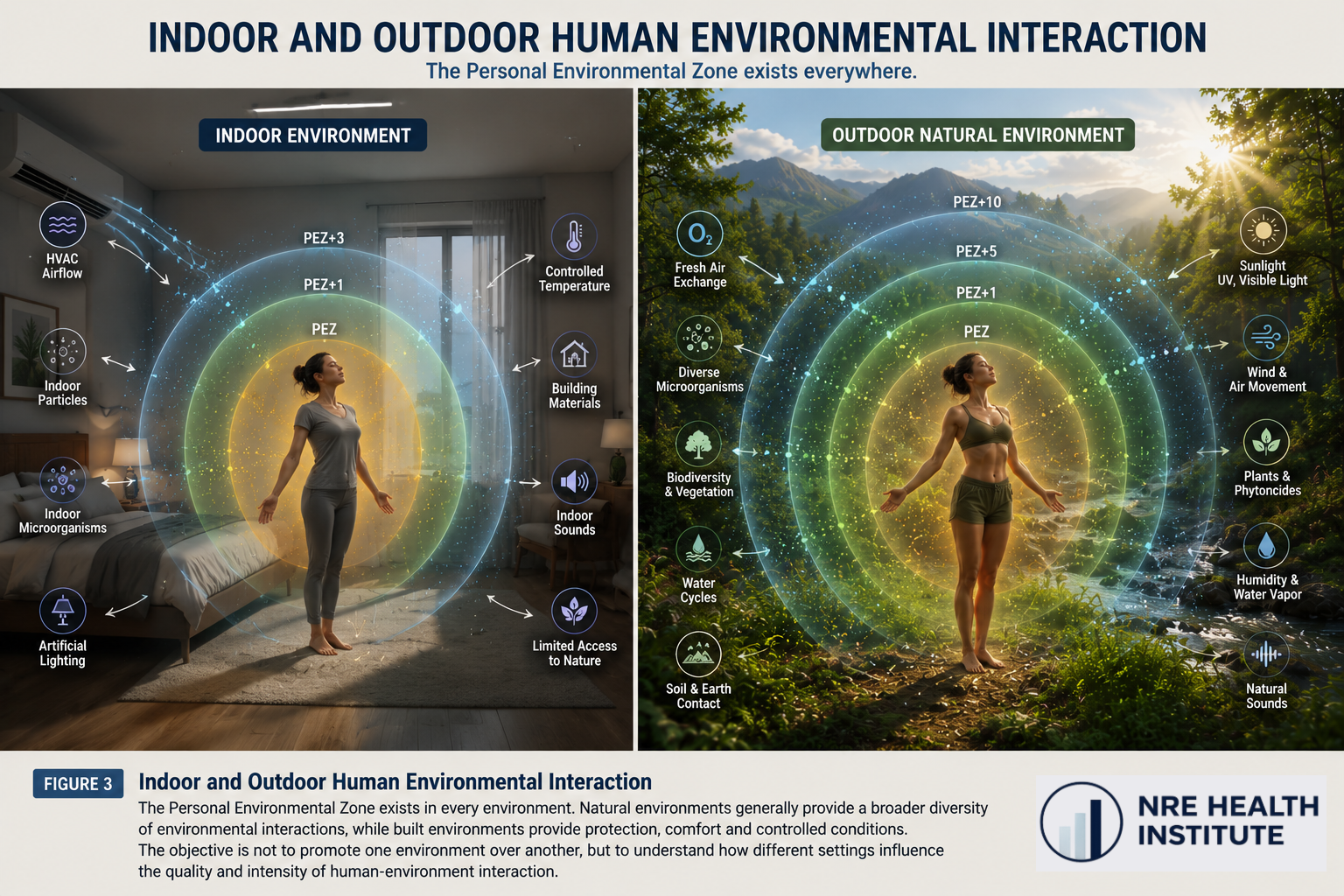
The Personal Environmental Zone (PEZ)
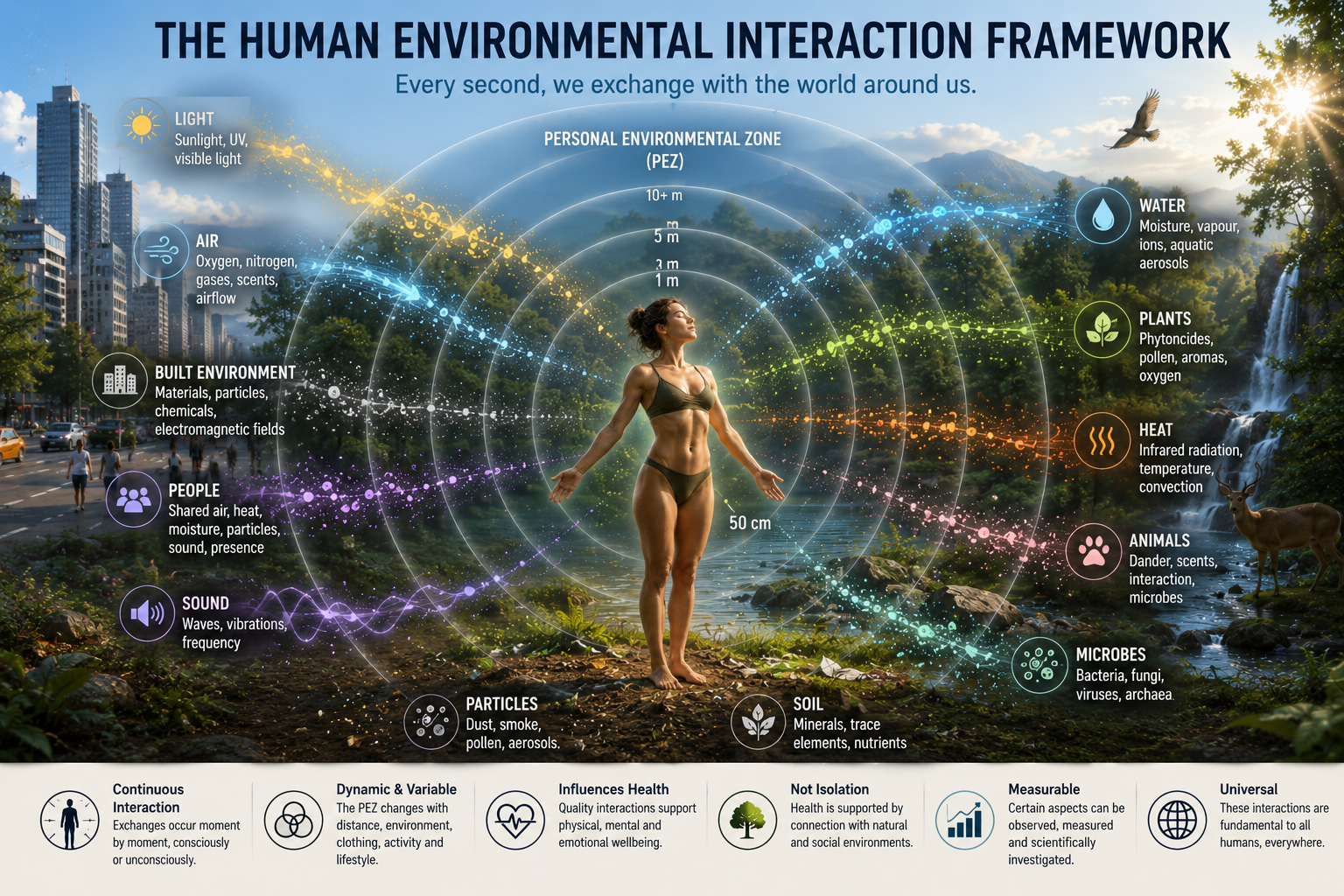
The NRE Health Institute introduces the Personal Environmental Zone (PEZ) as a conceptual model that helps visualise the immediate environment surrounding every individual. Rather than existing in isolation, every person continuously exchanges air, heat, moisture, particles, light, sound, microorganisms and countless other environmental influences with the world around them.
The PEZ is not a fixed boundary. It expands, contracts and constantly changes according to movement, airflow, clothing, surrounding people, architecture, vegetation, weather and many other environmental conditions.
PEZ
Direct body interaction. Skin, clothing, heat, moisture, touch and immediate body processes.
PEZ+1
Close personal interaction. Breathing, body heat, moisture, sound, nearby air movement and immediate environmental exchange.
PEZ+3
Environmental mixing. Dilution of exhaled air, movement of particles, airflow and interaction with nearby surroundings.
PEZ+5
Local environmental interaction. Greater integration with vegetation, water, animals and surrounding atmospheric conditions.
PEZ+10
Integration into the broader local environment. The individual's exchanges become progressively incorporated into the surrounding ecosystem.
The distances shown within the PEZ framework are reference zones used for education and visualisation. Actual interaction distances vary according to environmental conditions, including wind, ventilation, humidity, temperature, physical activity and the specific process being considered.
Indoor and Outdoor Human Environmental Interaction
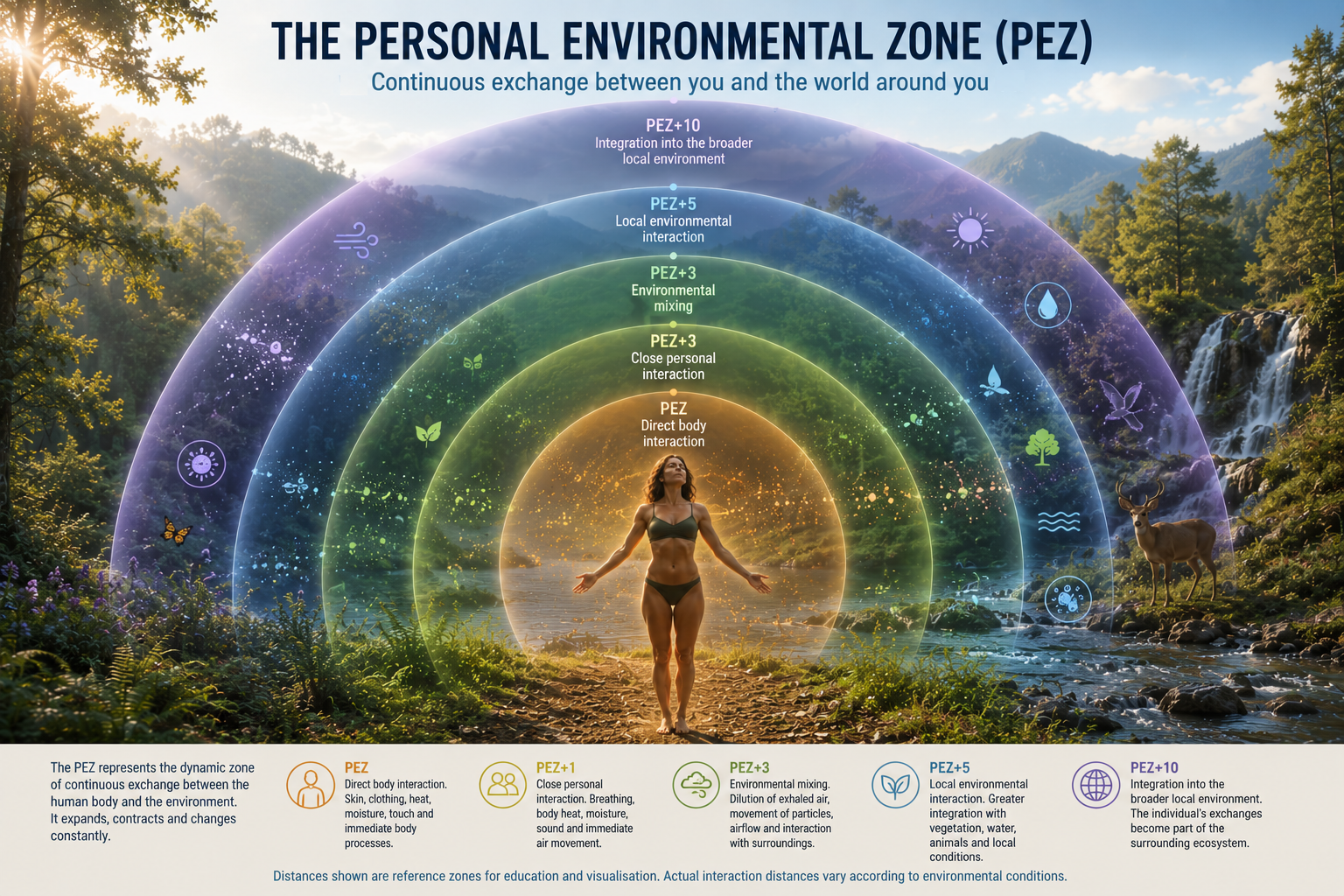
The Personal Environmental Zone exists everywhere. Whether a person is inside a building, walking through a city, relaxing in a park or standing beside a mountain stream, continuous interaction with the surrounding environment never stops.
What changes is not the existence of these interactions, but their quality, diversity and intensity. Natural and built environments present different combinations of air movement, light, heat, biological diversity, surfaces, sounds, particles and environmental conditions, all of which influence the character of the Personal Environmental Zone.
Typical Indoor Environment
- Artificial climate control
- Reduced air renewal
- Lower biodiversity
- Artificial lighting
- Building materials and furnishings
- Indoor microorganisms and particles
- Limited natural airflow
- Reduced direct contact with vegetation, soil and water
Typical Outdoor Natural Environment
- Continuous atmospheric exchange
- Natural sunlight
- Wind and changing airflow
- Greater biological diversity
- Vegetation and natural plant compounds
- Natural water cycles
- Soil and geological contact opportunities
- Dynamic environmental conditions
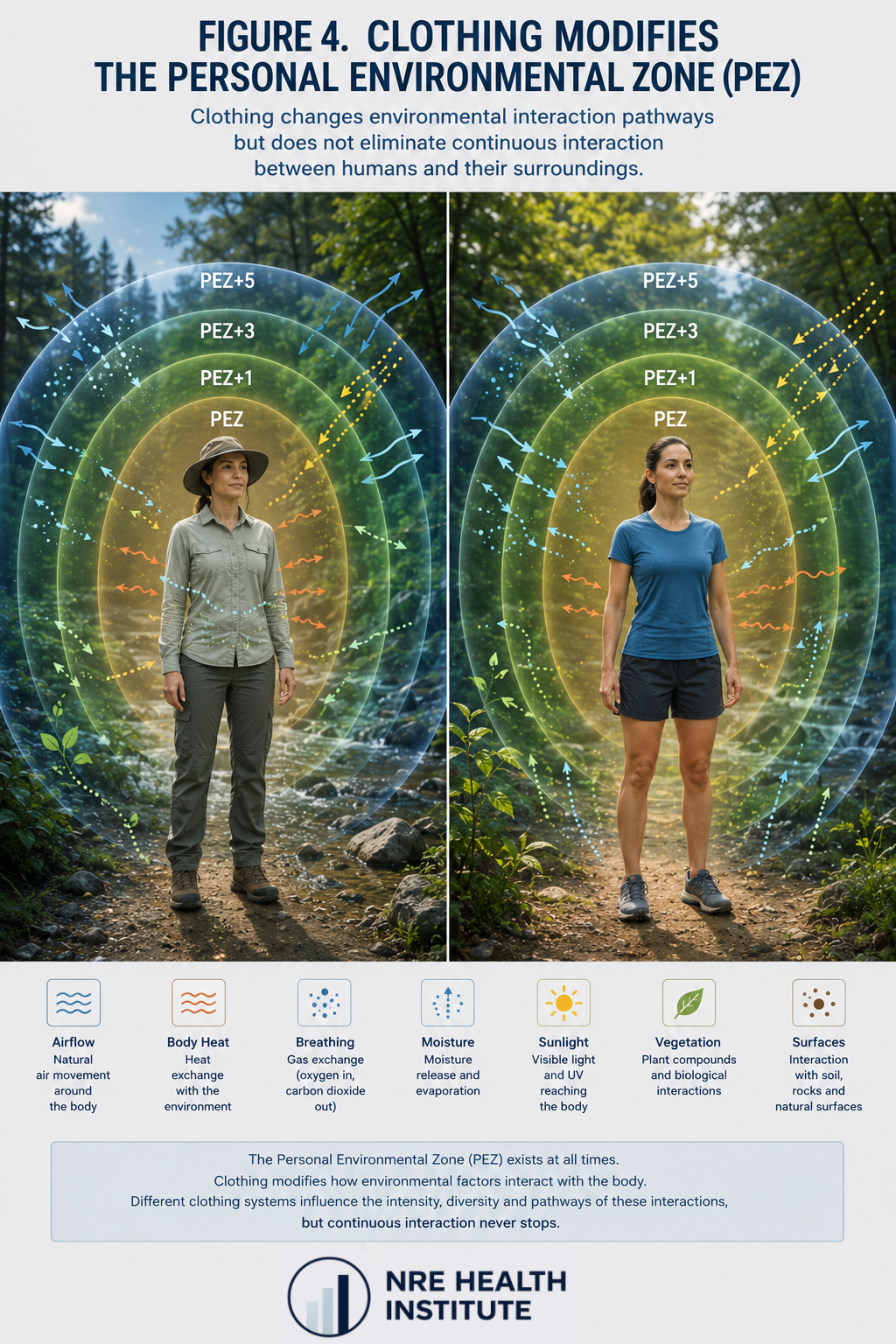
Clothing Modifies Human Environmental Interaction
Clothing is one of the variables that influences the Personal Environmental Zone. It does not isolate the human body from the environment, nor does it stop human-environment interaction. Instead, clothing modifies how those interactions occur.
Different clothing types, materials, thicknesses and coverage influence airflow, heat exchange, moisture evaporation, sunlight exposure, direct skin contact, movement and many other environmental processes.
Interactions Reduced
- Direct skin exposure
- Natural airflow across the body
- Evaporative cooling
- Direct sunlight reaching the skin
- Water contact
- Contact with vegetation and soil
- Skin particle release
- Environmental diversity reaching the skin
Interactions Continue
- Breathing and gas exchange
- Body heat production
- Moisture exchange
- Sound transmission
- Movement
- Visual interaction
- Environmental awareness
- Continuous environmental adaptation
Clothing changes the Personal Environmental Zone, but it does not eliminate it. Human beings remain in continuous interaction with their surroundings throughout every stage of daily life.
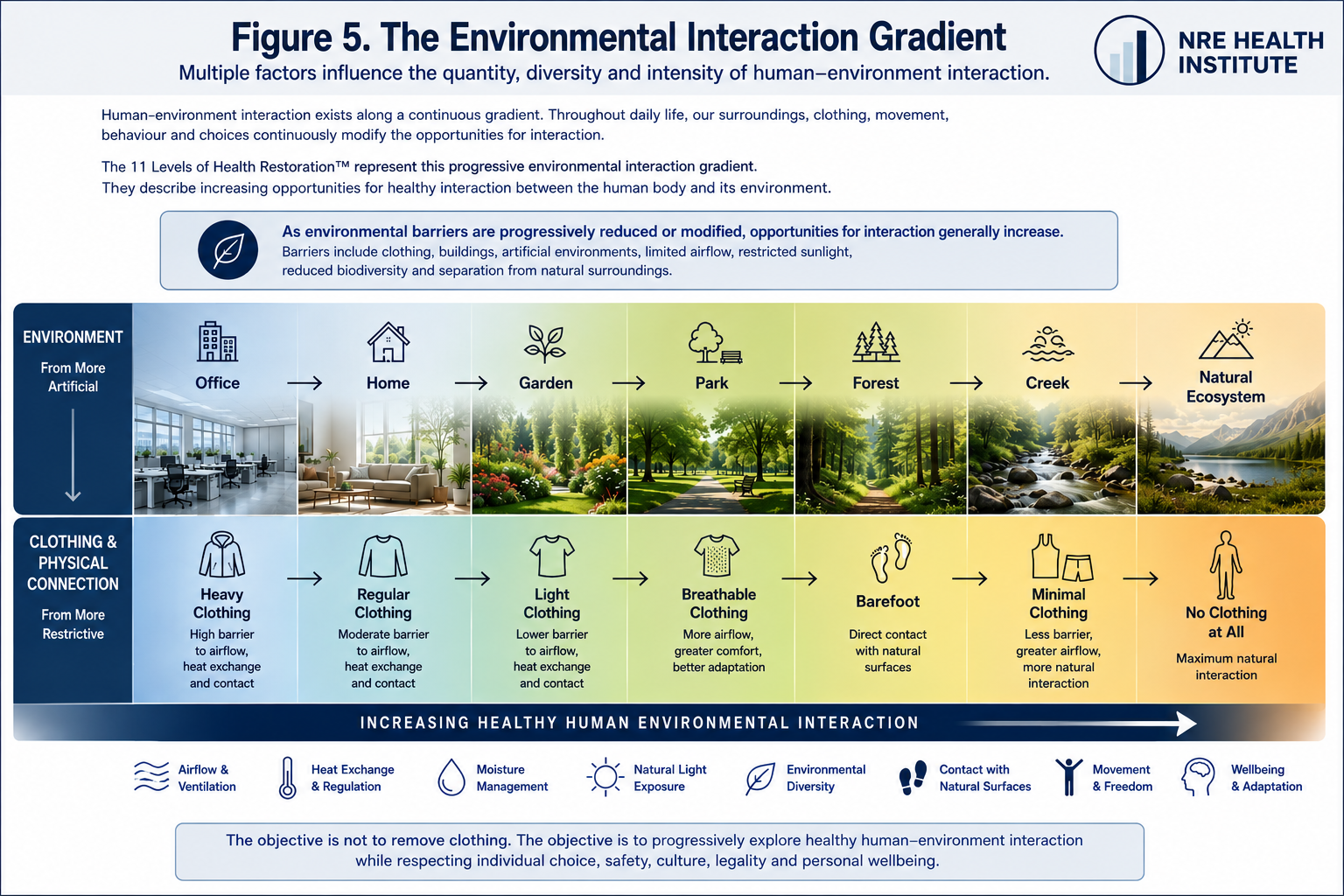
The Environmental Interaction Gradient
Human-environment interaction is not an "all or nothing" phenomenon. Instead, it exists along a continuous gradient. Throughout daily life, our surroundings, clothing, movement, behaviour and choices continuously modify the quantity, diversity and intensity of environmental interaction.
The 11 Levels of Health Restoration™ were developed to represent this progressive environmental interaction gradient. They do not describe eleven stages of nudity. They describe eleven increasing opportunities for healthy interaction between the human body and its environment.
- Interaction with air becomes progressively less restricted.
- Heat exchange changes.
- Natural airflow increases.
- Environmental diversity expands.
- Direct contact with natural surfaces may increase.
- Exposure to natural light can increase.
- Movement becomes less constrained.
- The Personal Environmental Zone becomes progressively more integrated with the surrounding environment.
The objective of the 11 Levels is not to remove clothing. The objective is to progressively explore healthy human-environment interaction while respecting individual choice, safety, culture, legality and personal wellbeing.
Why the 11 Levels Exist
The 11 Levels of Health Restoration™ were developed to provide a structured framework for understanding progressive human-environment interaction. Rather than viewing health restoration as a single event or a simple change in clothing, the framework recognises that restoration occurs through multiple interacting factors including environment, movement, breathing, light, biodiversity, airflow, temperature, contact with natural surfaces and personal comfort.
Every level represents an opportunity to progressively increase healthy environmental interaction while respecting personal choice, local laws, cultural expectations, safety and individual wellbeing.
Choice
Individuals decide how far they wish to progress. There is no obligation to move beyond any particular level.
Context
Different environments require different approaches. Weather, legality, safety and social context all influence the appropriate level.
Progression
Health restoration is viewed as a continuum rather than an all-or-nothing event. Small changes may still increase environmental interaction.
Integration
The framework integrates environmental science, public health, wellbeing, naturism and Safe Health Zones into one coherent educational model.
The following 11 Levels should therefore be understood as progressive opportunities for healthy human-environment interaction, not as requirements or measures of personal worth.