

Legal System Integration, Strategic Positioning, and Regulatory Equilibrium
Examining how naturist systems maintain legal viability through contextual alignment, operational predictability, strategic positioning, and resilience within fragmented regulatory environments.
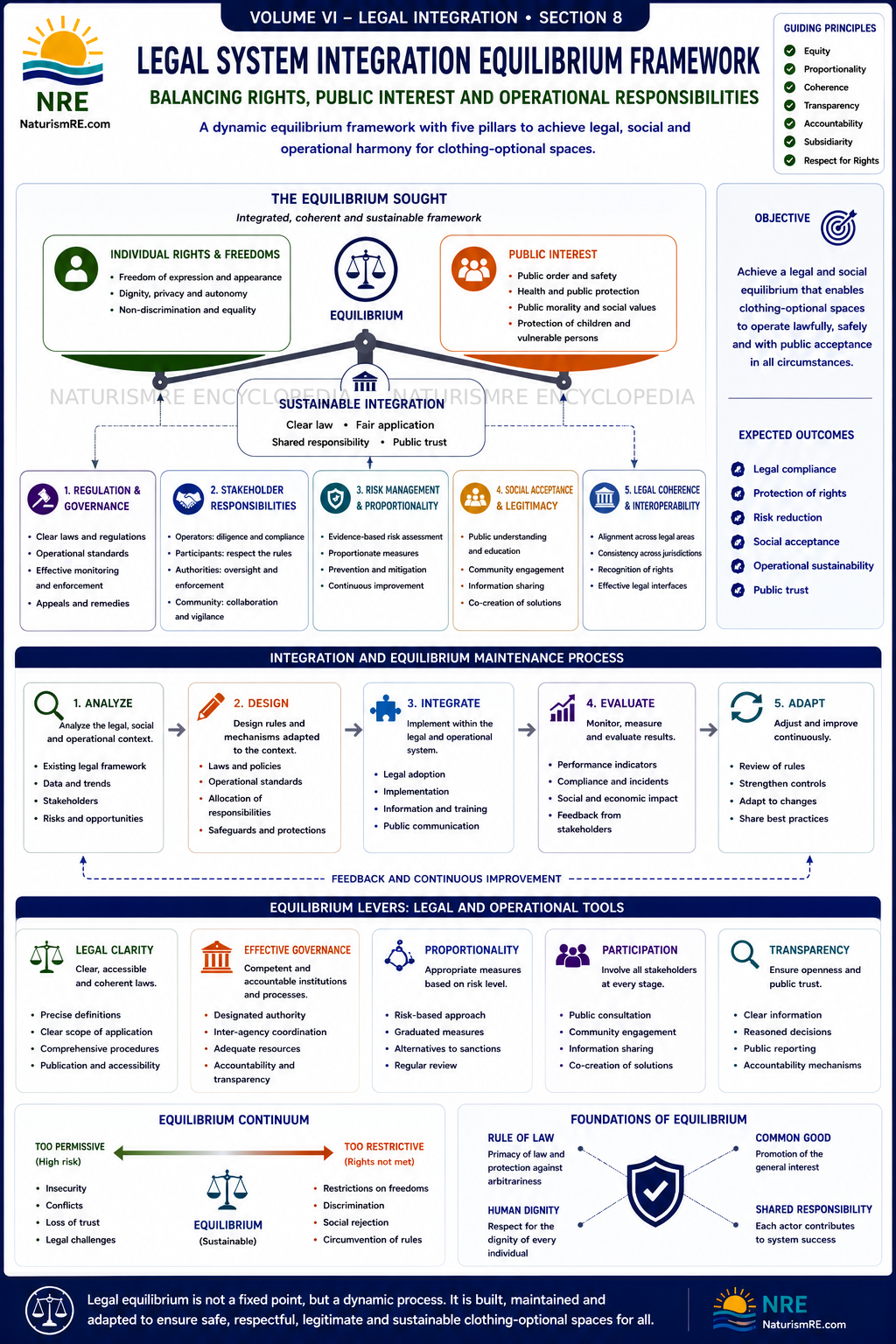
The long-term legal viability of naturist systems depends on their ability to function as context-aligned, compliance-driven, and resilient operational models that maintain equilibrium within fragmented legal frameworks, enabling predictable interpretation without reliance on immediate legislative transformation.
8.1 Convergence of Legal Variables
The preceding sections establish that naturist practice operates within a multi-layered legal system comprising statutory provisions, offence typologies, jurisprudential interpretation, sub-legislative regulation, liability structures, compliance architectures, and cross-jurisdictional variability.
These elements do not function independently. They converge into a single operational legal environment in which statutes define broad boundaries, courts interpret those boundaries, regulators apply them at the local level, and compliance systems translate them into practice.
Naturist systems must therefore operate within a network of interdependent legal variables rather than within a single governing rule.
8.2 From Legal Uncertainty to Operational Predictability
A defining characteristic of naturist practice is legal uncertainty arising from fragmented statutory frameworks, subjective interpretative standards, and variability in enforcement.
Uncertainty does not prevent operation. It requires conversion into operational predictability.
Predictability is achieved through clear environmental definition, consistent behavioural standards, alignment with recognised legal thresholds, and structured compliance mechanisms.
When these elements are present, interpretation stabilises, the likelihood of enforcement is reduced, and legal defensibility is strengthened.
The objective is not absolute legal certainty, which may be unattainable, but predictable interpretation within defined conditions.
8.3 Legal Positioning Through Contextual Alignment
Naturist systems achieve legal positioning by aligning with existing legal constructs rather than attempting to redefine them.
This involves operating within behaviour-based regulatory frameworks, maintaining non-disruptive and non-ambiguous conduct, and aligning environmental purpose with recognised uses of space.
Effective positioning is characterised by consistency between stated intent and observable conduct, environments that are interpretable by authorities and the public, and the absence of conditions that trigger offence-based thresholds.
This approach allows naturist systems to function within current legal paradigms without requiring immediate legislative reform.
8.4 Regulatory Equilibrium and Threshold Management
Legal systems operate around thresholds beyond which enforcement is triggered.
These thresholds may include perceived offensiveness, evidence of disruption or complaint, and deviation from expected norms.
Naturist environments must operate within a regulatory equilibrium zone in which conduct remains below enforcement thresholds, context supports interpretation of appropriateness, and risk of escalation is minimised.
Exceeding this equilibrium may result in enforcement action, regulatory restriction, or reputational impact.
Maintaining equilibrium requires continuous alignment between behaviour, context, and perception.
8.5 Strategic Use of Incremental Legitimisation
Given legal variability and risk sensitivity, expansion of naturist systems is most viable through incremental legitimisation.
This process involves initial operation within tolerated or low-risk contexts, demonstration of behavioural consistency and low incident rates, gradual recognition by local authorities, and potential transition to formal designation or policy inclusion.
Incremental legitimisation reduces perceived risk for regulators, limits stakeholder resistance, and lowers the likelihood of adverse enforcement.
It transforms naturist environments from ambiguous or marginal activities into recognised and manageable components of regulatory systems.
8.6 Limitations of Legal Reform as a Primary Strategy
Legal reform is often proposed as a pathway for expansion, but it presents significant limitations.
It is typically a low priority within legislative agendas, subject to political sensitivity, and influenced by variable social support.
Reliance on reform introduces uncertainty and delay, with outcomes that may differ across jurisdictions.
In contrast, operational alignment within existing frameworks provides immediate applicability, greater predictability, and reduced systemic resistance.
Legal reform may occur over time, but it is more likely to follow demonstrated operational viability than to precede it.
8.7 System Resilience Within Legal Environments
Legal resilience refers to the ability of a system to withstand scrutiny, absorb isolated incidents, and continue operating within acceptable thresholds.
Resilient naturist systems demonstrate consistent behavioural integrity, effective compliance mechanisms, capacity to respond to enforcement triggers, and adaptability to changing legal and regulatory conditions.
Resilience reduces dependence on favourable interpretation, limits vulnerability to isolated adverse events, and supports long-term operational stability.
8.8 Analytical Conclusion
The legal environment governing naturist practice is defined by complexity, variability, and interpretative dependence.
Naturism operates within interconnected legal variables rather than a single rule. Operational predictability can be achieved despite underlying uncertainty. Effective positioning relies on alignment with existing legal constructs. Regulatory equilibrium must be maintained to avoid enforcement thresholds. Incremental legitimisation provides a viable integration pathway. Reliance on legal reform alone is limited. System resilience is essential for sustained operation.
Naturist systems that succeed within this environment are those that operate coherently within legal structures, reduce ambiguity, and maintain alignment across all relevant variables.
This establishes the overarching principle of Volume VI:
The long-term legal viability of naturist systems depends on their ability to function as context-aligned, compliance-driven, and resilient operational models that maintain equilibrium within fragmented legal frameworks, enabling predictable interpretation without reliance on immediate legislative transformation.
Primary Supporting Articles
From Legal Diversity to Structural Convergence, A Global Synthesis of Naturist Regulation
From Legal Principle to Operational Reality, Why Law Requires Structured Environments to Function
Why Legal Clarity Without Operational Context Fails in Practice
Minimum Viable Standards for Global Naturist Systems
Why Systems That Rely on Interpretation Cannot Stabilise at Scale
Secondary Supporting Articles
Why Policy Without Structure Produces Control Instead of Clarity
Why Boundary Definition Determines Whether Systems Stabilise or Collapse
Interoperability Between Jurisdictions, Structural Conditions and Limits
Why Systems Without Defined Governance Layers Remain Operationally Fragile