

Social Systems: Perception, Stigma Formation, and Interpretative Stability
Examining the social mechanisms through which nudity, nudism, and naturism are interpreted, accepted, contested, and stabilised within structured and unstructured environments.
Nudity is not a fixed social category. It is a context-dependent signal interpreted through existing social frameworks.
7.1 Purpose
This section defines the social mechanisms through which nudity, nudism, and naturism are interpreted, accepted, and contested.
It establishes how norms, perception, demographic patterns, and structured environments influence social outcomes. Its objective is to move beyond descriptive analysis and identify the structural drivers of social response, enabling consistent interpretation across contexts.
7.2 Nudity as a Disruption of Social Signalling Systems
Clothing functions as a primary social signalling system, conveying role, status, identity, and conformity. The removal of clothing disrupts this system.
In structured environments, this disruption is replaced by behavioural norms. Visual hierarchy may become less apparent, and interpretation stabilises within defined conditions.
In unstructured environments, signalling is removed without replacement. Ambiguity increases, and observers rely on inference rather than defined expectations.
This establishes a core principle:
Social response to nudity is not a reaction to the body itself, but to the disruption of expected signalling systems.
7.3 Stigma Formation as a Predictable Process
Stigma does not arise spontaneously. It develops through identifiable mechanisms.
These mechanisms produce a consistent outcome:
Identical non-sexual behaviour may be interpreted differently depending on prior conditioning and context.
7.4 Exposure Dynamics and Normalisation Pathways
Social response to nudity is strongly influenced by patterns of exposure.
Where exposure is limited, ambiguity remains high and stigma is reinforced. As exposure increases, differentiation between contexts begins to emerge. Where exposure is repeated within structured environments, interpretative stability increases.
Structured environments contribute to this process by defining behavioural expectations, establishing consent boundaries, and reducing interpretative uncertainty.
This demonstrates a governing principle:
Normalisation is driven by structured exposure, not by abstract acceptance.
7.5 Naturism as a Controlled Social System
Naturism functions as a managed social system designed to stabilise interpretation.
It achieves this through explicit behavioural codes, consent-based participation, defined environmental boundaries, and governance and enforcement mechanisms.
These elements reduce the variables that typically trigger misinterpretation, including ambiguity of intent, unpredictability of behaviour, and uncertainty of audience.
This establishes a structural condition:
Social stability is produced through structure, not through the presence or absence of clothing.
7.6 Participation Structures and Social Distribution
Participation occurs through two overlapping systems.
Structured participation takes place within organised environments where behavioural expectations are defined and governance is present.
Informal participation occurs within private or non-regulated contexts where interpretation remains variable and dependent on situational conditions.
In most regions, informal participation exceeds formal membership. This indicates that naturism operates both as a regulated system and as a distributed behavioural phenomenon.
7.7 Inclusion, Accessibility, and Conditional Equalisation
Structured naturist environments may reduce emphasis on appearance-based hierarchy and status signalling. This can alter social interaction dynamics, reduce comparative judgement, and increase exposure to body diversity.
However, these effects are not universal. They are context-dependent and rely on governance quality, behavioural enforcement, and clarity of environmental norms.
Inclusivity is therefore conditional rather than inherent.
7.8 Cultural Resistance and Friction Points
Resistance to naturism typically arises where nudity is strongly associated with sexuality, where exposure is perceived as a moral or social threat, or where unfamiliarity produces uncertainty.
This resistance may manifest as stigma, reputational risk, restricted access, or defensive public responses. These responses vary across regions and are shaped by cultural context.
They are not uniform and should not be treated as fixed conditions.
7.9 Environmental Context and Spatial Dynamics
Social response is influenced significantly by spatial context.
In urban environments, higher density increases visibility and interpretative pressure. This leads to greater reliance on designated or controlled spaces and increased sensitivity in enforcement.
In rural environments, increased privacy reduces immediate social pressure and allows greater tolerance for informal participation.
This establishes a consistent condition:
Environment directly shapes perception and behavioural interpretation.
7.10 Measurement and Social Data Systems
Accurate social analysis requires structured measurement. This includes assessment of perception of nudity, comfort across contexts, exposure history, and demographic variation.
Standardised tools, including perception and stigma indices, enable cross-regional comparison, tracking of change over time, and evidence-based policy discussion.
Without structured measurement, analysis remains anecdotal and conclusions are vulnerable to bias.
7.11 Behavioural Stability as a System Condition
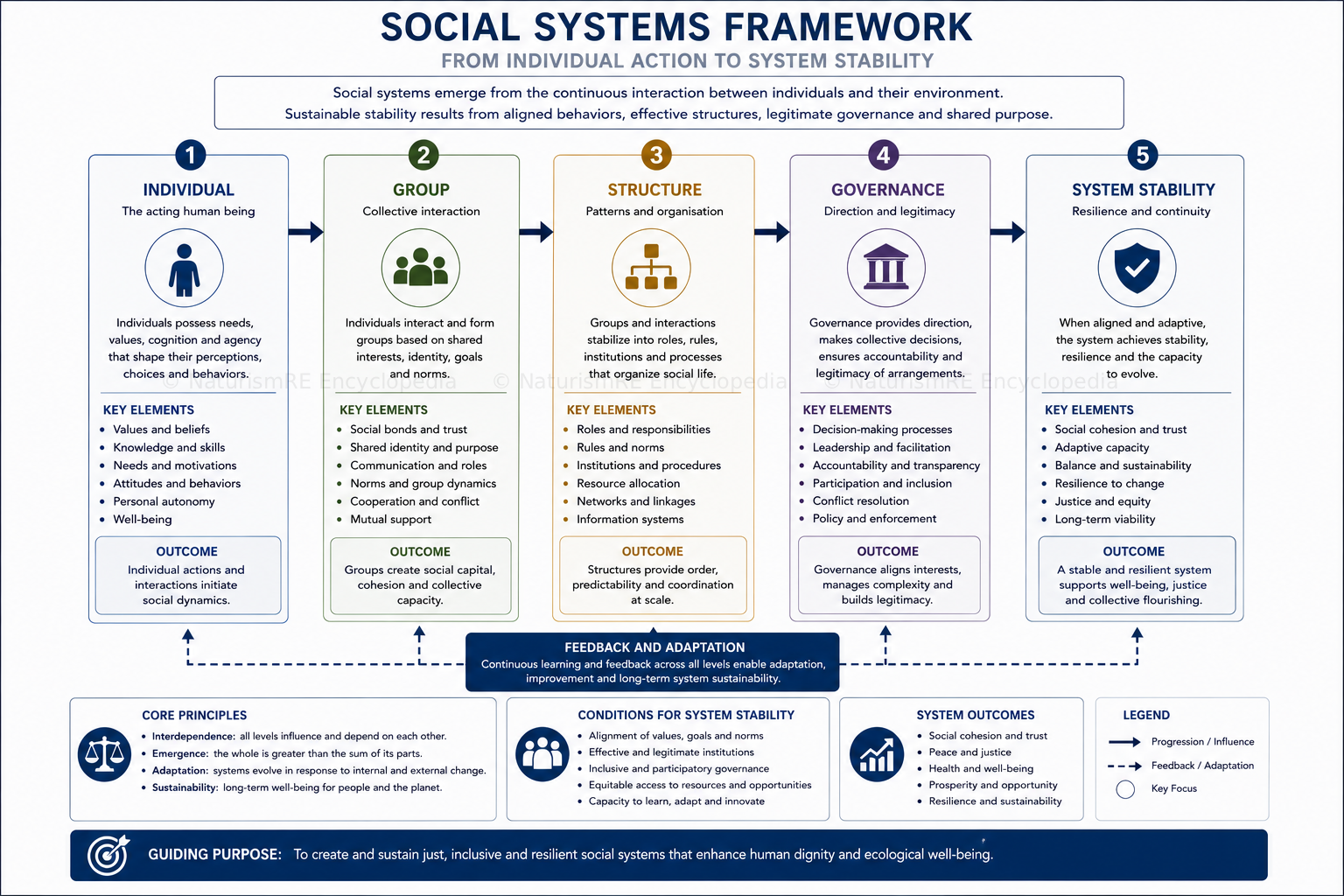
Social stability within naturist environments depends on clearly defined expectations, consistent behavioural enforcement, and shared understanding among participants.
This demonstrates a core system principle:
Stability is determined by behaviour and structure, not by clothing status.
7.12 Alignment with the Conceptual Framework
Social outcomes align with the analytical model established in earlier sections.
Context determines where behaviour occurs, perception determines how it is interpreted, and governance determines how it is controlled.
These variables explain both variability in response and consistency within structured systems.
7.13 Functional Role Within the Encyclopedia
This section provides the social foundation for Volume V, as well as for stigma and perception analysis, and policy and public engagement frameworks.
It ensures that social interpretation is treated as a structured and measurable system rather than as a subjective or purely reactive phenomenon.
7.14 Conclusion
Social responses to nudity are not inherent or universal. They are constructed through perception, conditioning, and context.
This leads to a defining principle:
Nudity is not a fixed social category. It is a context-dependent signal interpreted through existing social frameworks.
Naturism demonstrates that when behavioural expectations are clearly defined, consent is established, and governance is present, nudity can function within stable, predictable, and non-disruptive social systems.
This does not eliminate variability in response. It explains it.
Understanding nudity as a context-dependent social variable, rather than as a moral constant, is essential for accurate analysis, consistent policy development, and informed public discourse.
Primary Supporting Articles
From Social Interaction to Social Order, How Structured Environments Produce Predictable Behaviour
Social Alignment and Misalignment, Why Naturist Systems Stabilise or Fragment
Why Behaviour Remains Interpreted as Exception Rather Than Norm
The Normalisation Threshold, When Acceptance Actually Shifts
From Representation to Reality, Why Most Naturists Are Invisible to the System