

Education Systems, Knowledge Dissemination, and Capacity Building
Examining how education frameworks, structured learning systems, and accessible knowledge dissemination support scalable and coherent naturist system development.
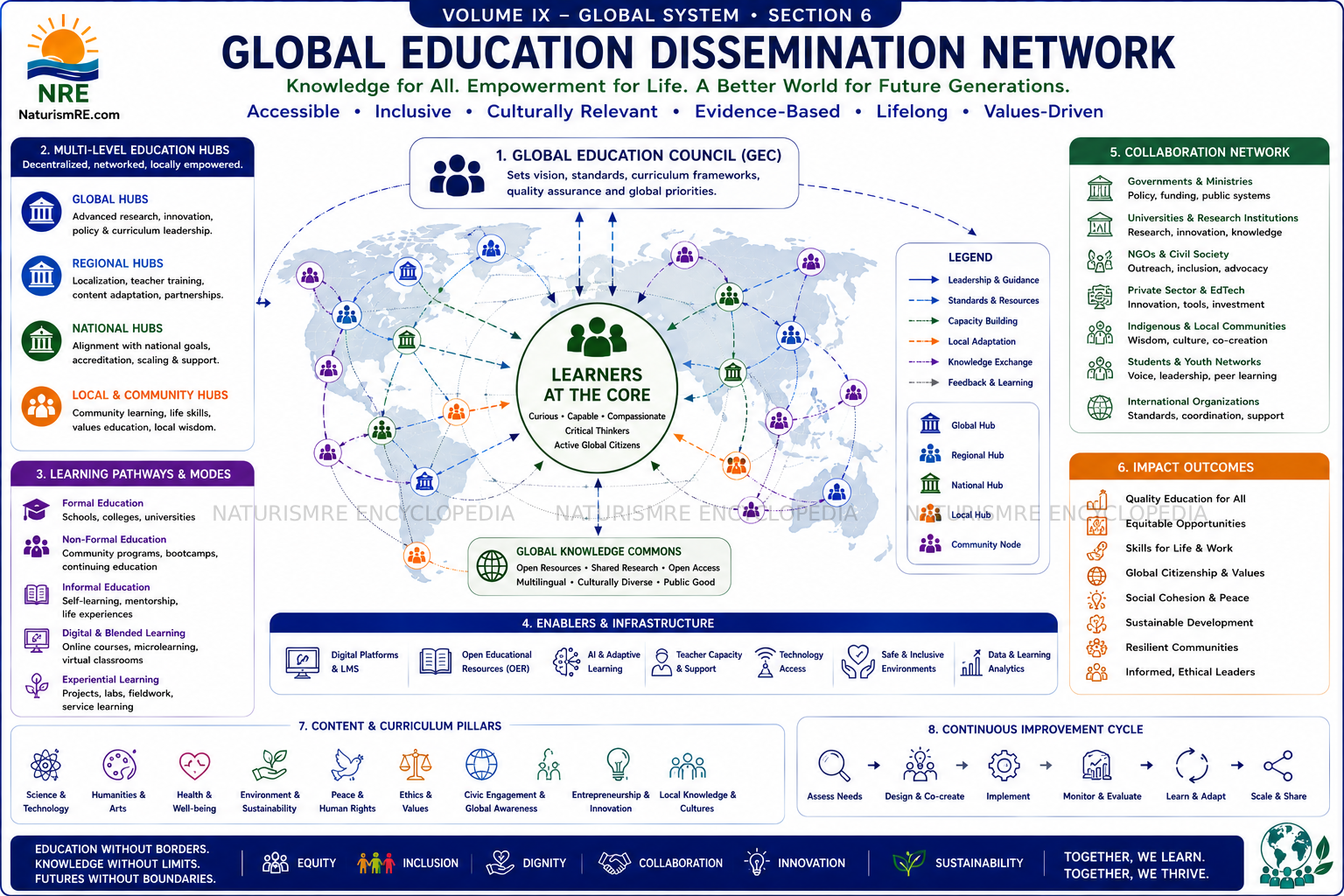
The development of a coherent global naturist system depends on the establishment of comprehensive education and knowledge dissemination frameworks that build capacity, ensure consistent interpretation, and support continuous adaptation across all levels of participation and implementation.
6.1 Education as a System Infrastructure
As naturist systems evolve toward global coherence, education becomes a core infrastructure rather than a supplementary function.
Without structured education, frameworks are inconsistently understood, behavioural standards are unevenly applied, and implementation quality varies across environments.
Education enables consistent interpretation of system principles, transfer of operational knowledge, and alignment between participants, operators, and stakeholders.
It functions as the primary mechanism for capacity building across distributed systems.
6.2 Domains of Knowledge Required for System Operation
Effective naturist systems require knowledge across multiple domains.
Behavioural Frameworks
Define conduct expectations and clarify operational boundaries, norms, and interpretative standards.
Environmental and Operational Knowledge
Supports awareness of site-specific variables and alignment with environmental constraints.
Risk and Safety Principles
Enable identification of foreseeable risks and application of mitigation strategies.
Legal and Regulatory Understanding
Provides awareness of applicable laws, thresholds, and jurisdictional variability.
Communication and Stakeholder Interaction
Supports clear articulation of context, behavioural purpose, and perception management.
Education systems must integrate these domains into coherent and accessible formats.
6.3 Structured Learning Pathways
To support scalability, education must be delivered through structured learning pathways.
These include introductory materials for participants, operational guidance for organisers, and advanced frameworks for coordination and governance.
Learning pathways should be progressive, allowing gradual acquisition of knowledge, modular to support adaptation to different roles and contexts, and aligned with framework standards.
Structured learning reduces misinterpretation, inconsistent implementation, and reliance on informal knowledge transfer.
6.4 Dissemination Mechanisms and Accessibility
Knowledge dissemination must be widely accessible, adaptable to different environments, and consistent across systems.
Mechanisms may include digital platforms, resource libraries, standardised documentation, and distributed training or orientation processes.
Accessibility ensures that individuals can engage without specialised background, new environments can be developed with minimal barriers, and knowledge is not restricted to specific organisations or regions.
6.5 Capacity Building and System Expansion
Education directly supports capacity building, defined as the ability to establish new environments, maintain operational standards, and adapt to changing conditions.
Capacity building enables decentralised implementation, reduces dependence on centralised expertise, and supports scalable system growth.
Without capacity building, expansion is constrained, quality varies across environments, and system coherence declines.
6.6 Continuous Learning and System Evolution
Education systems must support continuous learning in response to evolving legal frameworks, shifting social perception, and emerging operational challenges.
This involves updating educational materials, integrating feedback from operational environments, and incorporating new data and insights.
Continuous learning ensures that systems remain relevant, adaptable, and aligned with current conditions.
6.7 Alignment Between Education and Certification
Education and certification systems are interdependent.
Education provides the knowledge required to meet defined standards, while certification validates that those standards are applied in practice.
Alignment ensures that certification reflects informed operation and that education remains focused on operational requirements.
This integration supports consistent system performance, credible validation, and scalable implementation.
6.8 Analytical Conclusion
Education systems are essential for enabling coherent, scalable, and adaptive naturist frameworks.
They function as foundational infrastructure supporting consistent interpretation, integration of multiple knowledge domains, and structured learning pathways.
Accessible dissemination enables broad participation, while capacity building supports decentralised expansion.
Continuous learning ensures alignment with evolving conditions, and integration with certification supports consistency and credibility.
Naturist systems that prioritise education maintain consistent standards, support scalable implementation, and adapt effectively to change.
This establishes a defining principle for Volume IX:
The development of a coherent global naturist system depends on the establishment of comprehensive education and knowledge dissemination frameworks that build capacity, ensure consistent interpretation, and support continuous adaptation across all levels of participation and implementation.
Primary Supporting Articles
Public Knowledge Systems as Infrastructure
Behavioural Literacy in Population-Level Adoption
The Missing Interface, Why Behaviour Exists but Systems Fail to Capture It