

United Kingdom: Intent-Based Legal Structure and Contextual Interpretation
Examining the United Kingdom as a reference model of intent-based and context-sensitive legal interpretation relating to nudity, behaviour, and public exposure.
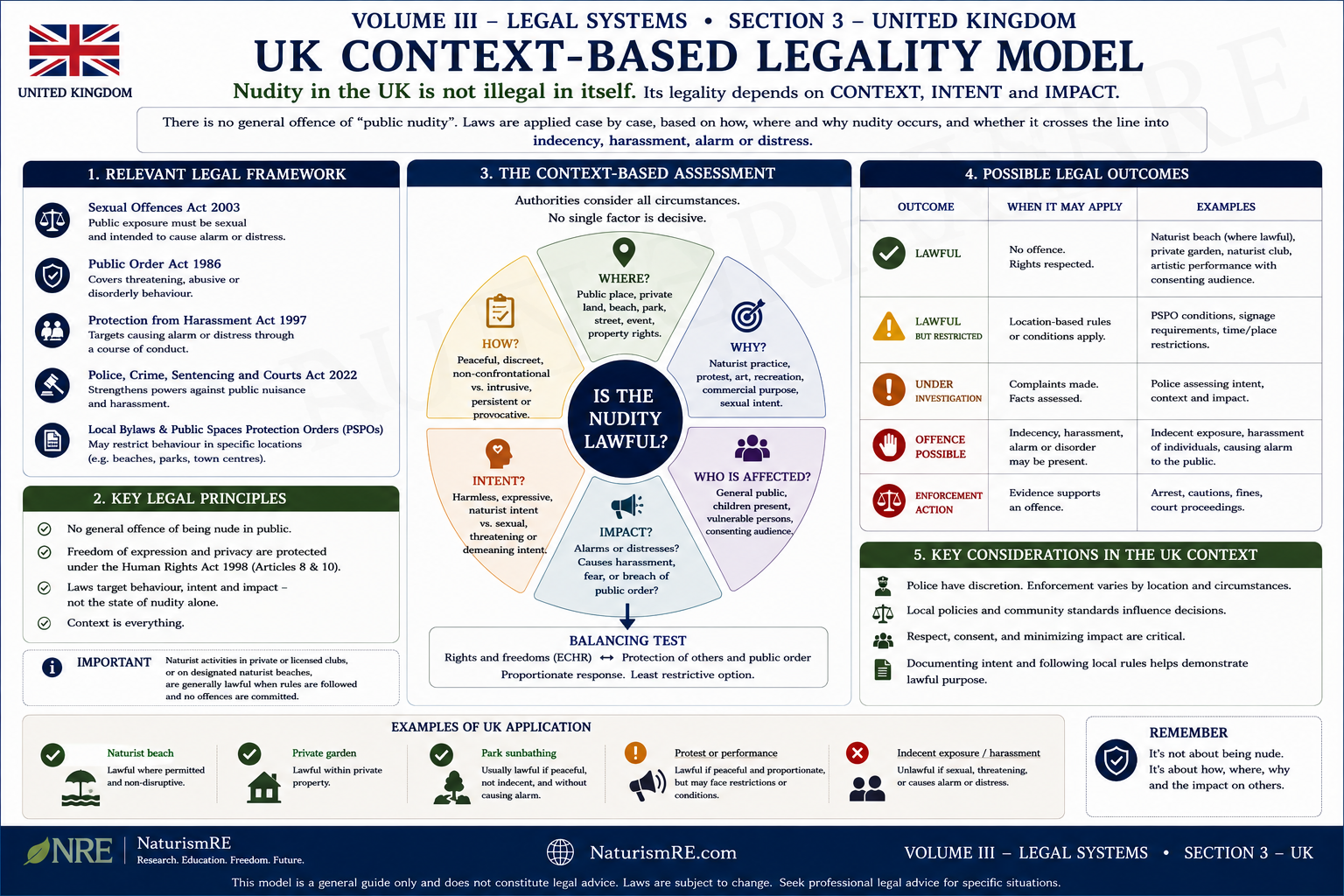
Legality is determined not solely by statutory definition, but by the interaction of intent, behaviour, context, and perception within a structured interpretative framework.
3.1 Purpose
This section examines the legal treatment of nudity in the United Kingdom as a reference model of an intent-based and context-sensitive legal system.
Its purpose is to analyse how statutory law, judicial interpretation, and enforcement interact, to demonstrate how abstract legal principles are applied in practice, and to define the operational conditions under which nudity is interpreted as lawful or unlawful.
This section provides a structural analysis of legal mechanics rather than a descriptive overview.
3.2 Absence of a General Prohibition
United Kingdom law does not contain a general prohibition on nudity as a physical condition.
There is no statute that criminalises the state of being unclothed in public or passive nudity in the absence of additional factors.
Legal intervention arises only when nudity is combined with specific intent, behaviour meeting defined thresholds, or impact on others.
This establishes a foundational legal principle:
Nudity, as a physical condition, is not inherently unlawful under UK law.
Legal relevance arises only through interpretative assessment.
3.3 Statutory Framework and Threshold Structure
The primary statutory provision governing exposure-related offences is Section 66 of the Sexual Offences Act 2003.
An offence is established only when all required elements are present. These include intentional exposure of genitals, intention that the exposure be seen, and intention to cause alarm or distress.
This creates a multi-element threshold structure in which the absence of any single element prevents classification as an offence.
This confirms that exposure alone is insufficient, intent is essential, and outcome in the form of alarm or distress is determinative.
3.4 Interaction with Public Order Legislation
Additional provisions may apply under the Public Order Act 1986.
Relevant offences concern behaviour that is threatening, abusive, or disorderly and that causes harassment, alarm, or distress.
Within this framework, nudity is not itself the offence. Behaviour constitutes the offence.
Nudity becomes legally relevant only when it contributes to conduct that meets defined behavioural thresholds.
3.5 Primacy of Intent in Legal Evaluation
The UK legal system places central emphasis on intent.
Judicial reasoning consistently distinguishes between exposure intended to provoke, alarm, or distress and passive or incidental nudity without harmful intent.
Intent is rarely explicit and is inferred through observable behaviour, surrounding circumstances, interaction with others, and response to external input.
This establishes a clear system logic:
Intent determines legal classification, not physical condition alone.
3.6 Behaviour as an Interpretative Indicator
While intent is central, it is established through behavioural indicators.
Courts assess whether conduct is passive or directed, whether interaction is initiated or avoided, and whether behaviour escalates after objection.
Behaviour becomes legally significant when it introduces ambiguity, creates confrontation, or persists in a manner likely to cause distress.
This reinforces a consistent principle:
Behaviour operationalises intent in legal assessment.
3.7 Role of Context and Environmental Expectation
Context plays a critical role in determining how behaviour is interpreted, whether exposure is considered avoidable, and whether individuals are reasonably expected to encounter it.
Courts differentiate between controlled or recognised environments, general public settings, and situations where exposure is imposed.
Nudity is more likely to be tolerated where context is predictable, participation is voluntary, and exposure is avoidable.
This establishes a core condition:
Context defines the interpretative framework within which intent and behaviour are evaluated.
3.8 Designated Environments as Legal Stabilisation
The United Kingdom permits nudity within certain structured contexts, including designated naturist beaches, private land and clubs, and organised events conducted under defined conditions.
Within these environments, expectations are clear, participation is voluntary, and exposure is contained.
These conditions reduce the likelihood of distress, minimise legal ambiguity, and limit enforcement intervention.
Such environments function as practical stabilisation mechanisms by aligning behaviour, context, and perception.
3.9 Enforcement Practice and Discretion
Enforcement in the United Kingdom operates through context-sensitive discretion.
Authorities assess the presence of complaints, behaviour of the individual, likelihood of escalation, and proportionality of response.
Where nudity is non-sexual, non-disruptive, and contextually explainable, enforcement may be limited.
Where behaviour produces discomfort, confrontation, or escalation, intervention becomes more likely.
This establishes a key operational reality:
Enforcement responds to perceived impact, not to the mere presence of nudity.
3.10 Influence of Social Perception
Although the legal framework is intent-based, social perception influences outcomes.
Cultural expectations, local attitudes, and sensitivity to public exposure affect the likelihood of complaint, the interpretation of behaviour, and enforcement decisions.
This introduces controlled variability within an otherwise structured legal system.
3.11 Risk Profile and System Limits
Despite the absence of a general prohibition, legal risk remains.
Risk increases where exposure is unavoidable by others, where behaviour is ambiguous or persistent, and where individuals fail to respond to authority intervention.
Possible outcomes include investigation, warning, or temporary detention, even where no offence is ultimately established.
This reflects a system in which legality is conditional rather than absolute.
3.12 Analytical Implications
The United Kingdom framework demonstrates several key system-level principles.
Condition vs Conduct
Nudity is not criminalised as a standalone condition. Legal significance emerges through conduct and interpretation.
Intent-Based Evaluation
Intent operates as the decisive factor distinguishing lawful from unlawful exposure.
Contextual Assessment
Context determines whether exposure is predictable, avoidable, and socially interpretable.
Structured Discretion
Enforcement remains discretionary but operates within a coherent interpretative structure.
This positions the United Kingdom as a highly developed intent-based model with strong internal coherence.
3.13 Conclusion
The United Kingdom provides a clear example of a legal system in which nudity is regulated through intent, behaviour, and contextual interpretation rather than through blanket prohibition.
The absence of a general offence confirms that the unclothed body is not inherently unlawful and that legal relevance arises only through interpretative conditions.
At the same time, reliance on intent, perception, and discretionary enforcement introduces variability in application.
This establishes a defining principle:
Legality is determined not solely by statutory definition, but by the interaction of intent, behaviour, context, and perception within a structured interpretative framework.
The UK model demonstrates the capacity of legal systems to differentiate between nudity and indecency and to maintain public order without absolute prohibition, while also illustrating the limits of such systems, where interpretation remains necessary, certainty remains conditional, and enforcement remains context-sensitive.
This makes the UK framework a reference model for intent-based regulation and a clear application of the principles established in this volume.
Primary Supporting Articles
Contextual Legality and Interpretive Enforcement, The United Kingdom Model of Naturist Regulation
Behavioural Thresholds and Legal Trigger Points in Structured Naturist Environments
Judicial Threshold Formation, How Courts Define Offensiveness and Acceptability in Naturist Contexts
Why Intent Cannot Protect Behaviour Without Defined Context
From Legal Principle to Operational Reality, Why Law Requires Structured Environments to Function