

Governance Models and Operational Frameworks in Structured Naturist Systems
Examining governance as the operational foundation enabling naturist systems to function predictably, maintain legitimacy, and scale within contemporary legal and social environments.
Governance is not a constraint. It is the operational foundation that allows naturism to exist, expand, and stabilise within modern society.
2.1 The Necessity of Governance Beyond Informal Norms
As naturism evolves toward structured, context-defined environments, reliance on informal cultural norms becomes insufficient for sustained operation. While historical naturist communities often functioned through shared understanding and peer-based regulation, contemporary conditions require explicit governance mechanisms.
This necessity arises from several structural realities, including increased interaction with non-participating public populations, greater legal scrutiny and regulatory expectations, amplified reputational exposure through media and digital channels, and the need to demonstrate safety, consistency, and accountability.
Governance in this context is not an imposition on naturist principles. It is a functional layer that enables naturism to operate within complex societal systems.
Without governance, structured environments remain vulnerable to behavioural drift, misinterpretation of intent, inconsistent participant conduct, and regulatory intervention.
Governance therefore becomes a precondition for scalability and legitimacy.
2.2 Core Components of Naturist Governance Systems
Effective governance in structured naturist environments is defined by the integration of policy clarity, operational protocols, and behavioural oversight.
Environmental Definition
Clear delineation of permitted environments, operational boundaries, and purpose-specific designation reduces ambiguity and stabilises interpretation.
Behavioural Standards
Explicit behavioural expectations reinforce non-sexual context and alignment with broader public norms.
Participant Awareness
Communication systems, signage, and voluntary participation conditions ensure informed understanding of environmental expectations.
Oversight and Intervention
Structured escalation pathways and supervisory mechanisms enable response to behavioural deviation and operational risk.
Risk Management
Governance systems integrate mitigation measures relating to safety, crowd dynamics, vulnerable populations, and reputational exposure.
Operational Consistency
Governance enables environments to function predictably and maintain alignment with legal and social expectations.
These components collectively form the operational backbone of system-based naturist environments, enabling them to function predictably and defensibly.
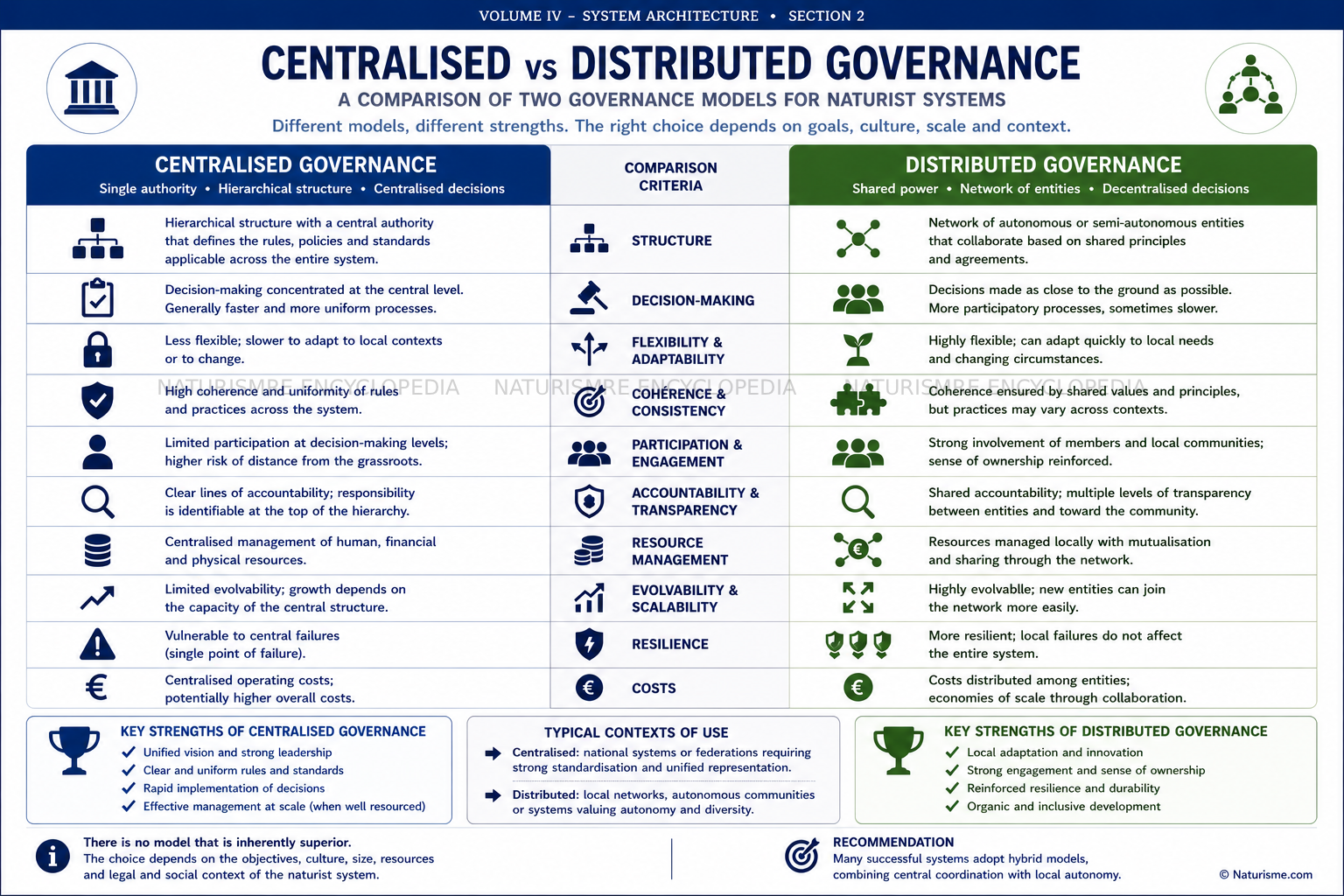
2.3 Centralised Versus Decentralised Governance Models
Governance structures in naturism can be broadly understood through two models.
Centralised governance is typically associated with traditional organisations. It involves defined leadership structures, membership-based participation, controlled environments such as clubs or resorts, and internal rule enforcement. This model provides high consistency of standards, established authority for enforcement, and reduced ambiguity within controlled spaces. However, it is limited in scalability beyond private or semi-private domains, depends on organisational resources, and has limited adaptability to informal or public environments.
Decentralised governance has emerged in response to broader participation trends. It relies on frameworks rather than institutions, distributed adoption by individuals or local groups, and context-specific implementation. This model offers scalability across diverse jurisdictions, flexibility in application, and reduced dependency on central bodies. Its limitations include variability in implementation quality, reduced direct enforcement capability, and greater reliance on participant self-regulation.
The trajectory of naturist systems indicates the emergence of hybrid governance models in which centralised entities maintain controlled environments, decentralised frameworks enable broader participation, and shared standards provide coherence across both structures.
2.4 Framework-Based Governance as an Enabling Mechanism
Framework-based governance represents a critical development in extending structured naturism beyond traditional organisational boundaries.
Unlike institutional governance, frameworks do not require membership or impose hierarchical control. They provide adaptable reference structures rather than fixed rules.
Such frameworks typically include standardised behavioural guidelines, environmental design principles, risk assessment templates, communication protocols, and considerations for legal positioning.
Their primary function is to reduce uncertainty. By providing consistent reference points, frameworks allow individuals to initiate or participate in structured environments with greater confidence, enable authorities to assess proposals against defined parameters, and assist stakeholders in understanding operational intent.
Framework-based governance therefore acts as a bridge between informal participation and formal regulatory systems.
2.5 Legitimacy, Accountability, and Public Confidence
For structured naturist systems to operate sustainably, governance must support three interdependent outcomes.
Legitimacy
Environments must be interpreted as appropriate, non-sexual, and aligned with recognised social expectations.
Accountability
Systems require clear responsibility structures and mechanisms capable of responding to incidents or behavioural deviation.
Public Confidence
External observers must perceive environments as safe, predictable, and effectively governed.
Failure in any of these areas increases exposure to public opposition, media amplification of negative incidents, and regulatory restriction or prohibition.
Governance systems must therefore be designed for both internal functionality and external interpretability.
2.6 Interaction with Regulatory and Policy Environments
Governance models in naturism interact directly with regulatory and policy frameworks.
Authorities assess environments based on public safety considerations, potential for disturbance or complaint, alignment with existing legal definitions, and risk of reputational impact.
Structured governance systems support favourable assessment by providing clarity of operation, demonstrating proactive risk management, and reducing uncertainty for decision-makers.
In this context, governance functions as a translation mechanism, converting naturist activity into a format that can be evaluated within legal and policy systems.
This increases the likelihood of pilot approvals, designated zones, and conditional permissions, although regulatory acceptance remains dependent on local conditions, cultural factors, and precedent.
2.7 Governance Limitations and Failure Points
Governance systems are subject to inherent limitations that must be recognised and managed.
Over-complexity can reduce participation and create operational rigidity. Under-enforcement can undermine credibility and weaken behavioural consistency. Inconsistent application across environments can reduce system coherence. Perception gaps may persist even in well-governed environments, leading to external misinterpretation. Dependency on specific individuals may introduce fragility in system continuity.
These limitations highlight the need for governance systems that are clear without being excessive, consistent while remaining adaptable, and visible without becoming intrusive.
2.8 Analytical Conclusion
Governance represents a foundational element in the transition of naturism toward structured, context-defined systems.
It enables predictable operation across diverse environments, supports alignment with legal and regulatory expectations, reduces behavioural and reputational risk, and increases public and institutional confidence.
The evolution of governance models reflects a broader shift from informal, culture-based participation toward structured, system-supported engagement.
Future naturist systems are likely to operate within hybrid governance architectures that combine institutional stability, framework-driven flexibility, and behavioural consistency across decentralised adoption.
The effectiveness of these systems will depend on their capacity to maintain clarity of purpose, ensure behavioural integrity, and adapt to varying legal and cultural contexts.
Governance, in this framework, is not a constraint. It is the operational foundation that allows naturism to exist, expand, and stabilise within modern society.
Primary Supporting Articles
From Informal Practice to Institutional Systems, How Naturism Scales
Governance Without Constant Intervention, Passive Control Systems in Naturist Contexts
Decentralised Governance vs Coordinated Systems
Why Governance Must Precede Acceptance
Why Systems Without Defined Governance Layers Remain Operationally Fragile
Secondary Supporting Articles
How Behavioural Standards Become Self-Enforcing Within Defined Environments
Why Behavioural Standards Function as Operational Infrastructure
Controlled Entry Systems and Their Role in Stabilisation
Why Boundary Enforcement Determines System Credibility
The Relationship Between Rule Simplicity and Compliance Rates