

System Integration, Human Adaptation, and Health Outcome Equilibrium
Examining how physiological, psychological, social, and environmental variables converge within naturist environments to produce adaptive and context-dependent human outcomes.
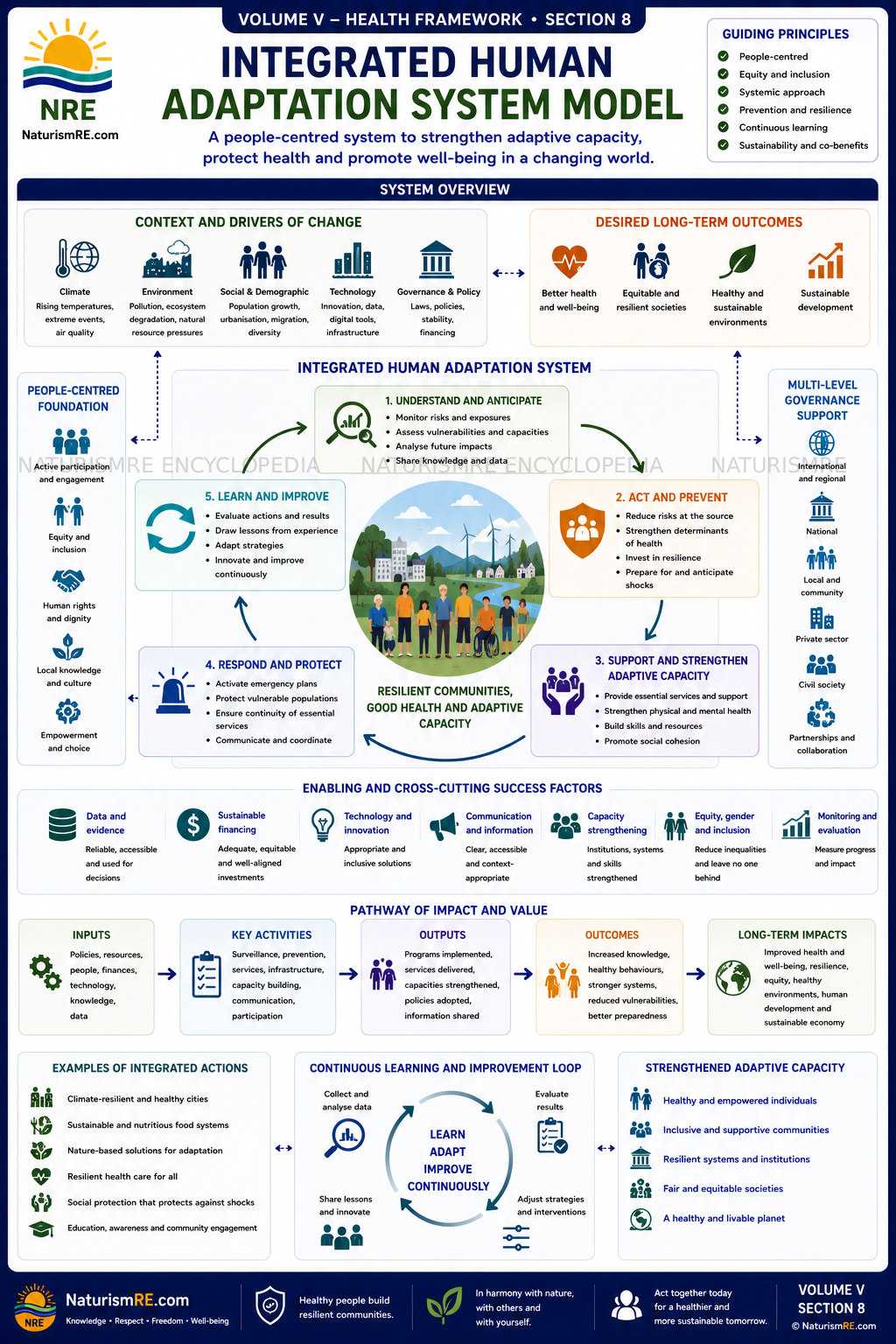
The influence of naturist environments on health and human factors depends on their ability to operate as integrated, adaptive systems that maintain equilibrium between environmental exposure, behavioural structure, and individual capacity within clearly defined and context-sensitive conditions.
8.1 Convergence of Biopsychosocial Variables
The analysis across Volume V demonstrates that naturist environments influence multiple interdependent domains, including physiological responses, psychological processes, social behavioural systems, and environmental exposure conditions.
These domains do not operate independently. They converge into an integrated system in which physiological states influence psychological perception, psychological comfort affects behavioural interaction, behavioural stability reinforces social predictability, and environmental conditions shape all domains simultaneously.
This convergence produces a condition in which health-related outcomes cannot be attributed to a single factor. They emerge from the interaction of variables within a defined context.
8.2 Human Adaptation as a Dynamic Process
Human response to naturist environments is best understood as a process of adaptation over time rather than as an immediate effect.
Physiological Adaptation
Includes adjustment to temperature variation, sensory modulation, and adaptation to environmental exposure patterns.
Psychological Adaptation
Includes reduction of self-consciousness, recalibration of body perception, and decreased cognitive load over time.
Social Adaptation
Includes alignment with behavioural norms, increased interaction predictability, and development of interpersonal trust.
Contextual Variability
The rate and extent of adaptation vary significantly between individuals and environmental conditions.
These adaptive processes reinforce that naturist outcomes are non-uniform, dynamic, and context-dependent.
8.3 Equilibrium Between Exposure and Capacity
A central concept emerging from this analysis is equilibrium between exposure and adaptive capacity.
This equilibrium is defined by alignment between environmental conditions and physiological tolerance, balance between psychological comfort and situational demands, and consistency between behavioural expectations and participant capability.
When equilibrium is maintained, exposure remains within adaptive limits, psychological responses stabilise, and social systems function predictably.
When equilibrium is exceeded, physiological stress may increase, psychological discomfort may emerge, and behavioural variability may rise.
Structured naturist environments function effectively when they operate within this equilibrium zone, avoiding both insufficient stimulation and excessive exposure.
8.4 The Role of Structure in Supporting Adaptation
Adaptation is not solely an individual process. It is influenced by environmental structure.
Structured environments support adaptation by providing predictable conditions, reducing ambiguity, reinforcing consistent behavioural norms, and enabling gradual exposure rather than abrupt change.
Without structure, adaptation may be delayed or disrupted, variability in experience increases, and risk perception may remain elevated.
Structure therefore acts as a stabilising framework that allows human adaptive systems to function effectively within naturist contexts.
8.5 Interaction Between Individual and System-Level Outcomes
Health-related outcomes emerge from the interaction between individual response profiles and system-level design and operation.
Individual factors include physiological tolerance, psychological disposition, and prior experience.
System-level factors include environmental conditions, governance and behavioural frameworks, and social dynamics.
Outcomes are optimised when individual capacity aligns with system conditions, environments are adaptable to participant variability, and participation remains voluntary and informed.
Misalignment between these levels may result in reduced participation sustainability, increased variability in outcomes, and heightened perception of risk.
8.6 Limits of Generalisation and Outcome Attribution
A critical constraint in analysing naturist environments is the limit of generalisation.
Due to variability in environments, populations, and participation patterns, it is not possible to attribute uniform outcomes across all contexts.
Outcomes must be interpreted within specific conditions. Causal relationships remain complex and multi-factorial. Broad claims risk exceeding available evidence.
This reinforces the need for context-specific analysis, cautious interpretation, and reliance on structured measurement frameworks.
8.7 Long-Term System Characteristics
Over time, structured naturist environments that maintain equilibrium and adaptive capacity tend to exhibit stable physiological interaction with environmental conditions, reduced psychological variability among participants, consistent behavioural patterns, and sustained participant engagement.
These characteristics indicate alignment between system design and human adaptive processes, resilience to minor fluctuations, and the capacity for continued operation without systemic instability.
Such systems do not eliminate variability. They contain it within manageable bounds.
8.8 Analytical Conclusion
The health and human factors implications of naturist environments are best understood through the lens of system integration and adaptive equilibrium.
Outcomes arise from the interaction of physiological, psychological, social, and environmental variables. Adaptation is a dynamic and time-dependent process. Effective environments maintain equilibrium between exposure and human capacity. Structured conditions facilitate stable adaptation and reduce variability. Individual and system-level factors must align for sustainable outcomes, and generalisation remains limited by contextual diversity.
Naturism, within this framework, is not a deterministic health model. It is a contextual system capable of influencing human adaptation processes when conditions are appropriately structured and maintained.
This establishes the overarching principle of Volume V:
The influence of naturist environments on health and human factors depends on their ability to operate as integrated, adaptive systems that maintain equilibrium between environmental exposure, behavioural structure, and individual capacity within clearly defined and context-sensitive conditions.
Primary Supporting Articles
Human Adaptation and Long-Term System Alignment in Structured Naturist Environments
Interpretation, Variability, and Structural Stabilisation in Health Outcomes
Health as Contextual Interaction, The Biopsychosocial Basis of Naturist Environments
From Social Interaction to Social Order, How Structured Environments Produce Predictable Behaviour
Secondary Supporting Articles
Body Perception as a Dynamic Construct in Contextualised Exposure Environments
Transitional Psychological States, Discomfort, Adaptation, and Perceptual Stabilisation
Risk Exposure as a System Variable, From Environmental Interaction to Managed Conditions
Behaviour Stabilisation in Open vs Controlled Access Environments