

Governance Integration, Policy Interface, and System-Level Coordination
Examining how naturist systems integrate with governance structures, align with policy frameworks, and coordinate across multi-level regulatory environments.
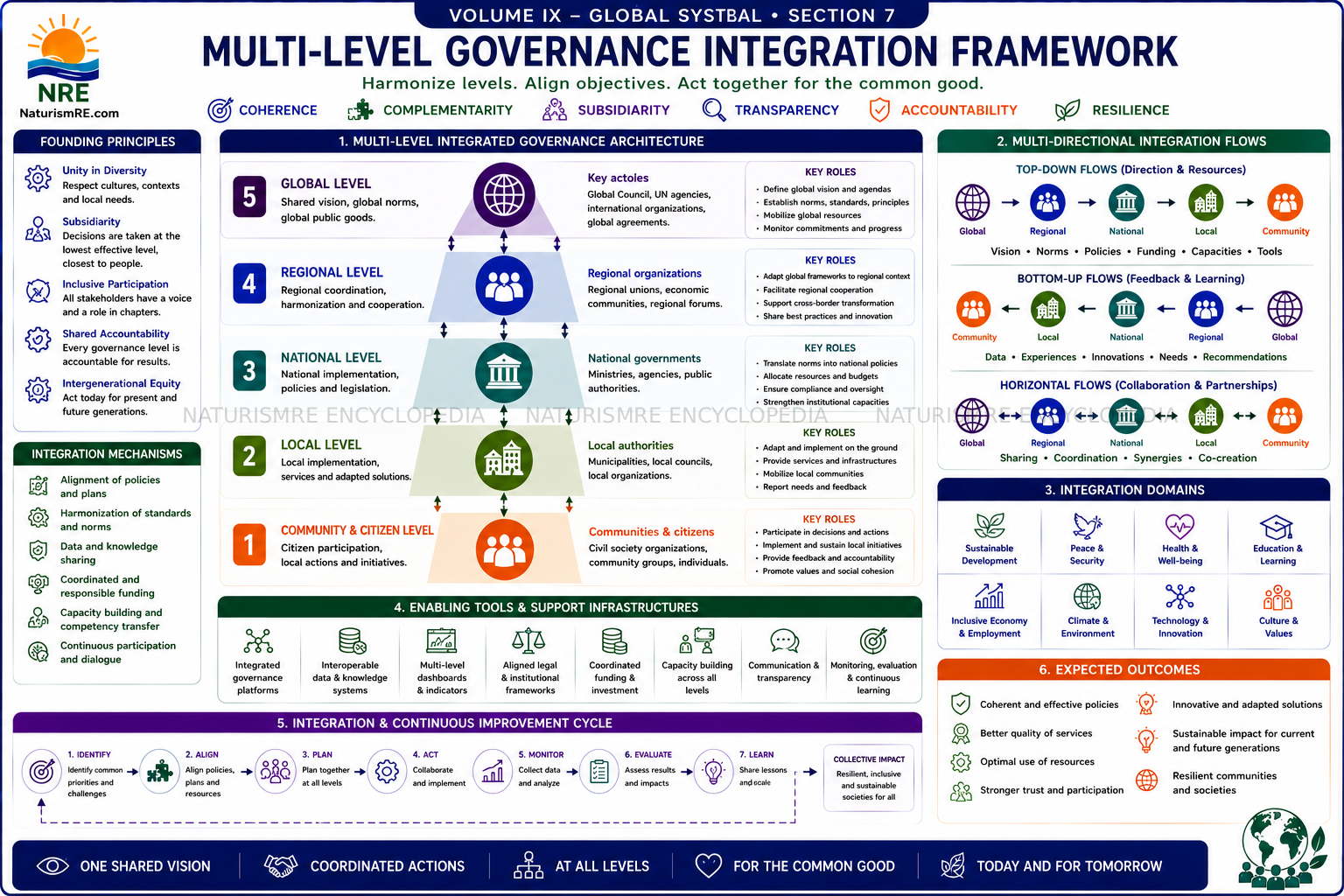
The long-term integration of naturist systems depends on their ability to interface effectively with multi-level governance structures, translating operational frameworks into policy-compatible models that enable recognition, coordination, and scalable implementation within existing regulatory environments.
7.1 Positioning Within Broader Governance Systems
As naturist systems evolve toward global coherence, long-term viability depends on integration within existing governance structures rather than operation in parallel or isolation.
Relevant structures include municipal and regional authorities, national regulatory frameworks, public health and planning systems, and environmental or land-use governance.
Integration requires naturist systems to be interpretable within policy language, compatible with regulatory objectives, and capable of operating within multi-layered governance environments.
This represents a transition from independent operational models to system components functioning within broader governance ecosystems.
7.2 The Policy Interface Layer
A critical element of integration is the policy interface, defined as the point at which naturist systems interact with formal governance processes.
This involves translation of system frameworks into regulatory-compatible terms, alignment with established policy categories such as recreation, wellbeing, and land use, and articulation of risk management and operational controls.
Effective policy interfaces enable clearer evaluation by authorities, reduce ambiguity in decision-making, and increase the likelihood of approval or acceptance.
Without a structured interface, systems may be misinterpreted, engagement with authorities becomes inconsistent, and regulatory friction increases.
7.3 Multi-Level Governance Coordination
Governance operates across multiple levels, including local, regional or state, and national structures.
Each level may apply distinct criteria, exercise authority over specific aspects, and interpret frameworks independently.
Effective coordination requires alignment of operational models across all relevant levels, recognition of jurisdiction-specific constraints, and adaptation of frameworks to differing regulatory environments.
Failure to coordinate across governance levels may result in conflicting requirements, operational inconsistency, and increased legal exposure.
7.4 Embedding Naturist Systems Within Policy Frameworks
Integration is achieved by embedding naturist systems within existing policy domains rather than creating entirely new regulatory categories.
Public Space Management
Naturist environments align with structured management and controlled use of shared public spaces.
Recreational Planning
Systems integrate within broader recreational and outdoor activity frameworks.
Health and Wellbeing Initiatives
Operational models align with preventive health and wellbeing-oriented policy objectives.
Environmental Stewardship
Systems support low-impact and environmentally aligned operational approaches.
Embedding involves aligning system objectives with policy goals, demonstrating compatibility with regulatory requirements, and providing evidence of controlled and low-risk operation.
This approach reduces the need for legislative reform, lowers institutional resistance, and mitigates perceptions of novelty or risk.
7.5 Coordination Mechanisms Across Systems
At a global level, coordination mechanisms are required to align frameworks across jurisdictions, support knowledge exchange, and maintain consistency in interpretation.
Such mechanisms may include shared reporting structures, standardised documentation, and collaborative communication platforms.
These enable distributed implementation while maintaining alignment at the system level and supporting continuous refinement.
7.6 Governance Alignment and System Legitimacy
Alignment with governance systems contributes directly to system legitimacy.
Legitimacy is reflected in recognition within formal structures, acceptance by regulatory authorities, and consistency with societal expectations.
It supports operational stability, scalability across jurisdictions, and integration into long-term planning frameworks.
Without alignment, systems remain marginal, face increased exposure to enforcement, and experience constraints on scalability.
7.7 Constraints and Limits of Governance Integration
Governance integration is subject to structural constraints.
These include variation in regulatory priorities, cultural and political sensitivity, and limitations within existing policy frameworks.
Such constraints result in uneven integration across regions, incremental adoption rather than uniform implementation, and continued reliance on context-specific solutions.
Systems must therefore remain adaptable, responsive to local conditions, and aligned with evolving governance dynamics.
7.8 Analytical Conclusion
Governance integration is a critical stage in the evolution toward coherent and scalable naturist systems.
Naturist systems must interface effectively with existing governance structures, translating operational frameworks into policy-compatible models.
Multi-level coordination is required to manage jurisdictional complexity, while embedding within existing policy domains enables practical integration.
Coordination mechanisms support global alignment, and governance alignment enhances legitimacy and scalability.
Integration remains constrained by regulatory and cultural variability, requiring adaptive and context-sensitive approaches.
Naturist systems that achieve governance integration are those that align with established frameworks, operate within regulatory expectations, and maintain adaptability across jurisdictions.
This establishes a defining principle for Volume IX:
The long-term integration of naturist systems depends on their ability to interface effectively with multi-level governance structures, translating operational frameworks into policy-compatible models that enable recognition, coordination, and scalable implementation within existing regulatory environments.
Primary Supporting Articles
From Policy Avoidance to Policy Design, The Case for Structured Clothing-Optional Zones
The Authority Gap, Who Actually Speaks for Naturism
Decentralised Governance vs Coordinated Systems
Interoperability Between Jurisdictions, Structural Conditions and Limits
From Zones to Systems, How Structured Environments Scale Across Jurisdictions