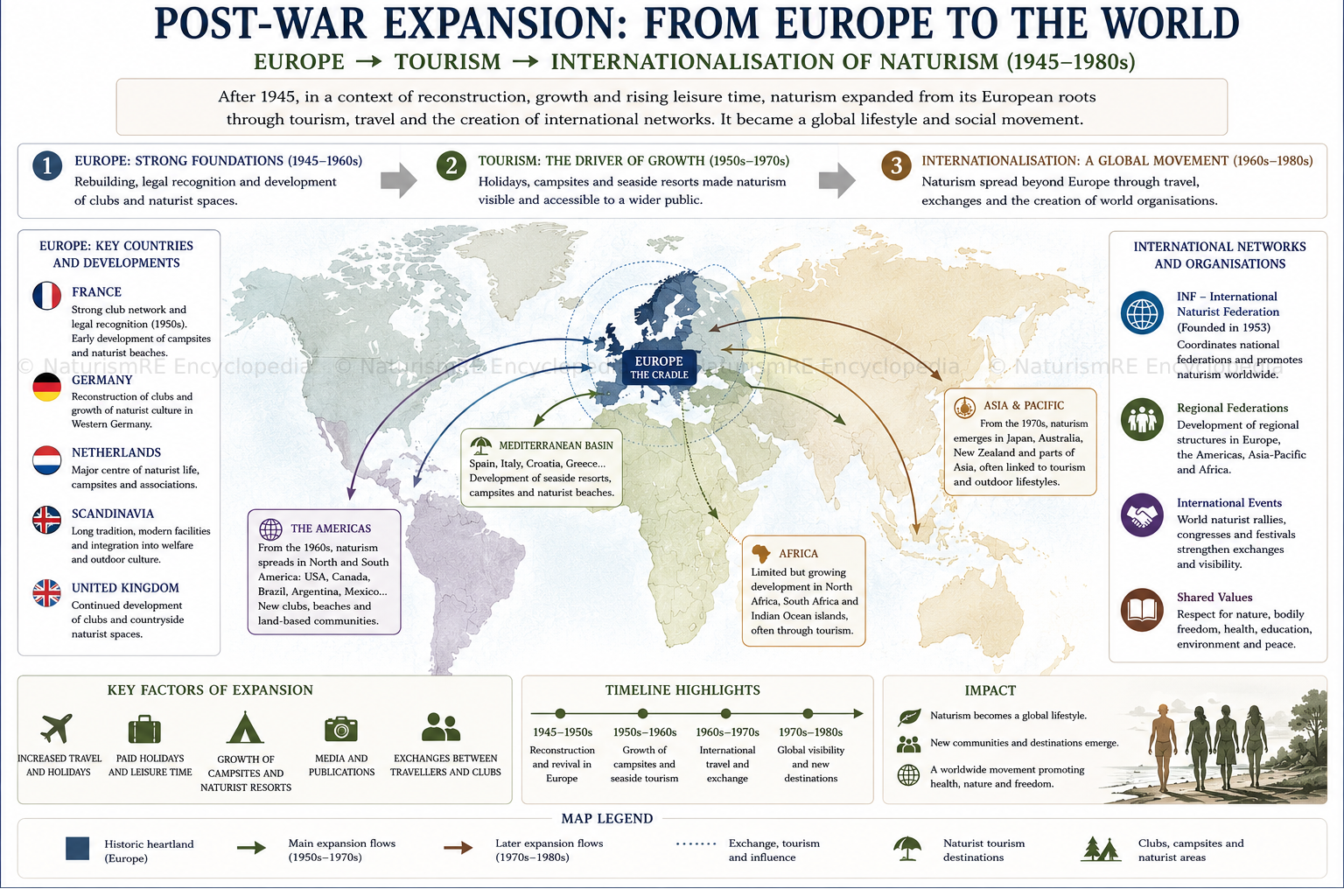
Post-War Expansion: Institutional Consolidation and Conditional System Scaling (1945–1980s)
Examining the post-war period as a phase of institutional rebuilding, controlled expansion, legal adaptation, and scalable but constraint-dependent naturist system development.
Naturism expands not by removing constraints, but by operating effectively within them.
6.1 Purpose
This section examines the post-Second World War period as a phase of system reactivation, institutional consolidation, and controlled expansion in the development of naturism.
Its purpose is to analyse how naturist systems re-emerged following systemic disruption, to identify the structural mechanisms that enabled scalability, and to define the conditions under which naturism transitioned into a stable and recognisable social and economic activity.
This section establishes naturism as a governance-dependent system capable of expansion within defined constraints.
6.2 Post-War System Reactivation Conditions
The post-war environment created conditions favourable to the reactivation of social systems, including naturism.
Return to Civilian Life
Re-establishment of civilian social systems enabled renewed participation in recreational and community activity.
Infrastructure Reconstruction
Physical and institutional rebuilding created conditions for organised participation and environmental redevelopment.
Health and Wellbeing Focus
Post-war emphasis on recovery, physical restoration, and wellbeing supported naturist expansion.
Expansion of Leisure Time
Industrial societies increasingly integrated organised leisure and recreational participation into everyday life.
Within this context, naturism re-emerged as part of broader patterns associated with outdoor recreation, physical restoration, and simplified, non-industrial lifestyle models.
This period represents a transition from constrained survival to structured reactivation under stabilising conditions.
6.3 Institutional Rebuilding as a Stability Mechanism
Naturist organisations re-established themselves through the reopening of pre-war structures, the formation of new associations, and the development of coordinated governance models.
This phase introduced clearer organisational frameworks, defined behavioural standards, and formalised membership systems.
These developments enabled naturism to operate with internal consistency, align with legal expectations, and present a coherent external identity.
Institutional rebuilding therefore functioned as a stabilisation mechanism enabling predictable system operation.
6.4 Emergence of Federated Structures and Network Coordination
A defining structural development was the creation of national federations and international coordinating bodies.
These entities facilitated standardisation of practices, representation in legal and policy contexts, and coordination across regions.
This marked a transition from isolated local systems to coordinated multi-level networks.
Federated structures enabled knowledge transfer, alignment of behavioural norms, and increased system coherence.
6.5 Infrastructure Development and Controlled Environments
Post-war expansion was supported by the development of dedicated environments, including resorts, campgrounds, designated beaches, and recreational facilities.
These environments provided controlled participation conditions, reduced interpretative ambiguity, and established predictable behavioural frameworks.
This enabled naturism to scale participation while maintaining internal consistency and reducing legal and social risk.
Infrastructure development therefore enabled scalable participation through environmental control.
6.6 Legal Adaptation and Conditional Recognition
Legal frameworks began to evolve in response to the presence of structured environments.
In several jurisdictions, designated areas were recognised or tolerated, enforcement became increasingly context-sensitive, and distinctions between nudity and indecency were clarified.
This did not constitute full legal acceptance. It established conditional tolerance, where permission was granted within defined boundaries and under controlled conditions.
Legal viability remained limited to environments characterised by non-disruptive behaviour and clearly defined participation contexts.
This reinforces a key principle:
Naturism becomes legally viable when it aligns with expectations of order, control, and predictability.
6.7 Social Normalisation and Controlled Perception Shift
Post-war societies experienced gradual shifts in attitudes toward the body, influenced by the expansion of leisure culture, growth in tourism, evolving social norms, and increased exposure through media.
Naturism benefited where it was positioned as family-oriented, health-associated, and behaviourally structured.
This contributed to partial social normalisation and increased tolerance within specific contexts.
However, acceptance remained uneven and perception continued to be context-dependent.
This demonstrates that normalisation occurs through controlled exposure rather than unrestricted visibility.
6.8 Economic Integration and System Hybridisation
Naturism became increasingly integrated into broader economic systems, particularly through tourism and destination-based participation.
Key developments included the establishment of dedicated resorts, the emergence of repeat participation patterns, and integration into regional economies.
This created a hybrid system combining social participation with economic activity.
Economic viability depended on the stability of environments, predictability of behaviour, and alignment with regulatory conditions.
6.9 Internal Standardisation and Behavioural Control
As participation expanded, internal consistency became critical.
Organisations implemented behavioural codes, safeguarding practices, and structured governance protocols to ensure maintenance of non-sexual positioning, reduction of internal risk, and consistency across environments.
Standardisation enabled expansion without loss of structural integrity.
6.10 Structural Constraints and System Limits
Despite expansion, naturism remained constrained by legal variability across jurisdictions, persistent social stigma in certain regions, dependence on designated environments, and sensitivity to public perception.
As a result, expansion was conditional, region-specific, and dependent on controlled conditions.
This confirms a fundamental system principle:
Growth occurs within constraints, not through their removal.
6.11 Analytical Implications
The post-war period establishes several critical system-level dynamics.
Reactivation Capacity
Naturist systems can recover and expand following disruption where institutional structure remains present.
Conditional Legal Adaptation
Legal tolerance develops incrementally and remains dependent on controlled conditions.
Economic Integration
Economic participation becomes viable through stability, predictability, and structured environments.
Behavioural Standardisation
Controlled behavioural frameworks enable expansion without destabilising system legitimacy.
These dynamics define naturism as a scalable but constraint-dependent system.
6.12 Conclusion
The post-war period marks the transformation of naturism from a constrained and fragmented system into a structured, coordinated, and scalable framework.
This transformation was enabled by institutional consolidation, infrastructure development, legal adaptation, and controlled shifts in social perception.
However, expansion did not eliminate dependency. Naturism remained contingent on governance structures, regulatory alignment, behavioural consistency, and controlled environments.
This leads to a defining principle:
Naturism expands not by removing constraints, but by operating effectively within them.
This distinction demonstrates that growth is conditional, scalability depends on structure, and stability depends on control.
The post-war period therefore establishes naturism as a scalable yet structurally constrained system, forming the foundation for the diversification and decentralisation observed in the late twentieth century.