

Case Law, Judicial Interpretation, and the Operationalisation of Legal Meaning
Examining how courts transform abstract statutory principles into operational legal outcomes through interpretation of intent, behaviour, context, and impact.
The law does not regulate nudity as a category. It regulates the circumstances under which nudity acquires legal meaning.
5.1 Purpose
This section examines the role of judicial decision-making in shaping the legal treatment of nudity through case law and precedent.
Its purpose is to identify consistent patterns in judicial reasoning across jurisdictions, to analyse how courts transform abstract legal principles into practical outcomes, and to define the mechanisms through which ambiguity is resolved.
This section positions case law as the operational layer of legal systems, where meaning is constructed through the interpretation of intent, behaviour, context, and impact.
5.2 Case Law as the Operational Layer of Legal Systems
Statutory provisions governing nudity are typically broad, flexible, and open to interpretation.
As a result, courts play a central role in determining how legal thresholds are applied, how ambiguous situations are classified, and how competing factors are balanced.
Judicial decisions therefore function as the mechanism through which legal frameworks become operational reality.
In this domain, statutes define potential boundaries, while courts determine how those boundaries are applied in practice.
5.3 Judicial Role of Intent
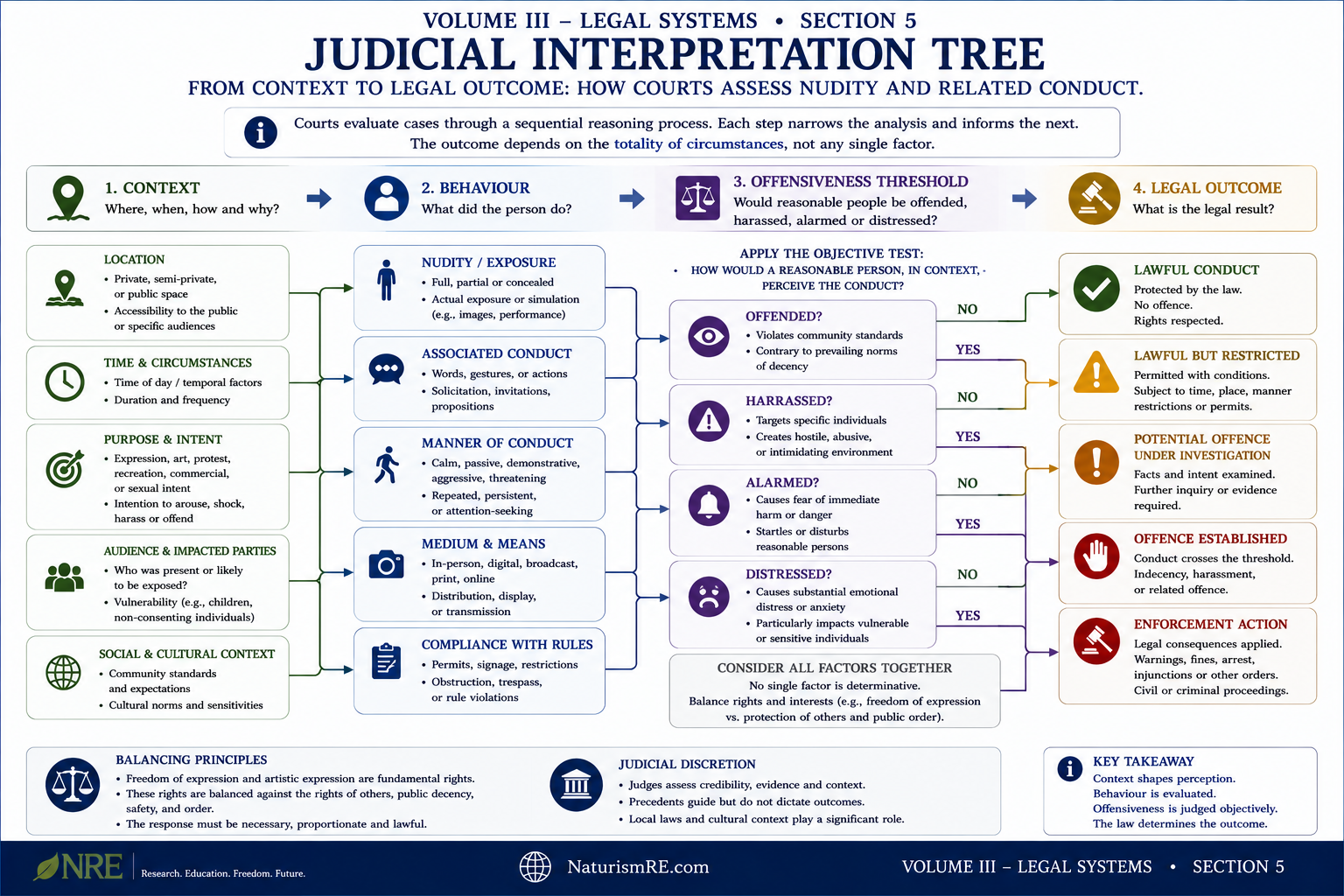
Across jurisdictions, courts consistently treat intent as a central evaluative factor, interpreted in conjunction with behaviour, context, and impact.
Judicial reasoning distinguishes between intent to cause alarm or distress, intent associated with sexual conduct, and the absence of demonstrable harmful intent.
Courts generally require evidence that intent reaches a defined threshold and that it aligns with observable conduct.
Where such intent is not established, liability may not be sustained and prosecution may fail despite the presence of nudity.
This establishes a consistent judicial principle:
Nudity without demonstrable harmful or disruptive intent may not meet legal thresholds, but intent alone is insufficient without supporting behavioural and contextual conditions.
5.4 Behaviour as the Trigger for Legal Classification
Courts do not assess intent in isolation. They evaluate observable behaviour.
Sexualised Conduct
Behaviour becomes actionable where exposure is linked to sexual activity or explicit sexual signalling.
Directed Interaction
Conduct directed toward specific individuals increases the likelihood of legal intervention.
Persistence After Objection
Continued exposure after complaint or instruction may elevate conduct beyond passive presence.
Escalation and Disruption
Behaviour becomes legally significant when it produces confrontation, coercion, or disruption of public order.
This reinforces a critical system principle:
Nudity becomes legally actionable through behaviour, not through presence alone.
5.5 Contextual Interpretation as a Determining Variable
Context is consistently treated as a decisive factor in judicial reasoning.
Courts differentiate between designated or controlled spaces, private or semi-private environments, and general public settings. They also consider whether exposure was avoidable, whether individuals were compelled to witness it, and whether the setting created reasonable expectations.
As a result, identical conduct may produce different legal outcomes depending on the context in which it occurs.
This confirms that legal classification is inseparable from environmental conditions.
5.6 Audience Impact and Perceived Harm
Courts evaluate the impact of exposure on others, including actual distress, likelihood of distress, and the characteristics of those present.
This introduces an element of controlled subjectivity, as perception varies between individuals and courts must apply general standards to specific circumstances.
This is typically operationalised through a reasonable person standard, which converts subjective perception into an objective legal threshold.
Judicial reasoning therefore balances measurable behaviour with the perceived impact of that behaviour within a defined context.
5.7 Threshold-Based Legal Determination
Case law demonstrates that courts apply threshold-based evaluation rather than absolute rules.
To establish an offence, multiple elements must converge, including intent, behaviour, context, and impact.
Where one or more elements are insufficient, thresholds are not met and liability is not established.
This confirms a fundamental legal structure:
Legal classification is conditional and requires convergence of multiple variables.
5.8 Variability and Interpretative Divergence
Judicial outcomes vary due to differences in statutory frameworks, cultural and regional context, interpretation by individual courts, and evidentiary strength.
Even within a single jurisdiction, similar cases may produce different outcomes depending on fact-specific analysis.
This variability is not incidental. It is the direct consequence of systems that rely on interpretation without stable contextual frameworks.
Legal outcomes therefore reflect the conditions under which interpretation occurs rather than inconsistency in principle.
5.9 Role of Precedent in System Evolution
Judicial decisions contribute to the evolution of legal standards through precedent.
Over time, case law clarifies ambiguous statutory language, refines thresholds of offence, and establishes recurring interpretative patterns.
Precedents may expand tolerance in defined contexts or reinforce restrictions under certain conditions.
This creates a dynamic system in which legal meaning evolves through cumulative interpretation rather than fixed definition.
5.10 Interaction Between Statutory Law and Judicial Interpretation
Case law operates in conjunction with statutory law.
Statutes provide structural definitions, while courts provide interpretative application.
Where statutory language is ambiguous, courts determine the scope of application, the limits of enforcement, and the practical meaning of legal terms.
This interaction is essential because rigid definitions are insufficient to address real-world complexity.
5.11 Analytical Implications
Analysis of case law reveals a consistent structural pattern.
Interpretative Determination
Legal outcomes emerge through judicial interpretation rather than fixed statutory rules alone.
Multi-Variable Evaluation
Intent operates in conjunction with behaviour, context, and impact rather than independently.
Threshold Convergence
Legal liability generally requires convergence of multiple evaluative conditions.
Evolving Standards
Legal meaning evolves through cumulative precedent and recurring interpretative patterns.
Consistency in this domain arises from shared reasoning processes rather than from uniform statutory structures.
5.12 Conclusion
Case law demonstrates that the regulation of nudity is not determined solely by statutory wording, but by judicial interpretation applied to specific factual conditions.
Across jurisdictions, courts consistently confirm that nudity is not inherently unlawful, that legal relevance arises only when combined with intent, behaviour, context, and impact, and that thresholds are defined through interpretation rather than fixed categorisation.
This establishes a fundamental legal condition:
The law does not regulate nudity as a category. It regulates the circumstances under which nudity acquires legal meaning.
Legal classification therefore remains conditional rather than absolute, and predictability is inherently limited due to interpretative variability. Consistency across jurisdictions arises from shared reasoning rather than identical statutes.
Case law functions as the mechanism through which abstract legal principles are operationalised, the process through which ambiguity is resolved, and the system by which legal boundaries are continuously defined and refined.
This condition explains why legal stability in naturist systems cannot be achieved through statutory definition alone, but requires alignment between legal interpretation and structured environmental conditions.
Understanding this distinction shifts analysis from written law to applied reasoning, enables accurate cross-jurisdictional comparison, and provides the foundation for structured legal and policy frameworks.
Primary Supporting Articles
Judicial Threshold Formation, How Courts Define Offensiveness and Acceptability in Naturist Contexts
Why Enforcement Is Driven by Perception Rather Than Legal Principle
Behavioural Thresholds and Legal Trigger Points in Structured Naturist Environments
From Legal Principle to Operational Reality, Why Law Requires Structured Environments to Function
Why Legal Clarity Without Operational Context Fails in Practice