

Early 20th Century: System Formation, Institutionalisation, and Behavioural Codification (1900–1939)
Examining the period in which naturism evolved from dispersed reform movements into structured, governed, and scalable institutional systems.
Naturism is not defined by nudity itself, but by the structured conditions under which nudity becomes socially and legally sustainable.
4.1 Purpose
This section examines the early twentieth century as the phase in which naturism transitioned from dispersed reformist practices to structured, institutionalised systems.
Its purpose is to analyse how nineteenth-century concepts were operationalised, to identify the mechanisms that enabled system formation, and to define the conditions under which naturism became a repeatable social model.
This section establishes the emergence of naturism as a governed system rather than as a collection of ideas or isolated practices.
4.2 Transition from Reform Concepts to Organised Systems
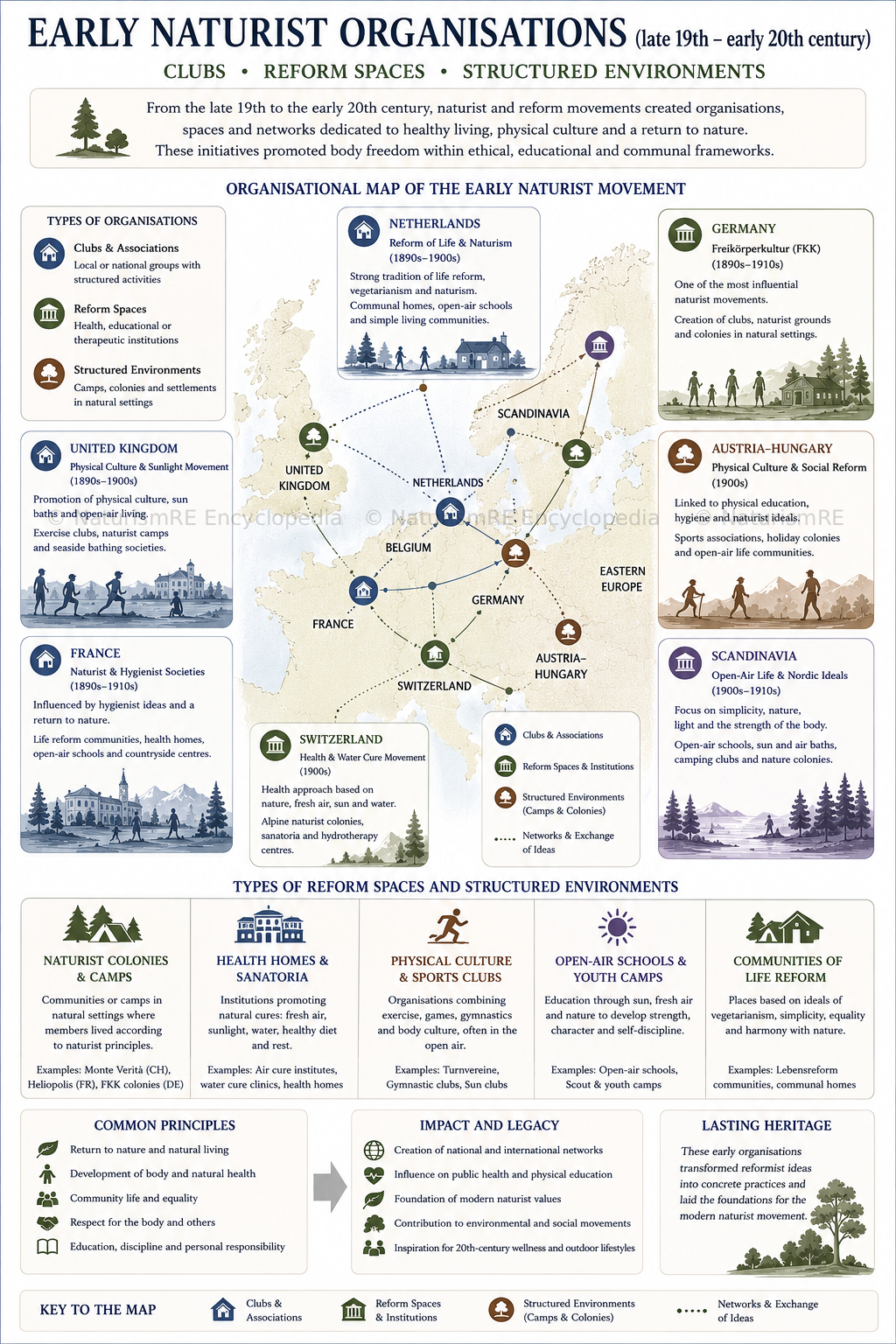
At the beginning of the twentieth century, previously fragmented practices began to consolidate.
Health-based and philosophical concepts developed during the nineteenth century were adopted by organised groups, implemented within controlled environments, and transmitted through emerging networks.
This introduced a structural transition from theoretical justification to operational implementation.
To support this transition, systems required shared rules, defined participation structures, and identifiable communities.
This marks the point at which naturism became a structured social system rather than an experimental or reformist practice.
4.3 Emergence of System Architecture
The early twentieth century introduced the core components of naturist system architecture.
Controlled Environments
Defined spatial conditions reduced ambiguity and stabilised behavioural interpretation.
Behavioural Regulation
Shared conduct rules established acceptable interaction standards and protected system legitimacy.
Organisational Governance
Governance mechanisms enabled consistency, continuity, and enforceable participation conditions.
Structured Participation
Membership systems and organised participation models enabled repeatability and scalability.
These components functioned collectively to reduce ambiguity, enable repeatability, and support both legal and social positioning.
This architecture has remained structurally consistent across subsequent developments.
4.4 Germany and the Formation of a Scalable Model
Germany played a central role in system development through the emergence of Freikörperkultur.
This model established organised associations, dedicated physical environments, and integration with physical culture and outdoor activity.
Within this system, nudity was explicitly framed as non-sexual, natural, and acceptable within defined conditions.
By the 1920s, this model demonstrated repeatability, expansion potential, and a recognisable social structure.
It represents the first instance of naturism operating as a scalable, organised system.
4.5 Institutionalisation and Governance Development
As participation expanded, governance structures became necessary to maintain consistency and legitimacy.
Organisations implemented codes of conduct, membership structures, access control mechanisms, and behavioural enforcement systems.
These structures served to maintain internal consistency, prevent misinterpretation, and align participation with legal expectations.
This introduces a defining system principle:
Nudity becomes socially viable only when governed.
Institutionalisation transformed naturism into a controllable, predictable, and legally interpretable system.
4.6 France and the Emergence of Integrated Environments
In France, naturism developed through a combination of medical frameworks, social experimentation, and lifestyle-based adaptation.
A critical development was the establishment of controlled communities and early resort-style environments.
These environments demonstrated that social nudity could be organised at scale, that economic and social systems could coexist, and that participation could be sustained within defined conditions.
This represents the emergence of integrated naturist environments combining social, economic, and spatial systems.
4.7 Britain and the Model of Controlled Restriction
In Britain, naturism developed under more restrictive legal and social conditions.
This produced a model characterised by small, private organisations, strict behavioural codes, and a strong emphasis on discretion and compliance.
Organisations implemented detailed conduct rules, privacy safeguards, and controlled interaction protocols.
This model prioritised legal defensibility, social acceptability, and risk minimisation.
It demonstrates that system structure adapts to external constraints while maintaining core principles.
4.8 North America and Legal Boundary Testing
In North America, naturism developed through controlled environments, structured participation models, and progressive legal testing.
Judicial decisions addressing non-sexual nudity among consenting adults within controlled environments contributed to the establishment of limited legal tolerance and recognition of contextual distinction.
This confirms a key system mechanism:
Legal viability emerges through alignment with controlled conditions rather than through general permission.
4.9 Political Interaction and System Vulnerability
Naturist systems did not develop in isolation. They interacted with political ideologies, social reform movements, and state control mechanisms.
In some contexts, naturism was associated with social reform and alternative lifestyles. In others, it was perceived as morally questionable or politically sensitive.
This created a structural condition in which naturist systems remain exposed to reinterpretation based on political context.
This exposure required ongoing adaptation, alignment, and controlled positioning.
4.10 Behavioural Standardisation as a Core Requirement
Across all regions, a consistent pattern emerged.
Nudity was acceptable only within clearly defined behavioural limits. These included prohibition of sexual conduct, requirements for respectful interaction, maintenance of non-disruptive conditions, and enforcement of boundaries.
These standards were not optional. They were necessary for legal survival, essential for social acceptance, and foundational for system stability.
This establishes a core principle:
Behavioural regulation is the defining feature of sustainable naturist systems.
4.11 Emergence of a Global Structural Pattern
By the late 1930s, naturism had established organised communities, defined behavioural frameworks, controlled environments, and early international connections.
Although participation remained limited in scale, the structural model was complete.
Naturism had become a repeatable, governed system capable of operating across multiple contexts.
4.12 Analytical Implications
The early twentieth century establishes several system-defining conditions.
Operational Systems
Naturism transitions from conceptual movement to organised and operational structure.
Institutional Governance
Governance mechanisms become essential for social legitimacy and long-term viability.
Behavioural Standardisation
Codified behavioural expectations enable legal tolerance and interpretative consistency.
Adaptive Survival
Naturist systems adapt structurally to varying legal, cultural, and political conditions.
These conditions define the operational architecture of modern naturism.
4.13 Conclusion
The early twentieth century represents the decisive transformation of naturism into a structured, governed, and scalable system.
This transformation was enabled by the creation of controlled environments, the codification of behavioural standards, and the development of institutional governance.
These elements allowed naturism to operate within legal frameworks, maintain social legitimacy, and sustain organised participation.
This establishes a defining principle:
Naturism is not defined by nudity itself, but by the structured conditions under which nudity becomes socially and legally sustainable.
This distinction explains why naturism can function in stable environments, why governance is required for legitimacy, and why it remains sensitive to external conditions.
The early twentieth century therefore establishes the enduring system model:
Naturism persists through structure, regulation, and adaptation rather than through unregulated expression.
This model underpins all subsequent developments, including disruption under conflict, expansion under stability, and diversification under changing social conditions.
Primary Supporting Articles
From Convergence to Organisation, The Formalisation of Naturist Systems (1900-1939)
Institutionalisation of Naturism, From Structured Practice to Organised Systems
Social Cohesion and Internal Regulation in Early Naturist Communities (1900-1939)
Secondary Supporting Articles
From Fragmented Practice to Structured Systems, The Evolution of Naturism as a Social Architecture
From Fragmented Systems to Operational Coherence, Defining Maturity in Naturist System Deployment
Behaviour Stabilisation in Open vs Controlled Access Environments
How Behavioural Standards Become Self-Enforcing Within Defined Environments
Why Boundary Definition Determines Whether Systems Stabilise or Collapse