

Legal Definitions of Nudity, Indecency, and Interpretative Structure
Examining the legal logic through which nudity is interpreted, differentiated from indecency, and assessed within structured systems of contextual evaluation.
The body is not the offence. The interpretation of its exposure determines whether an offence exists.
1.1 Purpose
This section establishes the foundational legal definitions and interpretative principles governing nudity across jurisdictions.
Its purpose is to define, with precision, how legal systems distinguish between nudity as a physical condition and indecency as a regulated category of conduct, to identify the elements required for legal classification, and to provide the analytical baseline for all subsequent sections.
This section does not describe jurisdiction-specific law. It defines the structural logic common to legal systems, enabling consistent cross-jurisdictional analysis.
1.2 Object of Legal Regulation
Across legal systems, the primary object of regulation is not the human body itself, but conduct, intention, and impact.
Nudity is therefore treated as a state of exposure, an observable condition that may acquire legal relevance only when combined with evaluative elements.
This reflects a foundational legal principle:
Law regulates behaviour and its consequences, not the mere existence of the body.
1.3 Working Definition of Nudity
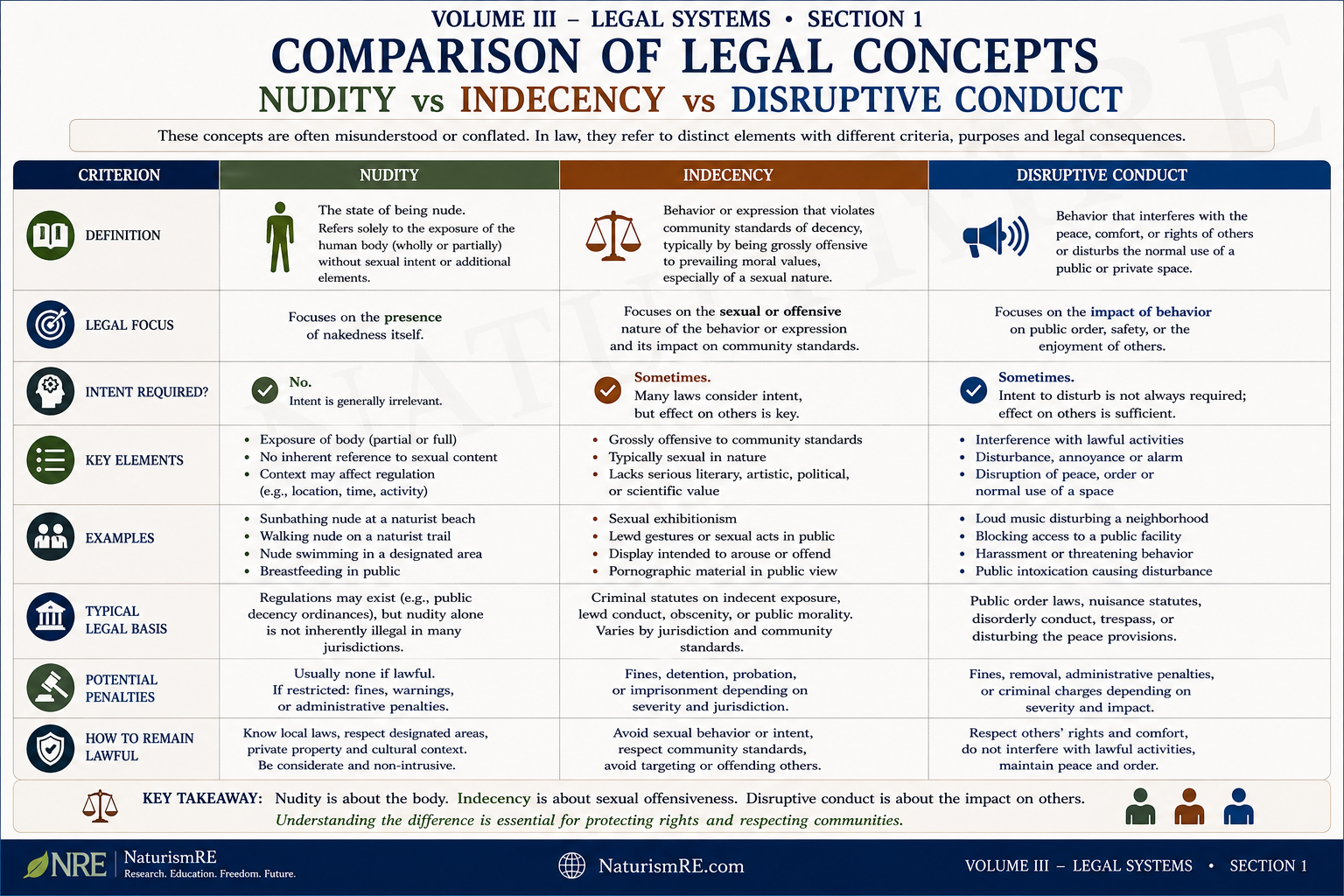
For the purposes of legal analysis, nudity refers to partial or full exposure of anatomical areas typically covered in public contexts.
While statutory definitions vary, they generally refer to the visibility of specific body regions, the degree and duration of exposure, and the circumstances under which exposure occurs.
This definition is descriptive and non-normative. It identifies a condition without, in itself, establishing illegality.
1.4 Indecency as a Legal Construct
Indecency is not a physical condition. It is a legal classification applied to conduct.
Offences associated with nudity, such as indecent exposure, lewd conduct, or public indecency, typically require additional evaluative elements. These include sexual intent or purpose, behaviour considered offensive or inappropriate, and the likelihood of causing distress, alarm, or disruption.
This establishes a critical distinction:
Nudity is observable. Indecency is interpreted.
1.5 Constitutive Elements of Legal Offence
To establish an offence involving nudity, legal systems generally require a combination of interacting elements.
Intent
Includes demonstrable purpose to arouse, offend, provoke, or cause alarm or distress.
Behaviour
Includes actionable conduct such as harassment, directed exposure, persistence, or sexual activity.
Context
Includes whether exposure occurs within public, private, controlled, or expected environments.
Impact
Includes actual or likely distress, involuntary exposure, disruption, or public order implications.
Where these elements are absent or insufficient, legal thresholds are typically not met.
1.6 Role of Intent in Legal Differentiation
Intent is frequently the decisive factor in distinguishing lawful from unlawful exposure.
Legal systems differentiate between non-sexual, contextually explainable exposure and conduct intended to produce a sexual or disruptive effect.
Intent is rarely explicit. It is inferred from observable behaviour, repetition, proximity to others, and response to external cues.
This allows authorities to distinguish between identical physical conditions producing different legal outcomes.
1.7 Behavioural Thresholds and Escalation Mechanisms
Legal frameworks operate through threshold-based escalation.
Conduct becomes actionable only when specific indicators are present. These may include persistence after objection or instruction, focus on specific individuals, integration of sexual gestures or conduct, or refusal to comply with reasonable direction.
These factors shift legal analysis from condition, which is neutral, to conduct, which is actionable.
1.8 Contextual Qualification of Exposure
Context is a primary determinant in legal interpretation.
Identical exposure may be assessed differently depending on whether it occurs in medical or functional settings, artistic or educational contexts, designated or controlled environments, or general public spaces.
Legal systems therefore apply context-sensitive evaluation rather than uniform rules.
1.9 Public Decency and Order Frameworks
Most jurisdictions regulate nudity through broader legal categories such as public decency, public order, or nuisance.
These categories are intentionally flexible. They allow adaptation to social norms, judicial interpretation, and discretionary enforcement.
This flexibility enables contextual application but introduces variability in outcomes.
1.10 Audience, Consent, and Exposure Dynamics
Legal assessment considers whether exposure is avoidable or unavoidable, and whether it is consensual or imposed.
A distinction is made between environments where individuals choose to be present and those where exposure cannot be avoided.
This introduces the principle of contextual consent, in which participation implies acceptance of conditions, while lack of choice increases legal sensitivity.
1.11 Sexual Versus Non-Sexual Classification
Legal systems do not presume that nudity is inherently sexual.
Classification depends on intent, behaviour, and situational indicators. This distinction prevents automatic conflation of non-sexual social nudity with sexually motivated exposure.
Maintaining this distinction is essential for consistent legal classification and proportional enforcement.
1.12 Jurisdictional Variability Within Structural Consistency
While application varies across jurisdictions due to differences in statutory language, cultural context, judicial precedent, and enforcement practice, the underlying interpretative structure remains consistent.
Variability exists at the level of application, not at the level of legal logic.
1.13 Enforcement and Discretion as Operational Factors
In practice, enforcement involves structured discretion.
Authorities assess the presence of harm or complaint, behaviour and cooperation, likelihood of escalation, and contextual conditions.
Legal outcomes are therefore shaped by interpretation within defined boundaries.
1.14 Analytical Alignment with System Framework
The legal framework described aligns directly with the broader system model established in Volume I.
Across jurisdictions, interpretation depends on context, intent, behaviour, consent, governance, and perception. Legal systems operationalise these variables through statutory definitions, case law, and enforcement practices.
1.15 Conclusion
Legal systems do not criminalise the human body. They regulate the conditions under which exposure acquires legal meaning.
Nudity becomes legally relevant only when combined with demonstrable intent, qualifying behaviour, defined context, and measurable or perceived impact.
This establishes a controlling principle:
The body is not the offence. The interpretation of its exposure determines whether an offence exists.
This principle ensures that classification remains precise, interpretation remains consistent, and conclusions remain legally defensible.
Without this distinction, legal analysis becomes assumption-based. With it, the regulation of nudity can be understood as a structured, conditional, and context-dependent legal system.
Primary Supporting Articles
Legal Definition and the Limits of Regulation: Why Law Alone Cannot Stabilise Naturist Systems
From Legal Principle to Operational Reality, Why Law Requires Structured Environments to Function
Behavioural Thresholds and Legal Trigger Points in Structured Naturist Environments
Judicial Threshold Formation, How Courts Define Offensiveness and Acceptability in Naturist Contexts
Secondary Supporting Articles
Why Enforcement Is Driven by Perception Rather Than Legal Principle
Why Intent Cannot Protect Behaviour Without Defined Context
Why Legal Clarity Without Operational Context Fails in Practice
Contextual Legality and Interpretive Enforcement, The United Kingdom Model of Naturist Regulation