

Global Synthesis: Legal Structures, Interpretation, and System Limits
Integrating global legal frameworks, enforcement systems, and interpretative models into a unified analysis of how nudity is regulated across jurisdictions.
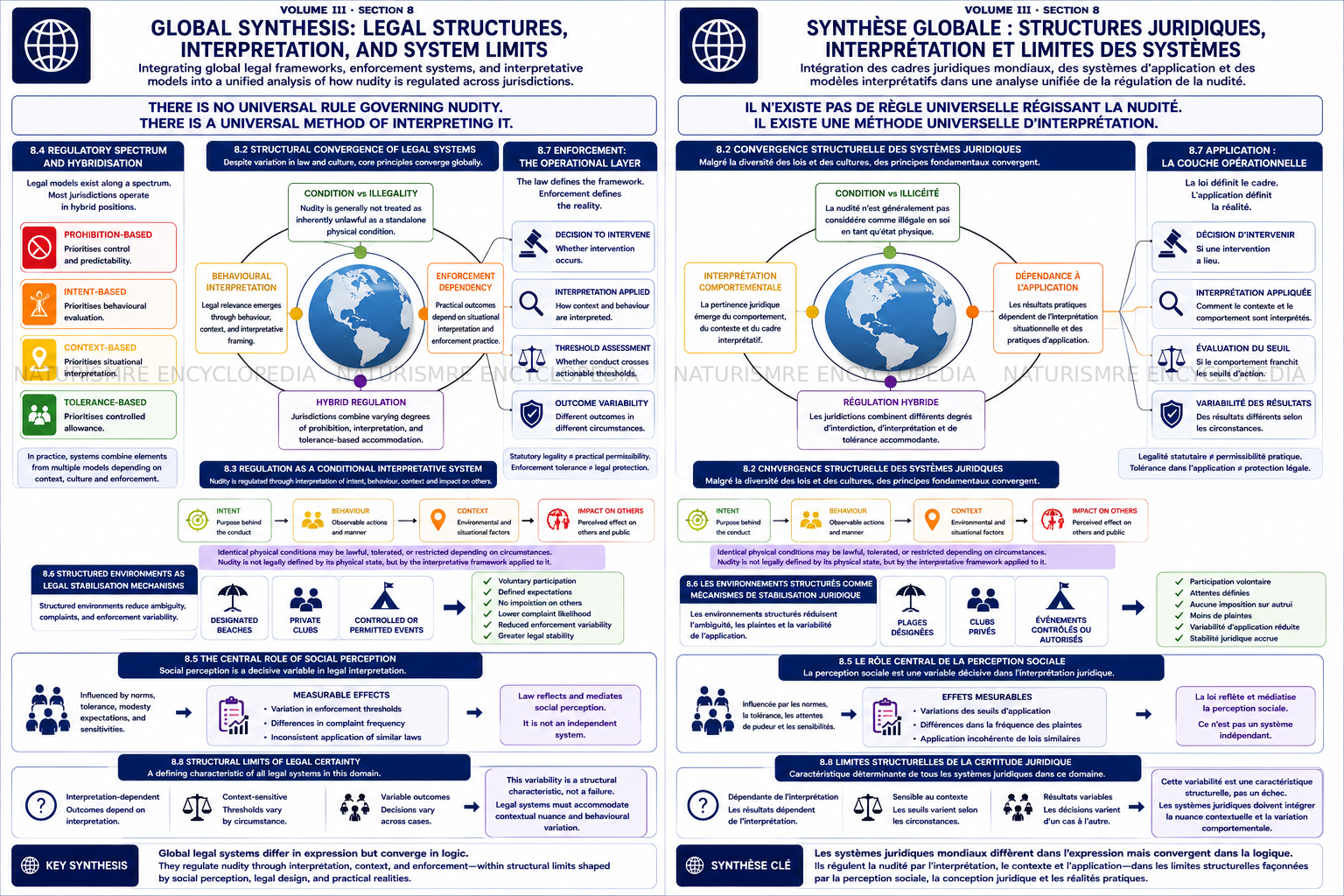
There is no universal rule governing nudity. There is a universal method of interpreting it.
8.1 Purpose
This section provides a system-level synthesis of the legal frameworks governing nudity across jurisdictions, integrating the statutory models, enforcement patterns, and interpretative mechanisms identified in preceding sections.
Its purpose is not to introduce new legal categories, but to identify structural consistencies across legal systems, define the operational logic governing legal interpretation, and establish the limits of regulatory control.
This synthesis positions nudity regulation as a dynamic interpretative system rather than as a fixed legal construct.
8.2 Structural Convergence of Legal Systems
Despite variation in statutory language, enforcement practices, and cultural context, legal systems demonstrate a high degree of structural convergence.
Condition vs Illegality
Nudity is generally not treated as inherently unlawful as a standalone physical condition.
Behavioural Interpretation
Legal relevance emerges through behaviour, context, and interpretative framing rather than exposure alone.
Enforcement Dependency
Practical outcomes depend on situational interpretation and enforcement practice rather than automatic classification.
Hybrid Regulation
Jurisdictions combine varying degrees of prohibition, contextual interpretation, and tolerance-based accommodation.
These principles apply across all identified regulatory models, including prohibition-based, intent-based, context-based, and tolerance-based systems.
This convergence indicates that legal diversity exists at the surface level, while underlying regulatory logic remains consistent.
8.3 Regulation as a Conditional Interpretative System
Legal systems do not regulate nudity as a fixed category. They regulate it through conditional interpretation frameworks.
Interpretation is typically based on the interaction of intent, observable behaviour, environmental context, and perceived impact on others.
As a result, identical physical conditions may be classified differently depending on circumstances. Conduct may be lawful in one context, tolerated in another, and restricted or penalised elsewhere.
This establishes a universal condition:
Nudity is not legally defined by its physical state, but by the interpretative framework applied to it.
This condition explains both variability in outcomes and consistency in reasoning processes.
8.4 Regulatory Spectrum and Hybridisation
The legal models identified in earlier sections exist along a regulatory spectrum rather than as discrete categories.
Prohibition-based systems prioritise control and predictability. Intent-based systems prioritise behavioural evaluation. Context-based systems prioritise situational interpretation. Tolerance-based systems prioritise controlled allowance.
In practice, most jurisdictions operate within hybrid positions, where elements of multiple models are combined.
These models shift depending on enforcement context, cultural conditions, and administrative priorities. This reflects a balancing process between legal certainty, social expectation, and practical enforcement considerations.
No system operates in isolation. All are adaptive responses to competing constraints.
8.5 The Central Role of Social Perception
Across all jurisdictions, social perception acts as a decisive variable in legal interpretation.
Legal outcomes are influenced by public tolerance levels, cultural norms, expectations of modesty, and sensitivity to perceived exposure.
This produces measurable effects, including variation in enforcement thresholds, differences in complaint frequency, and inconsistent application of similar laws.
This confirms a structural reality:
Legal regulation of nudity is inseparable from the social environment in which it operates.
Law functions not as an independent system, but as a mechanism that reflects and mediates social perception.
8.6 Structured Environments as Legal Stabilisation Mechanisms
A consistent global pattern is the role of structured environments in stabilising legal interpretation.
Examples include designated beaches, private clubs, and controlled or permitted events. Within these environments, participation is voluntary, expectations are defined, and exposure is not imposed on non-participants.
These conditions reduce interpretative ambiguity, lower the likelihood of complaint, and limit enforcement variability.
Structured environments therefore function as legal stabilisation systems, reducing reliance on discretionary interpretation.
8.7 Enforcement as the Operational Layer of Law
While statutes define legal thresholds and conceptual boundaries, enforcement determines practical outcomes.
Enforcement bodies decide whether intervention occurs, how interpretation is applied, and whether conduct crosses actionable thresholds.
This creates a universal condition:
The law defines the framework. Enforcement defines the reality.
This distinction is critical. Statutory legality does not guarantee practical permissibility, and enforcement tolerance does not guarantee legal protection.
8.8 Structural Limits of Legal Certainty
A defining characteristic of all legal systems in this domain is the limit of certainty.
Because regulation depends on interpretation, outcomes cannot be fully predicted, thresholds are context-sensitive, and decisions vary across cases.
This variability is not a failure of the system. It is a structural characteristic of law governing human behaviour and perception.
Legal systems must accommodate contextual nuance, behavioural variability, and evolving social norms. As a result, absolute certainty is unattainable.
8.9 Alignment with the Conceptual Framework
The global legal synthesis aligns directly with the conceptual model established in Volume I.
Across jurisdictions, legal interpretation depends on context, intent, behaviour, consent, governance, and perception.
Legal systems operationalise these variables through statutory provisions, judicial interpretation, and enforcement practices.
This confirms that the conceptual framework is not theoretical. It is structurally embedded within real-world legal systems.
8.10 Analytical Implications
This synthesis establishes several system-level conclusions.
Interpretative Regulation
No legal system regulates nudity as an isolated physical condition independent of interpretation.
Behavioural Evaluation
Behaviour and intent remain central determinants of legal classification across jurisdictions.
Contextual Thresholds
Context determines operational acceptability and shapes enforcement response.
Perception-Driven Application
Social perception directly influences complaint likelihood, enforcement intensity, and legal outcomes.
These principles form a unified analytical model applicable across jurisdictions.
8.11 Conclusion
Global regulation of nudity is not defined by prohibition or permission, but by interpretative processes.
Across jurisdictions, a consistent structural reality emerges. Nudity is not inherently unlawful. Legality arises from the interaction of behaviour, intent, context, and perception. Enforcement determines how these variables are applied in practice.
This leads to a defining principle:
There is no universal rule governing nudity. There is a universal method of interpreting it.
This principle explains both the diversity of legal outcomes and the coherence of legal reasoning across systems.
It also defines the limits of legal control. Law can establish frameworks, but it cannot eliminate interpretative variability.
Naturism therefore operates within a dynamic legal system in which meaning is continuously constructed through the interaction of law, society, and behaviour.
Understanding this system enables cross-jurisdictional analysis, supports policy development, and provides the foundation for structured system design.
Primary Supporting Articles
From Legal Diversity to Structural Convergence, A Global Synthesis of Naturist Regulation
Interoperability Between Jurisdictions, Structural Conditions and Limits
Why Standardisation Fails Without Transferable Context
The Global Integration Problem, Why Naturism Remains Fragmented Across Countries