

Measurement Frameworks, Data Integrity, and Evidence Construction
Examining the methodological requirements necessary to evaluate naturist environments through structured, context-sensitive, and evidence-based analytical frameworks.
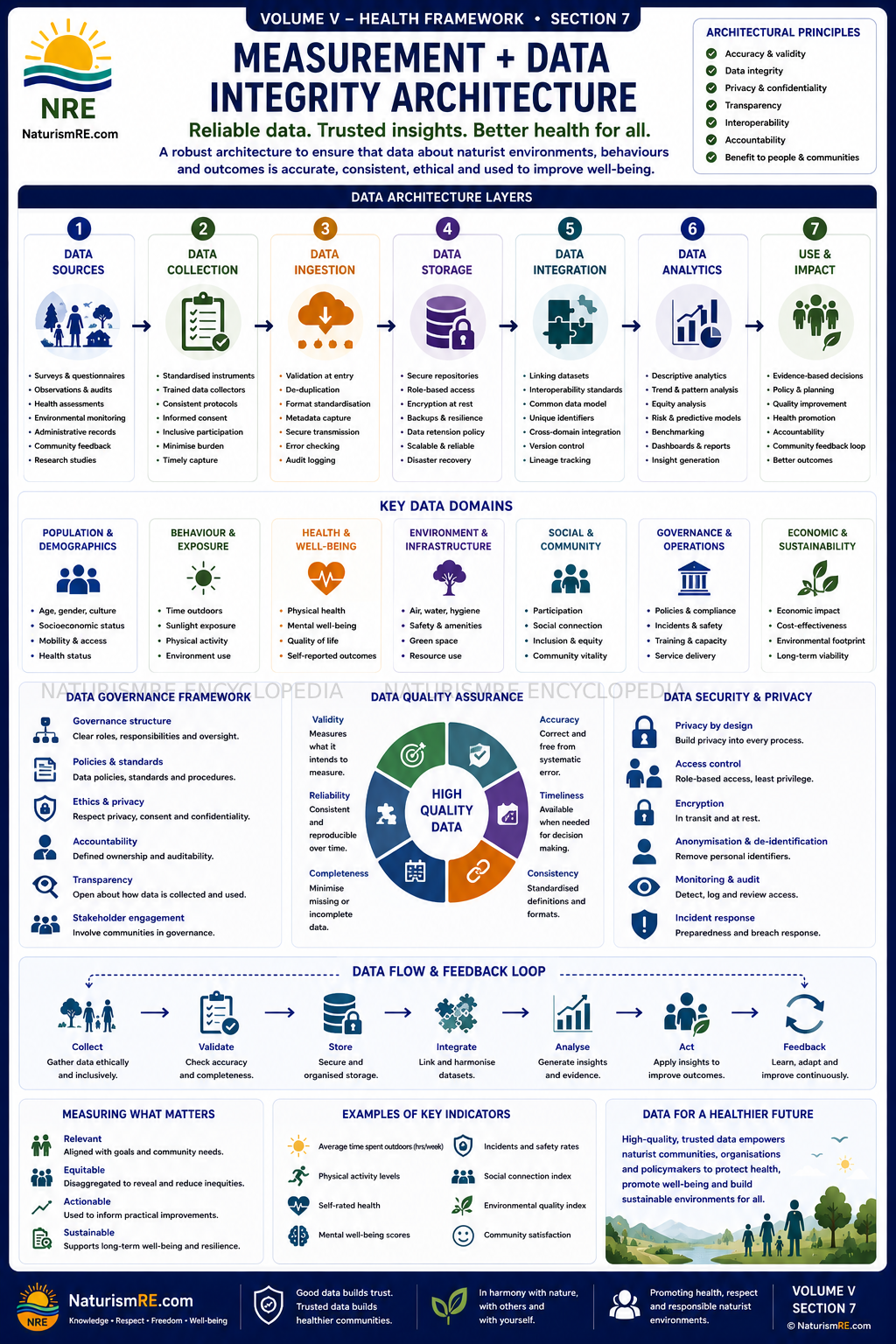
The advancement of naturist systems within health discourse depends on the ability to develop, apply, and maintain robust measurement frameworks that produce reliable, context-aware data capable of supporting evidence-based analysis without exceeding the limits of available information.
7.1 The Need for Structured Measurement in Naturist Health Analysis
Advancing naturist environments within a health-oriented framework requires systematic measurement rather than anecdotal observation.
Key limitations in existing discourse include reliance on subjective reports, absence of standardised metrics, variability in environmental conditions, and lack of longitudinal data.
Without structured measurement, outcomes cannot be compared across contexts, policy relevance remains limited, and claims risk overgeneralisation.
Measurement frameworks are therefore essential to transform naturism from a descriptive concept into an analytically assessable system.
7.2 Defining Measurement Domains
Assessment of naturist environments within a biopsychosocial framework requires multi-domain measurement.
Physiological Indicators
Includes thermal comfort, hydration and fatigue markers, and observable physical activity patterns within environmental conditions.
Psychological Indicators
Includes body perception, comfort levels, stress response, and self-reported cognitive-emotional states.
Social and Behavioural Indicators
Includes behavioural consistency, interaction patterns, and frequency or type of behavioural deviation.
Perception and Acceptance Indicators
Includes participant perception of safety, willingness to re-engage, and measurable responses relating to sustainability and public interaction.
These domains provide the analytical structure necessary to evaluate naturist environments as integrated biopsychosocial systems.
7.3 Context Sensitivity and Variable Control
A central challenge in measurement is context sensitivity.
Naturist environments vary significantly across climate, geography, population density, governance structure, and participant demographics.
As a result, data cannot be interpreted independently of context. Cross-comparison requires careful normalisation, and isolated findings may not be generalisable.
Effective measurement frameworks must therefore incorporate detailed contextual descriptors, consistent data collection protocols, and explicit acknowledgement of variability.
This ensures that data remains interpretable and proportionate to the conditions under which it is collected.
7.4 Data Collection Methods and Limitations
Data collection in naturist environments is subject to specific constraints related to participant privacy, sensitivity of observational contexts, and variability in participation patterns.
Common methods include self-reported surveys, observational recording of behavioural patterns, and environmental condition monitoring.
Each method introduces limitations. Self-reports may involve response bias. Observational data may be incomplete or context-specific. Environmental data requires alignment with participant response to be meaningful.
Data must therefore be interpreted with recognition of methodological constraints, and definitive conclusions must be avoided where evidence remains limited.
7.5 Standardisation and the Role of Measurement Instruments
Improving comparability and reliability requires the use of standardised measurement instruments.
Standardisation enables consistency across environments, aggregation of data over time, and increased analytical validity.
This includes consistent survey structures, defined criteria for behavioural observation, and uniform reporting formats.
Structured tools allow naturist environments to contribute to cumulative knowledge rather than isolated observations.
7.6 Data Integrity and Bias Management
Data integrity is essential for maintaining analytical credibility.
Key risks include selection bias, where participants self-select into environments; response bias in self-reported measures; observer bias in behavioural assessment; and incomplete datasets due to variable participation.
Mitigation requires transparency in methodology, clear definition of sample limitations, avoidance of overstated conclusions, and inclusion of uncertainty where appropriate.
Maintaining data integrity ensures that findings remain defensible and suitable for policy-level consideration.
7.7 From Data Collection to Evidence Construction
Data alone does not constitute evidence. Evidence emerges through aggregation of consistent findings, replication across contexts, and alignment with established scientific frameworks.
For naturist environments, evidence construction requires repeated measurement across multiple settings, integration of physiological, psychological, and social indicators, and cautious interpretation of correlations without assuming causation.
This process transforms individual data points into structured knowledge capable of informing broader analysis.
7.8 Analytical Conclusion
Measurement frameworks are essential for evaluating naturist environments within a health and human factors context.
Multi-domain measurement is required to capture biopsychosocial interaction. Context sensitivity limits direct generalisation. Data collection methods introduce inherent constraints. Standardisation improves comparability. Data integrity must be actively maintained. Evidence construction depends on cumulative and replicable data rather than isolated observations.
Naturism, when examined through structured measurement, can be analysed as a system of interacting variables within defined environments rather than as a collection of anecdotal experiences.
This establishes a defining principle for Volume V:
The advancement of naturist systems within health discourse depends on the ability to develop, apply, and maintain robust measurement frameworks that produce reliable, context-aware data capable of supporting evidence-based analysis without exceeding the limits of available information.
Primary Supporting Articles
Data Integrity and Validation Logic in Contextualised Naturist Measurement Systems
Measurement Consistency Across Cultural Contexts